Thursday, January 26, 2006

Villa Shines Through Getty's Clouds (by Christopher Knight, the Los Angeles Times)


Note to the photo: The renovated villa has 48,000 square feet of gallery space displaying 1,200 artifacts - not to mention four gardens with more than 300 flowering plants. (Stephen Osman / LAT)

link to the image source

ART REVIEW

By Christopher Knight
Times Staff Writer (the Los Angeles Times)

January 26, 2006

Visiting the new Getty Villa is a bittersweet affair. The pleasure comes from witnessing an exceptional museum idea executed with verve and skill. Alloyed to that delight, however, is the pain of the project's larger context.

The concept of a sizable museum devoted solely to the art of ancient Greece, Rome and Etruria (the region of modern Tuscany and Umbria) is inspired. For one thing, the modern notion of an art museum as a place of public enlightenment grew, like America itself, from the 18th century European revival of classical ideals.

For another, when it opens to the public Saturday as a museum devoted to art of the ancient Mediterranean, the villa will be unique in the United States. It's a smashing ensemble.

But the villa's Greek and Roman art tells a story, and it's a tale of the rise of civilizations and the fall of empires. First Athens became an imperial power, then Rome. As they did, each society sowed the seeds of its own destruction.

Two dozen centuries ago, the Athenian general Thucydides said that when empires expand, they deteriorate into tyrannies abroad and at home. Athenians doomed the democracy they invented, while the eventual ruin of Rome's republic was never in doubt. Forget the gods or fate; in Thucydides' estimate, human nature was the cause.

There's a lesson buried there, and the villa project teases it out.

The original building — a modern re-creation of a 1st century Roman country house, which opened at the edge of Malibu in 1974 as the J. Paul Getty Museum — is now wrapped in structures carved into the narrow canyon walls and striated like layers of earth. The deft design alludes to an archeological excavation. What's being dug up, however, isn't just old Greek pots and antique Roman statues.

Like a ruined temple discovered in the jungle or an ancient tomb unearthed from beneath the sands of time, an art museum appears to be the primary artifact being exhumed. An emblem of modern reason and enlightenment emerges at the far edge of the American continent, as if from a lost world.

The disinterred Getty Villa is gorgeous, vulgar, filled with astounding treasure, tainted by corruption, often brilliant, more than a little decadent — not unlike the vivid twilight of empire itself. As redesigned by the Boston-based architectural team of Rodolfo Machado and Jorge Silvetti, the extraordinary complex exudes an unmistakably elegiac aura.

Shuttered nearly nine years ago for transformation, the villa features one of the nation's largest and finest collections of classical art. Altogether some 1,200 antiquities are on view.

Incomparable works include the famous Getty Bronze — a magnificent Greek figure of an audacious young athlete crowning himself in glory — and the Lansdowne Herakles, a beefy Roman statue that was the late oil tycoon's first major purchase.


Note to the object: the famous Getty Bronze. Victorious Youth, Unknown
Greek, 300 - 100 B.C., Bronze, 59 5/8 x 27 9/16 x 11 in. 77.AB.30
link to the original source


Note to the object: the Lansdowne Herakles. The Lansdowne Herakles, Unknown Roman, about A.D. 125, Marble, H: 76 3/16 in., 70.AA.109
link to the original image source


They are joined by superb vase paintings, exquisite small bronzes, excellent Cycladic sculptures, impressive funerary objects and a startlingly fine collection of ancient glass — recently acquired and having its debut. A commanding, larger-than-life cult statue of Aphrodite, goddess of love, may be the greatest Greek sculpture in America.


Note to the object: the cult statue of Aphrodite. Goddess, Probably Aphrodite, Unknown, Greek, South Italy, 425 - 400 B.C., Limestone, marble, and pigment, H: 7 ft. 6 in., 88.AA.76
Link to the original image source


It may also be stolen. The statue is one of 34 works on view claimed by the Greek and Italian governments to have been looted. The charges are serious and troubling. But they form only part of the framework for this unprecedented artistic enterprise.

In a second-floor gallery, an astounding marble sculpture shows a ferocious pair of griffins attacking a fallen doe. Griffins combine the lethal features of a lion, a snake and an eagle. Here their spiky talons and beaks tear at the tender flesh of a supine deer. Her placid, elegant head is a stark contrast to the muscular monsters flanking it.

Traces of original multicolored paint, which has miraculously survived for millenniums, retain echoes of the work's archaic extravagance. The dramatic S-curves of the griffins' upraised wings suggest to scholars that this sculpture once formed the base of a ceremonial table. The doe's bloody fate may imply what was carried out on that long-lost tabletop. Griffins, lords of heaven and earth, guarded ancient tombs.

A Getty handbook aptly describes the wondrous sculpture as "the embodiment of deadly beauty." Brutality is fused with loveliness, cruelty with exquisite grace. The work was made in a Greek outpost in southern Italy, about a century after Athens fell.

The griffin sculpture is one of 14 pieces on that subject in the room. They date from 1400 BC to AD 100 and range in origin from Greece and Crete to far-flung corners of the empire — Spain, Persia and Central Asia. The Getty's collection is not installed according to chronology or region, which is the norm. Instead, most items are installed by theme.

One ground-floor gallery is devoted to stories from the Trojan War. Another features Dionysus and the theater. Others host gods, goddesses and similar creations from mythology.

Upstairs there are rooms with art segregated by gender, as ancient society was, and a modest gallery for athletic competitions. The sexy Getty Bronze occupies its own specially climate-controlled room adjacent. There is even a teenage mummy from Greco-Roman Egypt, plus exceptional painted funerary portrait-masks.

Happily, these thematic groupings are fascinating.

Art museum theme installations enjoyed a brief 1990s vogue internationally, culminating with the 2000 debut of London's Tate Modern. But most were poorly received. Sometimes the themes were meant to shake up received ideas; often they just seemed like bald attempts to hide big gaps in a museum's collection, diverting attention like a street hustler playing three-card monte with supple hands.

The Getty's theme installations are uncomplicated, but their cross-cultural comparisons are dramatic and complex. Juxtaposing great objects from different centuries and cultures makes formal distinctions stark. Everywhere the emphasis is exactly where it belongs: The objects take center stage.

This was not always the case. When the Getty Center opened in Brentwood eight years ago, the inaugural temporary exhibition featured a disastrous antiquities installation, meant to prefigure the refurbished villa. The helpless art was drowned in "educational" flotsam — flashy plasma screens, clumsy labels and reams of informational text silk-screened on walls.

But there's no such deluge at the villa, where just the right balance has been struck. A high-tech interactive information room is on the ground floor, tucked off to the side. Wall texts and video monitors are helpful yet discreetly placed, and the numerous display cases are uncluttered with labels. Everywhere the art draws you in first, while supporting information is deferential yet easily accessible.

Clearly the Getty learned from those earlier thematic experiments. The villa is opening more than four years behind schedule — 2001 was the target year — largely because of contentious lawsuits from anxious neighbors determined to block the expansion. They failed, and the site now includes a performance theater, a cafe and bookstore, conservation labs and a study center. But the extra time was well spent.

It's true that this thematic installation conceals gaps. There's no stellar Attic geometric vase, for example, just a couple of minor ones. But how could there not be holes? The survey spans 3,500 years across the entire Mediterranean.

Furthermore, as recent newspaper headlines have proclaimed, classical antiquities are a collecting area studded with landmines.

The Getty Villa opens under a dark cloud, with former curator Marion True on trial in Rome on charges of conspiracy to receive looted antiquities — including the spectacular Aphrodite cult statue, acquired in 1988 for $18 million. The trial is the finale in a long battle between archeologists and art historians.

Art historians (including most museum curators) value the aesthetic knowledge gained from art. Archeologists, by contrast, value the knowledge gained at the "find site" — the place where an ancient object is dug up. Looting affects archeologists most severely, because the conditions of the discovery remain unknown. In the struggle between them, archeologists have lately — and rightly — gained the upper hand.

Part of the case against True alleges that stolen antiquities were laundered through private collectors, including Getty Trustee Barbara Fleischman, who resigned Wednesday, and her late husband, Lawrence. (Their names are chiseled into the new outdoor theater at the villa.) The Fleischmans sold more than 30 Greek and Roman artifacts to the Getty for $20 million and donated about 300 more with an estimated value of $40 million.

The inevitable crisis represented by the trial was exacerbated by the inaction of Getty Trust President Barry Munitz. He was told in 2002 of an inappropriate loan involving True, the Fleischmans and London antiquities dealer Robin Symes, who sold the Aphrodite to the Getty — but Munitz did not remove the curator. The shocking story exploded in the press last fall. True, whose guiding museum vision is now being unveiled, was forced to resign. The timing could not have been worse.

A visit to the villa shows why the pressure was on to aggressively acquire antiquities. Check the object labels: Those that carry an acquisition number beginning with "96" were mostly part of the Fleischman gift and purchase. A wonderful Etruscan amphora decorated by the Tityos Painter shows the beheaded Medusa, with Pegasus flying out of her bloody neck. The serpent-haired Gorgon turns up again as a dramatic bronze relief on the back of a 5th century BC mirror. A monumental Etruscan storage jar uses linear drawing to show Odysseus and his men jamming a spear into the Cyclops' eye as muscular horses prance nearby.

There are scores more. In fact, the Getty acquired three-fourths of the collection's finest works in only the last 20 years or so, from the time former director John Walsh hatched the plan for an antiquities center. The villa's model is the Cloisters — the northern Manhattan branch of the Metropolitan Museum of Art devoted solely to the art of Europe in the Middle Ages. The Cloisters, funded by John D. Rockefeller Jr. and housed in a 1938 building reminiscent of a medieval monastery, is home to the famous Unicorn Tapestries and other treasures. It is a unique and remarkable cultural asset — and for ancient art, the Getty Villa is every bit its equal.

It is likely to remain so, whatever the outcome of the looting trial in Rome. The Getty spent about $275 million on the villa site. Although much of that went into infrastructure, it feels as if every penny is on vibrant display in the deluxe renovation. The modern fantasy of ancient Greece as a pristine world of pure white marble is belied by the flamboyance that actually marked their brightly painted statuary and buildings. Likewise the ancient Romans were notoriously vulgar, reveling in showy excess, and that impression has only been intensified in the remodeling.

Ours is likewise an era when nothing succeeds like ostentatious displays of power. Expect the remarkable Getty Villa to be an enormous popular hit.


link to the original posting or the printed version

Link to the J. Paul Getty Trust (including the Museum and the Villa)

Wednesday, January 25, 2006

Soul Eyes (by Arthur C. Danto, the Nation)


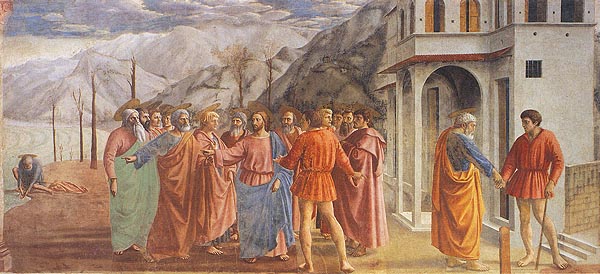
Note to the image: the Brancacci Chapel fresco, by Masaccio


Note to the image: the Annunciation, by Fra Angelico,

[from the February 6, 2006 issue]

Fra Angelico and the prodigy Masaccio are considered the major artists of their time--the second quarter of the fifteenth century--but their contributions were entirely distinct from each other. Of the two, Masaccio's impact is easier to identify: He more or less laid the foundations for High Renaissance painting. His fresco cycle in the Brancacci Chapel has been described as the "school of Florentine painting" by the formidable sixteenth-century art writer Giorgio Vasari, since everyone who was anyone learned from his example, including Fra Angelico himself. Masaccio was the first to apply to painting the principles of perspective (discovered by the architect Brunelleschi), as well as the first to imbue his figures with roundness through the use of light and shade. It was from Masaccio that Leonardo learned chiaroscuro, the way bodies are defined by light and shadows from a single source of illumination. And everyone learned from Masaccio's compositions how to group figures together in a natural way. When Vasari divided the Renaissance into three periods, he named one after Masaccio.

No period in art is named after Fra Angelico, but his achievement is arguably more profound--albeit more elusive--than Masaccio's. The difference between the two quattrocento masters is essentially the difference between two kinds of illusion. Masaccio discovered how convincingly to make a two-dimensional figure on a flat plane look like a three-dimensional object in real space. Fra Angelico discovered how convincingly to create the illusion of a living figure whose exterior features express an inner spiritual state--the look of love, a state of devotion or one of anguish.

Contrasting the two artists in his great work on aesthetics, Hegel praised Fra Angelico for his invention of what the philosopher called "interiority"--"the investigation of inner coordination, the indwelling meaning of facial expressions." Fra Angelico's work is infused, Hegel writes, "with the fervor of a religious love remote from the world, with a conventual purity of disposition, elevation, and sanctity of soul." He was not called Fra Angelico for nothing. But who would expect an exhibition of works by so pure a spirit, so naïve a faith, so innocent a vision to be the hottest show of the season? No one would say that the remarkable
exhibition of Fra Angelico at the Metropolitan Museum of Art (through January 29) is likely to be the school for contemporary New York artists. But it is the show to which artists tell me they keep going back.

It was in the depiction of interiority that Hegel believed painting had found its highest vocation, one that, moreover, distinguished the art of the Christian era from that of the classical era, whose defining medium was sculpture. A Greek statue of Aphrodite embodies the idea of erotic love but tells us nothing about what is going on inside her mind. What Hegel describes as "the spiritual depth of feeling, the bliss and grief of the heart" would not have been in the Greek repertory. It would simply have been taken for granted that mothers and their offspring are bonded through love. Christianity demanded that paintings of the Madonna visually depict this love. Thus Hegel contrasts those pictures with an Egyptian image of Isis holding her child, Horus, on her knees:

In a general way the subject here is the same as it is in Christian pictures of the Madonna: a divine mother with her child. But the difference in the treatment and portrayal of this subject is enormous. In this pose...there is nothing maternal in [Isis], no tenderness, no trait of that soul and feeling which is not entirely missing even in the stiffer Byzantine pictures of the Madonna. What has Raphael, or indeed any other of the great Italian masters not made of the Madonna and the Christ-child! What depth of feeling, what spiritual life, what inner wealth of profound emotion, what sublimity and charm...does not speak to us out of every line of these pictures!


Fra Angelico's masterpiece is the complex of frescoes he produced between 1440 and 1445, in the common spaces and cells of the Dominican convent of San Marco in Florence. As far as I know, Hegel never traveled to Italy. His knowledge of Fra Angelico was in all likelihood based on engravings of some of the more famous San Marco frescoes--The Annunciation, say, or The Coronation of the Virgin. Yet he must have recognized through these works that however much the Renaissance based itself on classical models, a face like that of the Annunciate Virgin
would have been unthinkable in classical representation. The Greek sculptors were well in advance of quattrocento painters in handling human anatomy. The latter excelled in showing through facial expression and body language how a figure like Mary would respond to the astonishing revelation that she would give birth to an incarnate god. She bends forward, holding her hands to her middle, as if protecting the life that is already within while her face shows her contemplating the meaning of her new role. The angel genuflects, acknowledging the difference in their stations. The drama of disclosure is enacted within a loggia, in the execution of which Fra Angelico demonstrates how much he has learned from Masaccio. The perspective is impeccable. The rational order of the architecture contrasts with the cosmic disruption of the historical order. A new era has begun.

Fra Angelico was at the height of his powers in the San Marco frescoes. Several of these wonders appear in beautiful reproductions on the upper level of the show at the Metropolitan. By contrast, many of the works on the lower level of the Lehman Wing are primarily of an art-historical interest. The paintings here merely reflect the gloriousness of Fra Angelico's vision, which comes through even in the reproductions on the upper level. The lower level shows the present state of art-historical scholarship: Several works now attributed to him were once thought to be by different artists. We must take the word of the scholars that these are autographed, or mostly autographed works. Despite their attribution, however, they have very little of the exalted interiority of the San Marco frescoes that so inspired Hegel. The Lehman Wing thus has something of the structure of Plato's allegory of the cave. How, then, did Fra Angelico become the artist whose work is a place of pilgrimage, the man whose name was given to him only after his death in 1455?

Fra Angelico was born Guido di Pietro; he became Fra Giovanni when he entered the Dominican order. In his early paintings, the Renaissance hardly appears to have begun. Paintings like the early Crucifixion--which shows a semicircle of Roman cavalrymen and foot soldiers standing at the base of the cross and looking coolly upward as if waiting for Christ to die, while four holy figures in front of the cross support the Virgin, who has fainted--is a powerfully condensed demonstration of Auden's observation about how well the old masters understood the meaning of suffering. But it feels like a Gothic painting, giving no hint that the Renaissance is about to dawn. It is difficult to know how to respond to the Penitent Saint Jerome, in a panel from Princeton University, since Fra Angelico merely restored parts of it. The small, circular depictions of saints from the predella of an altarpiece said to date from 1417 are exciting only because we now know them to be the work of the young Fra Angelico.

On the other hand, it is difficult not to be touched by The Nativity, from the Minneapolis Institute of Art, or the tiny Virgin and Child With Four Angels, from the Detroit Institute of Art, whatever their art-historical significance may be. In The Nativity Mary and Joseph, as well as the ox and the mule, kneel in adoration of the luminous baby lying on a mat of golden rays. A quintet of angels has settled on the thatched roof, and the gold leaf of the sky conveys the sense of a new kind of dawn. It is a celebration of the divine and at the same time entirely human. In Virgin and Child Jesus looks like a fifth angel, and the Virgin's star-spangled mantle looks like a piece of the night sky. Her face displays the dreamy expression one sees on new mothers everywhere. From the perspective of the stone bench she is seated on, and the way the side walls of the manger converge toward a vanishing point, one can tell that the Renaissance has arrived. Space is now naturalistic; these scenes of holiness take place in the same world we live in.

Upon entering the upper level of the Lehman Wing, one faces a greatly enlarged panel from an altarpiece that still remains to be identified. The original can be seen on the lower level, together with several other panels that belonged with it. The catalogue essay devoted to this altarpiece--which tells when it was painted, for what site it was painted, what the subject of the main panels might have been--is a serious piece of scholarly detective work. The panel that has been reproduced and enlarged for the upper level serves another purpose. It helps define precisely at what point Fra Angelico emerged as the master of his period. And it inadvertently provides a test for determining which works belong to the period that made his name. The test: Any work that would be at home in San Marco belongs to Fra Angelico's prime. None of the paintings thus far discussed from the exhibition would pass that test, however engaging they may be. But this painting does pass the test. Any work that can stand up to the great Annunciation is Fra Angelico in his prime, if not at his peak.

The painting is called The Naming of Saint John the Baptist. An elderly man at the panel's left is seated in a walled garden, writing with great concentration. He is Zacharias, father of John the Baptist. There are six lovely women, wearing opulent gowns picked out in gold. One of them is Saint Elizabeth, holding the child destined to be John the Baptist, in a very different kind of garment than the shaggy skin in which he is conventionally portrayed. The biblical story partly illustrated by this scene, which viewers in Fra Angelico's time would have known, is that Zacharias has expressed doubts about his son's role, revealed by an angel, and has been struck dumb. His speech is restored when he writes: "John is his name." The little panel has the poetry of Botticelli's Primavera--beautiful women, beautifully dressed, are gathered in the open air in a flowered landscape under a blue sky. The work is luminous, and we can see what a remarkable colorist Fra Angelico was, something Hegel could not have gleaned from the engravings. All the panels that allegedly belong with The Naming of Saint John the Baptist show the same almost translucent robes. There is something of the Middle Ages in the enclosed garden, carpeted with flowers. But the organization of space, especially in the wall's perspective, implies the innovations of Masaccio and the spirit of the Renaissance. Two great periods in the history of art thus overlap in The Naming of Saint John the Baptist.

As, in fact, they do in much of Fra Angelico's work. Consider, for instance, the left panel of his Last Judgment, which shows a number of the saved dancing to Paradise in the company of angels. It is a vision of life as fine as could have been imagined. Men, women and angels are dressed exquisitely, their hair done up in elegant coiffures, wearing garlands as well as the nimbuses they deserve as tiaras of sorts, tracing the figure of a courtly dance, tripping across a flower-strewn park, indifferent to the torments of the damned on the facing panel, as they move in rhythmic circles toward eternal bliss. At the top of the panel, figures board a flight of clouds and move into a new and unimaginable state expressed by an expanse of golden emptiness. The physical beauty of the dancers, human or angelic, may be metaphorical, but it is a compelling advertisement for the rewards that await the faithful, and as art it is the high point of this show. As for their expressions, they do not look happy. They look appropriately solemn, perhaps reflecting on the test they have passed in life below, and relieved to have earned the glory they share with the angels.


link to the original

Monday, January 23, 2006

The man behind Abercrombie & Fitch (By Benoit Denizet-Lewis, Slate.com)


Mike Jeffries turned a moribund company into a multibillion-dollar brand by selling youth, sex and casual superiority. Not bad for a 61-year-old in flip-flops.


Jan. 24, 2006 |

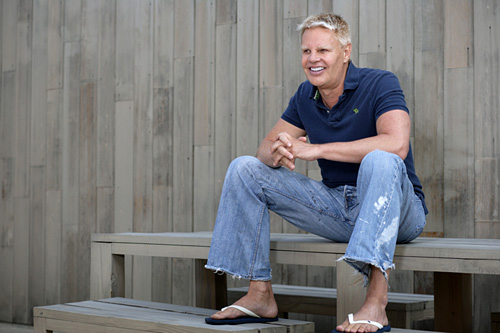
Mike Jeffries, the 61-year-old CEO of Abercrombie & Fitch, says "dude" a lot. He'll say, "What a cool idea, dude," or, when the jeans on a store's mannequin are too thin in the calves, "Let's make this dude look more like a dude," or, when I ask him why he dyes his hair blond, "Dude, I'm not an old fart who wears his jeans up at his shoulders."

This fall, on my second day at Abercrombie & Fitch's 300-acre headquarters in the Ohio woods, Jeffries -- sporting torn Abercrombie jeans, a blue Abercrombie muscle polo, and Abercrombie flip-flops -- stood behind me in the cafeteria line and said, "You're looking really A&F today, dude." (An enormous steel-clad barn with laminated wood accents, the cafeteria feels like an Olympic Village dining hall in the Swiss Alps.) I didn't have the heart to tell Jeffries that I was actually wearing American Eagle jeans. To Jeffries, the "A&F guy" is the best of what America has to offer: He's cool, he's beautiful, he's funny, he's masculine, he's optimistic, and he's certainly not "cynical" or "moody," two traits he finds wholly unattractive.

Jeffries' endorsement of my look was a step up from the previous day, when I made the mistake of dressing my age (30). I arrived in a dress shirt, khakis and dress shoes, prompting A&F spokesman Tom Lennox -- at 39, he's a virtual senior citizen among Jeffries' youthful workforce -- to look concerned and offer me a pair of flip-flops. Just about everyone at A&F headquarters wears flip-flops, torn Abercrombie jeans, and either a polo shirt or a sweater from Abercrombie or Hollister, Jeffries' brand aimed at high school students.

When I first arrived on "campus," as many A&F employees refer to it, I felt as if I had stepped into a pleasantly parallel universe. The idyllic compound took two years and $131 million to complete, and it was designed so nothing of the outside world can be seen or heard. Jeffries has banished the "cynicism" of the real world in favor of a cultlike immersion in his brand identity. The complex does feel like a kind of college campus, albeit one with a soundtrack you can't turn off. Dance music plays constantly in each of the airy, tin-roofed buildings, and when I entered the spacious front lobby, where a wooden canoe hangs from the ceiling, two attractive young men in Abercrombie polo shirts and torn Abercrombie jeans sat at the welcome desk, one checking his Friendster.com messages while the other swayed subtly to the Pet Shop Boys song "If Looks Could Kill."

If looks could kill, everyone here would be dead. Jeffries' employees are young, painfully attractive, and exceedingly eager, and they travel around the campus on playground scooters, stopping occasionally to chill out by the bonfire that burns most days in a pit at the center of campus. The outdoorsy, summer-camp feel of the place is accentuated by a treehouse conference room, barnlike building and sheds with gridded windows, and a plethora of wooden decks and porches. But the campus also feels oddly urban -- and, at times, stark and unwelcoming. The pallid, neo-industrial two-story buildings are built around a winding cement road, reminding employees that this is a workplace, after all.

Inside, the airy and modern workspaces are designed to encourage communication and teamwork, and everywhere you look, smiley employees are brainstorming or eagerly recounting their weekends. "I'm not drinking again for a year," one young employee said to another as they passed me in the hall. There are few "offices" and even fewer doors at A&F central. Jeffries, for example, uses an airy conference room as his office, and he spends much of his days huddling with designers who come armed with their newest ideas and designs.

The press-shy Jeffries rarely grants interviews, but he invited me to A&F's Ohio headquarters to promote the opening of his first flagship store, a four-story, 23,000-square-foot behemoth across the street from Trump Tower in Manhattan. To celebrate the opening, in November Jeffries threw a packed, ritzy, invitation-only party at the store, at which slightly soused women paid $10 apiece to have Polaroids of themselves taken with shirtless A&F model Matt Ratliff. And why not throw a party? Life is good for Jeffries, who in 14 years has transformed Abercrombie & Fitch from a struggling retailer of "fuddy-duddy clothes" into the most dominant and imitated lifestyle-based brand for young men in America.

Valued at $5 billion, the company now has revenues approaching $2 billion a year rolling in from more than 800 stores and four successful brands. For the kids there's Abercrombie, aimed at middle schoolers who want to look like their cool older siblings. For high schoolers there's Hollister, a wildly popular surf-inspired look for "energetic and outgoing guys and girls" that has quickly become the brand of choice for Midwestern teens who wish they lived in Laguna Beach, Calif.


When the Hollister kids head off to college, Jeffries has a brand -- the preppy and collegiate Abercrombie & Fitch -- waiting for them there. And for the post-college professional who is still young at heart, Jeffries recently launched Ruehl, a casual sportswear line that targets 22- to 35-year-olds.

While Wall Street analysts and the companies' many critics gleefully predict A&F's impending demise every year or so, they have yet to be right. The company struggled some in the post-9/11 period, when, unlike other slumping retailers, it refused to offer discounts or promotions. But A&F's earnings have nonetheless increased for 52 straight quarters, excluding a one-time charge in 2004. "To me it's the most amazing record that exists in U.S. retailing, period," says A.G. Edwards analyst Robert Buchanan.

As his A&F brand has reached iconic status, Jeffries has raised prices, only to find that the brand's loyal fans will gladly pay whatever he asks. Total sales for November 2005 increased 34 percent over the year before, more than five times the gain made by A&F's main competitor, American Eagle. And while many retailers struggled during the Christmas season, Abercrombie thrived -- it scored year-over-year gains of 29 percent in December, compared to 1.5 percent for other specialty retail stores.

Next, Jeffries plans to open his first store overseas, in London, and continue the transformation of A&F from American frat-bro wear to luxury lifestyle brand. I wouldn't bet against him. If history is any indication, Jeffries won't let anyone -- "girlcotting" high school feminists, humorless Asians, angry shareholders, thong-hating parents, lawsuit-happy minorities, nosy journalists, copycat competitors or uptight moralists -- get in his way.

Examples of his strange behavior abound. According to Business Week, at A&F headquarters, Jeffries always goes through revolving doors twice, never passes employees on stairwells, parks his Porsche every day at the same angle in the parking lot (keys between the seats, doors unlocked), and has a pair of "lucky shoes" he wears when reading financial reports.

His biggest obsession, though, is realizing his singular vision of idealized all-American youth. He wants desperately to look like his target customer (the casually flawless college kid), and in that pursuit he has aggressively transformed himself from a classically handsome man into a cartoonish physical specimen: dyed hair, perfectly white teeth, golden tan, bulging biceps, wrinkle-free face, and big, Angelina Jolie lips. But while he can't turn back the clock, he can -- and has -- done the next best thing, creating a parallel universe of beauty and exclusivity where his attractions and obsessions have made him millions, shaped modern culture's concepts of gender, masculinity and physical beauty, and made over himself and the world in his image, leaving them both just a little more bizarre than he found them.

Much more than just a brand, Abercrombie & Fitch successfully resuscitated a 1990s version of a 1950s ideal -- the white, masculine "beefcake" -- during a time of political correctness and rejection of '50s orthodoxy. But it did so with profound and significant differences. A&F aged the masculine ideal downward, celebrating young men in their teens and early 20s with smooth, gym-toned bodies and perfectly coifed hair. While feigning casualness (many of its clothes look like they've spent years in washing machine, then a hamper), Abercrombie actually celebrates the vain, highly constructed male. After all, there is nothing casual about an A&F sweatshirt worn over two A&F polos worn over an A&F T-shirt. (A&F has had less of a cultural impact on women's fashion. Its girls' line is preppy, sexy and popular, but the company has mostly remained focused on pleasing the all-American college boy.)

For many young men, to wear Abercrombie is to broadcast masculinity, athleticism and inclusion in the "cool boys club" without even having to open their mouths (that may be why the brand is so popular among some gay men who want desperately to announce their non-effeminacy). But because A&F's vision is so constructed and commodified (and because what A&F sells is not so much manhood but perennial boyhood), there is also something oddly emasculating about it. Compared to the 1950s ideal, A&F's version of maleness feels restrictive and claustrophobic. If becoming a man is about independence and growing up, then Abercrombie doesn't feel very masculine at all.

In that way, the brand is a lot like its creator. While Jeffries wears A&F clothes, the uniform doesn't succeed at making him seem boyish or particularly masculine. And for a man obsessed with creating a "sexy and emotional experience" for his customers, Jeffries comes off as oddly asexual. He is touchy-feely with some of his employees, both male and female, but the touch is decidedly paternal.

Remarkably little is known about Jeffries' personal life. There are few people who claim to know Jeffries well, and those who do wouldn't comment for this story. What is known is that Jeffries has a grown son, lives separately from his wife, and, according to Business Week, has a Herb Ritts photo of a toned male torso hanging over the fireplace in his bedroom.

Jeffries wouldn't discuss any of that with me, and he fidgeted nervously and grew visibly agitated when I asked about several of the many controversies and lawsuits he has weathered in his 14 years at the helm of A&F. Our first bump came when I mentioned the 2002 uproar over the company's thongs for middle-school girls, which had "Eye Candy" and "Wink Wink" printed on their fronts. "That was a bunch of bullshit," he said, sweating profusely. "People said we were cynical, that we were sexualizing little girls. But you know what? I still think those are cute underwear for little girls. And I think anybody who gets on a bandwagon about thongs for little girls is crazy. Just crazy! There's so much craziness about sex in this country. It's nuts! I can see getting upset about letting your girl hang out with a bunch of old pervs, but why would you let your girl hang out with a bunch of old pervs?"

Later I brought up the brouhaha surrounding the A&F Quarterly, which, until it was discontinued in 2003, boasted articles about the history of orgies and pictures of chiseled, mostly white, all-American boys and girls (but mostly boys) cavorting naked on horses, beaches, pianos, surfboards, statues and phallically suggestive tree trunks. The magalog so outraged the American Decency Association that it called for a boycott and started selling anti-Abercrombie T-shirts: "Ditch Fitch: Abercrombie Peddles Porn and Exploits Children." Meanwhile, gay men across America were eagerly collecting the magazines, lured by photographer Bruce Weber's taste for beautiful, masculine boys playfully pulling off each other's boxers.


Jeffries nearly fell over in exasperation when I mentioned the magalog, although I'm not sure which charge -- that he sells sex to kids or that his advertising is homoerotic -- bothered him more. "That's just so wrong!" he said. "I think that what we represent sexually is healthy. It's playful. It's not dark. It's not degrading! And it's not gay, and it's not straight, and it's not black, and it's not white. It's not about any labels. That would be cynical, and we're not cynical! It's all depicting this wonderful camaraderie, friendship, and playfulness that exist in this generation and, candidly, does not exist in the older generation."

Jeffries alternates his grumpy defensiveness with moments of surprising candor, making him at times oddly endearing. He admitted things out loud that some youth-focused retailers wouldn't (which may be why he panicked and pulled his cooperation from this story two days after I left A&F headquarters, offering no explanation). For example, when I ask him how important sex and sexual attraction are in what he calls the "emotional experience" he creates for his customers, he says, "It's almost everything. That's why we hire good-looking people in our stores. Because good-looking people attract other good-looking people, and we want to market to cool, good-looking people. We don't market to anyone other than that."

As far as Jeffries is concerned, America's unattractive, overweight or otherwise undesirable teens can shop elsewhere. "In every school there are the cool and popular kids, and then there are the not-so-cool kids," he says. "Candidly, we go after the cool kids. We go after the attractive all-American kid with a great attitude and a lot of friends. A lot of people don't belong [in our clothes], and they can't belong. Are we exclusionary? Absolutely. Those companies that are in trouble are trying to target everybody: young, old, fat, skinny. But then you become totally vanilla. You don't alienate anybody, but you don't excite anybody, either."

Jeffries' obsession with building brands began when he was 5. He grew up in Los Angeles, where his father owned a chain of party supply stores for which a young Jeffries liked to organize and design the windows and counters. "I would always say to my parents, 'We need another store. We need another!'" Jeffries recalls. "I always wanted to expand and get bigger, and I would get off on saying, 'Why do we do the fixtures like this? Why don't we do it another way?' That totally turned me on."

Jeffries says he had a "very classic American youth," although he was not good at sports. "I broke my dad's heart because I wasn't good at basketball," he says. In high school in the late 1950s, Jeffries always wore Levi's jeans. "Actually, don't write that," he tells me, laughing. "But Levi's was definitely the uniform back then, kind of like what A&F has become. If you didn't wear 501s you were considered weird."

No one cool wore Abercrombie & Fitch when Jeffries went off to Claremont McKenna College and then to Columbia University, where he earned a master's degree in business administration. In fact, the company's best years were long behind it. Founded in 1892, in its heyday it served Presidents Hoover and Eisenhower (they bought their fishing equipment there), Ernest Hemingway (guns), and Cole Porter (evening clothes). During prohibition A&F was where the in crowd went for its hip flasks. But by the 1970s it had become a fashion backwater, holding on for dear life.

Leslee O'Neill, A&F's executive vice president of planning and allocation, remembers what the company was like before Jeffries got there. "We had old clothes that no one liked," she says. "It was a mess, a total disaster. We had this old library at our headquarters with all these really old books. There were croquet sets lying around. It was very English."

The company, which since 1988 had been owned by the Limited, was losing $25 million a year when Jeffries arrived and announced that A&F could survive and prosper as a "young, hip, spirited company." "We're all there thinking, Oh yeah, right. Abercrombie & Fitch?" recalls O'Neill. "But in the end we were like, Well, why not? It can't get any worse." Jeffries, then in his late 40s, dressed in oxford shirts and corduroy pants. "He was a lot more normal back then," O'Neill says. "Today he's much more eccentric, obviously."

Maybe, although former co-workers at Paul Harris recall that Jeffries had an odd personal style even back then. "He wore the same outfit to work every day," recalls Thomas Yeo, a Paul Harris colleague. "Nearly worn-out suede loafers, a pair of gray flannel pants, and a double-breasted navy blazer. I don't think he ever changed his clothes. All that seemed to matter to him was the success of the brand."

Jan Woodruff, who also worked with Jeffries at Paul Harris, remembers him as a workaholic. "If he had a life outside work, it wasn't something people knew about," says Woodruff. But Woodruff and others say he has a superlative fashion mind. "It's so rare to find someone who is brilliant at both the creative and the business sides. But Jeffries is both. He's good at thinking in broad terms, but he's also obsessed with details. And I've never seen anyone as driven as Mike. I had no doubt he would be incredibly successful if he found the right venue. And he found it."

Soon after taking over A&F, Jeffries went looking early on for the right man to help him make A&F a sexy, aspirational brand. He settled on Bruce Weber, already a renowned photographer known for his male nudes. "But back then we couldn't afford him for an actual shoot," Jeffries told me, "so we bought one picture from him and hung it in a store window."

Fourteen years later, Jeffries' success is the envy of the fashion world. In a recent feature called "The Abercrombie Effect" in DNR, a newsmagazine about men's fashion and retail, the magazine noted that "not since Ralph Lauren's ascent in the 1980s has a single brand perfected a lifestyle-based look so often alluded to and imitated." Now Ralph Lauren's doing the imitating, opening a chain of collegiate, WASPy Polo knockoff stores called Rugby for young customers, featuring in-store grunge bands and beautiful salespeople.

"Imitation is the sincerest form of flattery," says Margaret Doerrer, national sales manager for young men at Union Bay, another youth-oriented label. "In the young men's market, for the longest time no one was creating a 'lifestyle.' Particularly in the department stores, everyone was focused on hip-hop and urban brands, and no one was creating that average, American Joe look. Jeffries never lost sight of who his customer is, and he created a quality brand that caters to the cool clique and has a sense of exclusivity, yet it still has a mass appeal, because people want to be a part of it. It's genius."

Maybe it's just the price of success, but it's not a normal day in America if someone isn't suing (or boycotting, or "girlcotting") Abercrombie & Fitch, which has become a lightning rod for both the left and the right. In 2004 A&F paid $40 million to settle a class-action suit brought by minority employees who said they were either denied employment or forced to work in back rooms, where they wouldn't be seen by customers. While A&F denied any wrongdoing, Jeffries said the suit taught him a lesson: "I don't think we were in any sense guilty of racism, but I think we just didn't work hard enough as a company to create more balance and diversity. And we have, and I think that's made us a better company. We have minority recruiters. And if you go into our stores you see great-looking kids of all races."

In the latest episode, last fall a group of high school girls from Allegheny County, Penn., made the rounds of television talk shows to protest the company's "offensive" T-shirts. Of particular concern were shirts that read "Who Needs a Brain When You Have These?" "Gentlemen Prefer Tig Ol' Bitties" and "Do I Make You Look Fat?"

"Abercrombie has a history of insensitivity," the group's well-spoken Emma Blackman-Mathis, 16, told me, "and there is no company with as big an impact on the standards of beauty. There are kids starving themselves so they can be the 'Abercrombie girl,' and there are guys who think they aren't worthy if they don't look exactly like the guys on the wall."

The protest (which resulted in A&F pulling "Who Needs a Brain When You Have These?" and "Gentlemen Prefer Tig Ol' Bitties" but retaining "Do I Make You Look Fat?" and others) began after my visit, so I couldn't ask Jeffries about it. But I did ask him about other T-shirt dust-ups, including "It's All Relative in West Virginia" (which West Virginia's governor didn't find funny), Bad Girls Chug. Good Girls Drink Quickly (which angered anti-addiction groups), and Wong Brothers Laundry Service -- Two Wongs Can Make It White (which triggered protests from Asian groups).

Remarkably, Jeffries says he has a "morals committee for T-shirts" whose job it is to make sure this sort of thing doesn't happen. "Sometimes they're on vacation," he admits with a smile. "Listen, do we go too far sometimes? Absolutely. But we push the envelope, and we try to be funny, and we try to stay authentic and relevant to our target customer. I really don't care what anyone other than our target customer thinks."

What about shareholders? Last year aggrieved Abercrombie shareholders filed a suit against the company alleging that Jeffries' compensation was excessive. (The suit was settled; his $12 million "stay bonus" was reduced to $6 million, and he gave up some stock options. In 2004 he made approximately $25 million.) Other suits, still pending, accuse Jeffries of misleading stockholders about the company's profits. "You settle because it's a distraction," Jeffries told me. "I can't let anybody be distracted here. Me included. We are passionate about what we do here on a daily basis, and if any of us is tied up with this nonsense, it's counterproductive. We're a very popular company. We have a lot of money. And we're targets."

Jeffries dismisses the idea that he courts controversy deliberately to sell clothes, although the endless complaints about Abercrombie perverting the minds of America's youth undoubtedly makes the brand even more appealing to them. Meanwhile, the slogan-free items, which are for the most part as unthreatening as those of any other, less controversial label, fly under the parental radar. "Abercrombie remains a very acceptable look for Mom," says Union Bay's Doerrer. "I don't think many mothers of 16-year-old boys dressed in Abercrombie will make them go upstairs and change."

--------

Jeffries says that A&F is a collaborative environment ("a diva-free zone," is how he put it to me), but in the end he makes every decision -- from the hiring of the models to the placement of every item of clothing in every store. There are model stores for each of the four brands at A&F headquarters, and he spends much of his time making sure they're perfect. When they are, everything is photographed and sent to individual outlets to be replicated to the last detail. If there's an A&F diva, it's Jeffries.

I got a firsthand look at his perfectionism in action when he invited me along for the final walk-through for the Christmas setup of his stores.

"How does a store look? How does it feel? How does it smell? That's what I'm obsessed with," Jeffries said as we walked quickly toward the Hollister model store surrounded by a handful of his top deputies, including Tom Mendenhall, a senior vice president whom Jeffries recently lured away from Gucci.

Inside the dimly lit Hollister store, which is designed to look like a cozy California beach house (there are surfboards, canoes, comfy chairs to lounge in, magazines to read, and two screens with live shots of Huntington Beach, courtesy of cameras permanently affixed to a pier), Jeffries paused in front of two mannequins and shook his head. "No, no, we're still not there, guys," he shouted over the No Doubt song "Spiderwebs," which blasted throughout the store. He stared at the jeans on the female mannequin. "The jeans are too high. I think she has to be lower."

A guy named Josh got down on his knees and started fidgeting with the jeans, trying to pull them down so they hung to the ground. "And we need to make the leg as skinny as we can," Jeffries said. "Should we clip the back of the leg in the knee?" Two employees scurried off to get clips. "We want it bigger at the top and skinnier at the legs. Yes, that's sexier. Much better. That's less butch." (Jeffries isn't a fan of the "butch" look, though when they were all the rage he grudgingly incorporated camouflage army pants into his Hollister line for girls.)

Jeffries then turned his attention to the male mannequin. "OK, how rugged and masculine can we make this guy?" he asked, prompting a couple of his assistants to fidget with the jeans, making them bigger in the leg. "Good, he looks cooler now. He's got more attitude. We love attitude."

There was more mannequin fixing at the A&F store, where a male one decked out in jeans wasn't looking very manly. "We have to fix this guy's package," Jeffries said. "We could stuff him," a girl suggested while a guy fiddled with the crotch, trying to make it poofier. With that fixed, Jeffries turned to a male mannequin in cargo pants. To make sure it looked realistic, he had a very attractive male employee put on a pair of the pants and stand next to the mannequin. "That looks great," he said as the young man did a 360, the pants sagging off his ass. Jeffries looked at the mannequin again. "Are the pants low enough? This guy's got it lower."

"They're right at the edge of falling off," said an assistant.

"OK, that's good," Jeffries said. "Let's get them as low as we can without them falling off. We don't want him looking like an old guy."


link to the original posting


link to Abercrombie & Fitch

Study Buddy (by Ben McGrath, the New Yorker)


Note to the illustration: “Dear Mom and Dad: Thanks for the happy childhood. You’ve destroyed any chance I had of becoming a writer.” (College girl writing to parents from a little dorm cubby.) ID: 69004, Published in The New Yorker December 22, 2003

link to the illustration source

Note from the blog editr: the illustration did not come with the article, but when I saw this when it was publish, I loved it.

Issue of 2006-01-23
Posted 2006-01-16

Whatever side you’re on in the homework wars (more vs. less, phonics vs. “whole language”), a case can be made that study habits formed i grade school establish patterns for negotiating life as an adult. The kid whose mom builds his diorama may expect a rent-check stipend later; the gir who spends Friday night finishing her science project will likely resist the temptations of happy hour with her co-workers

When the city’s public libraries announced, last month, the launch of an all-points Web site, homeworkNYC.org, for K-12 students, proponents hailed it as a critical blow to the old “dog ate my homework” excuse. Dakota Scott, a freshman at Bard High School Early College, stood before a group of teachers and librarians at the Donnell Library, on West Fifty-third Street, and demonstrated some of the site’s features, performing searches on “insects” and “ancient Egypt.” She did not click on a link for “live homework help,” but, had the demonstration occurred between 2 P.M. and 11 P.M., the link would have connected her, via Tutor.com, to any of twelve hundred tutors around the country sitting on their sofas, or in cafés, and, for all we know, sipping margaritas, while dispensing advice on trigonometry or mitochondria or intransitive verbs.

Or, as it happens, love. On a recent Friday night, Yasmin, a graduate student in animation, sat on a futon in her boyfriend’s studio apartment, in Brooklyn. For roughly ten dollars an hour, she had signed on to counsel students looking to get a jump on the weekend’s assignments. She had her laptop open and was logged in to the Tutor.com server.

On her screen, a window popped up: “A student has requested your help.” The student was apparently in the fourth grade and was logging on from California. A chat session began:

Student: Can you help me with wrighting?
Yasmin: Sure. What is your assignment?
Student: Fiction. . . .
Yasmin: Ok, great. Do you know what you want to write about?
Student: My frind said love hurts but I want it to be about passion.
Yasmin: You want to write a love story? . . . Or should we brainstorm?

A nine-year-old writing a love story on a Friday night? Suddenly, the Internet connection failed and the session was terminated.

Sometimes, Yasmin explained, it’s difficult to tell whether a student is legit. But she thought the fiction-writing kid was for real. “Teachers can get pretty creative with assignments,” she said. “The other day, a student had to make a mix tape for a character in a book.” He was to include liner notes, explaining why each song had been chosen.

One of the songs that the student had picked was “Kokomo,” by the Beach Boys, about Caribbean romance. (“Afternoon delight / Cocktails and moonlit nights / That dreamy look in your eye / Give me a tropical contact high.”) The book he’d read was called “The Curious Incident of the Dog in the Night-Time.” “He related it to the character, a guy going somewhere with his mother,” Yasmin said. She wrote to the student, “ ‘Kokomo’ isn’t exactly a song I think of when discussing a person’s relationship with their mom.”

Back on Yasmin’s laptop, a new request came in, from a sixth grader:

Student: I need to learn about William Shackspear
Yasmin: Ok, great. Do you have a specific assignment?
Student: Nooooooooo. . . . .
Yasmin: Have you read any sonnets or plays?
Student: Nooooooooo.
Disconnected.

The aspiring fourth-grade romance novelist signed on again:

Yasmin: You said “love hurts.” Tell me more. How? Why?
Student: Well, I changed it to passion.
Yasmin: Ok, what about passion? Let’s make up some characters?
Student: Do you have any idears?
Yasmin: Do you want to have one male and one female character? What should their names be?

On a shared “whiteboard,” a virtual chalkboard, the student scrawled the names Jesus and Christine, using his mouse. Yasmin, still credulous, tried to develop the backstory: How did they meet? (“Um”) Where should they meet? (“At a special place. Could you think of any?”) They agreed on Hawaii as the setting:

Yasmin: How will they meet? Do they know any of the same people . . . ?
Student: She was thirsty, so she wanted a drink.
Yasmin: . . . So she goes to a restaurant?
Student: Yep
Yasmin: Is Jesus working there? Is he there having dinner?
Student: Yes. . . .
Yasmin: Christine goes to the restaurant for a drink and meets Jesus . . . how?
Student: He took her order
Yasmin: So he’s the waiter?
Student: Yep
Yasmin: And then what?
Student: She looked up and saw him.

And, with that, the session, which had lasted nearly half an hour, timed out. Yasmin dutifully typed an entry into her tutor’s log: “We started brainstorming a story about passion.”

link to the original posting

Sunday, January 22, 2006

No Sex Please Until We're At Least 17 Years Old, We're British (by Denis Campbell, social affairs correspondent, the Observer)


Tuesday January 24, 2006
Denis Campbell, social affairs correspondent
Observer

A remarkable portrait of Britain's increasingly liberal attitudes towards sex, relationships and fidelity is revealed today in a special poll commissioned by The Observer. The MORI poll of 1,790 adults reveals that people are delaying the moment when they decide to first have sex, that they support greater sex education in schools and that they think prostitution should be legalised.
The fact that Britons are losing their virginity later is perhaps the most surprising detail, dispelling the widespread belief that teenagers are having record levels of under-age sex.

The poll reveals that the number of people having sex before 16 years old has fallen from 32 per cent in 2002 to 20 per cent now.

The age at which the typical Briton loses their virginity has increased since they were last asked in 2002, when the figure was 17.13 years. Young women generally have sex younger than their male counterparts - at the age of 17.44 years, compared with 18.06 for men.

Surprisingly, the proportion of teenagers losing their virginity before the legal age of consent at 16 has fallen, with the drop most notable among 14- and 15-year-olds. The survey of people aged 16-64 also shows that Britain has undergone a significant softening in attitudes to other sexual issues.

The most alarming finding, however, was that almost one in three women said she had sex without her consent. Fourteen per cent of women said they had had non-consensual sex while trying to keep the other person happy. Nine per cent did so under the influence of alcohol and 8 per cent when there was physical pressure to do so.

In addition, almost two-thirds believe prostitution should be legalised, an increase of four points since 2002. Those admitting to having had sexual contact with someone of the same sex has also risen, from 11 per cent to 15. Almost three in 10 Britons have had sex with someone of a different colour.

A high proportion, 84 per cent, backs the recent call from the government's advisers that all schools should teach pupils about sexual behaviour and relationships, not just the basic biology of reproduction, which is the only statutory sex education. Anne Weyman, head of the FPA (formerly the Family Planning Association) said: 'For years young people have told us this part of their school education is "too little, too late and too biological". It's a big step forward to see so many adults agreeing with them at last.'

However, one in five is dissatisfied with their sex life. 'We may be more liberal in our attitudes but we are clearly not any happier,' said Paula Hall, a sexual psychotherapist with the counselling organisation Relate.

She said that another key finding, the fall in the number of people who believe that monogamy is natural, from 74 per cent to 67, showed that with Britons living longer and healthier lives, the idea of lifetime fidelity is in decline.

'However, it's probably the case that people nowadays increasingly expect to be in more than one significant relationship, but still expect to be faithful for as long as that goes on,' Hall said.

'The large number of people who break up and quickly become involved with [someone who becomes] another long-term partner bears that out.'

link to the original posting


Sex

Do we care about being faithful? Are we happy with our sex lives and relaxed about how others behave? The results of a MORI poll for The Observer show that Britain is gradually becoming a more tolerant society. Denis Campbell reports


Britain's quiet revolution

Whether it's the graphic intercourse in Michael Winterbottom's film Nine Songs , Eve fondling Jesus's genitals in Jerry Springer The Opera , or the recurring concern over issues such as teenage pregnancy, the subject of sex is often mired in controversy.

Bellowing headlines of the 'where will it all end' variety often suggest a country that would be more comfortable with the sexual mores of the 1950s than the 21st century. Raise the issues of prostitution, of the age of consent for gays, or of sex education and the very public debate that ensues seems to reveal that the British remain resolutely reactionary about their most intimate relations.

However, The Observer 's authoritative survey this month of sexual behaviour and attitudes shows that, in a quiet revolution, Britons have become strikingly liberal over a range of key issues. Among a plethora of fascinating, revealing and sometimes contradictory findings, this significant degree of tolerance and an increasing appetite for more adventurous sex comes through strongly.

Most conspicuously, 84 per cent agree that schools should teach children about sexual behaviour and relationships – going beyond the basic biology of reproduction, the only sex-related education they are currently obliged to provide. On that issue, public opinion is far ahead of the government, which will almost certainly reject the recent call by its own independent advisers on sexual health to make such tuition mandatory.

'For years young people have told us this part of their school education is "too little, too late and too biological",' said Anne Weyman, head of the FPA (formerly the Family Planning Association). 'It's a big step forward to see so many adults agreeing with them at last.'

Similarly, about two-thirds (65 per cent) believe prostitution should be legalised, an increase of 4 per cent since our last survey in 2002. The number of people who have had some form of same-sex 'sexual contact' has also risen, from 11 to 15 per cent. And almost one in three people (27 per cent) has slept with someone from a different ethnic background. People from a non-white background make up 8 per cent of the UK's population.

'The survey has highlighted a definite softening of attitudes, which is heartening,' said Kaye Wellings, professor of sexual and reproductive health at the London School of Hygiene and Tropical Medicine. 'It shows that as a society we are losing our hypocrisy towards sex – thinking one thing and doing another – which has been a feature of our sexual mores in the past.

'It's better for society to have tolerant attitudes but quite constrained behaviour, rather than censorious attitudes and repressed behaviour. While Britons are becoming increasingly tolerant towards same-sex sex and paying for sex, for example, the vast majority of people are not doing the things they're quite relaxed about. That's good for the country's sexual health.'

As we become more comfortable with sex, we also appear to be more prepared to wait to have sex for the first time until we feel ready. The MORI poll reveals that the proportion of people losing their virginity before the age of consent, 16, has fallen from 32 per cent in 2002 to 20 per cent, with the number losing their virginity at age 14 or 15 dropping from 23 per cent to 15 per cent. The average age at which people have sex for the first time has actually gone up from just over 17 to nearer 18. The notion of commonplace underage sexual activity is just one of many myths that the poll dispels.

The average number of times Britons have sex every month has remained constant, at around six. There has also been a slight decrease in the number of sexual partners which the average Briton has had, from 9.6 in 2002 to 9.55. As Wellings says, the fact that most people do not have a greater number of sexual partners 'contradicts the misleading impression you get from the media of sexual hyperactivity and exoticism, the idea that there is more and more unselective, uncontrolled sexual behaviour going on'.

Fewer people had sex with someone whose name they did not know (17 per cent, down from 21), or with a work colleague (down from 31 to 28 per cent), or in order to boost their job prospects (18 per cent down to just 5), further substantiating that trend. The morals surrounding sex and faithfulness also appear to be changing. Yet as a nation we are often unconstrained – what some would call amoral – as the survey shows.

Two in five (40 per cent) have been unfaithful – 10 per cent 'frequently' or 'occasionally', despite the greater risk of detection from emails or text messages being read by the person being cheated on. The same number (39 per cent) have been involved in two overlapping sexual relationships – behaviour which experts say carries one of the greatest risks of catching herpes, chlamydia or other sexually transmitted diseases. And more Britons are having one-night stands: 53 per cent, up from 51 per cent in 2002.

Are we happy with our sex lives? Yes, according to The Observer' s survey: 28 per cent declared themselves 'very satisfied' and another 34 per cent 'fairly satisfied'. As one in five (19 per cent) were 'fairly' or 'very dissatisfied', it appears that on the surface all is well.

But, as Paula Hall, a sexual psychotherapist with relationship counsellors Relate, points out: 'Add the 17 per cent who said they were "neither satisfied nor dissatisfied" to those 19 per cent who are unhappy, and that shows that 36 per cent of people can't say they are satisfied, which is disappointing. There's a mythology that says that everyone else is having a great sex life, which creates anxiety in people who feel they should be satisfied as much as everybody else. But a third of us aren't, which is sad.'

Hall, whose client list is drawn from that dissatisfied minority, believes 'the increased medicalisation of sex in recent years, through things like Viagra and firms offering solutions to female sexual dysfunction, has increased the pressure on people to feel they are "good at sex". It has made us focus more on performance rather than pleasure. It has prioritised physical fulfilment, through the number of orgasms and erections achieved, over emotional and sensual fulfilment. We have lost sight of the fact that real sexual fulfilment lies in the whole of your body and your heart and your head.'

Perhaps inevitably, our poll brought out some big differences between the sexes. Women, in general, come over as more cautious and less adventurous than men. For example, the average woman has had eight sexual partners, three fewer than men. More than a third of women wish they had waited longer before losing their virginity, but only one in seven men said the same. And 18 per cent of men compared, with 2 per cent of women, would consider paying for sex.

Asked 'After starting a new relationship, how long do you usually wait to have sex with that person?', 20 per cent of men answered either 'immediately' or 'one week', whereas 6 per cent of women gave the same answers.

Wellings said that the survey's findings will put many people at ease about their sex life. 'Despite the sexualisation of society, and the impression you get from the media about unselective and uncontrolled sexual behaviour, and the fact that we're constantly bombarded with advice about how to improve our sex lives, it's heartening that most people are still having sex six times a month with a monogamous partner,' she said. 'That may not fit with the more salacious impression the media gives, but it's actually the case, and that will be reassuring from the point of view of both our sexual health and ordinary people's expectations.'

MORI conducted the fieldwork online among 1,790 British adults aged 16-64 between 6 and 10 January. Data were weighted to reflect the national population profile.


link to the original posting

Friday, January 20, 2006

How Should a Book Sound? And What About Footnotes? (by Andrew Adam Newman, the New York Times)

Note from the blog editor: Thank you for the wait. I attached the links and the illustration with the article. It looks somehow complete now. Enjoy!


Note to the illustration: by Nigel Holmes, attached with the article below.


January 20, 2006

When David Foster Wallace, reading the audiobook version of his newly published collection of essays, "Consider the Lobster" (Time Warner AudioBooks), hits one of its many footnotes, listeners may be inclined to adjust the volume - his voice sounds suddenly distant, as if he has fallen down a well. Then, footnote finished, his voice returns just as abruptly to normal. But don't touch the dial. The voice manipulation, for which audiobook producer John Runnette used a "phone filter" - a voice-through-the-receiver effect used in radio dramas - was an attempt to aurally convey Mr. Wallace's discursive, densely footnoted prose.

Or as he says in the audiobook introduction: "I sometimes use footnotes in these essays, which presents kind of a nasty problem for an audiobook: where do the footnotes go? There is no bottom of the page in an audiobook, obviously." [Audio clip.]

For Mr. Runnette, who has recorded audiobooks for 15 years and won three Grammy Awards, this is the first time he has had to ponder what a footnote sounds like. But the industry increasingly has to address such vexing one-hand-clapping questions: What does an illustration sound like? Or a chart? A map? A photograph? A blank page?

Because an audiobook is essentially a performance, there is less a right answer than myriad choices. Another production, Susanna Clarke's novel, "Jonathan Strange & Mr. Norrell" (Audio Renaissance), also recorded footnotes. Like Mr. Wallace, the book's narrator, Simon Prebble, read the footnotes wherever they appeared, but the producer, Paul Ruben, did not alter his voice. Instead, the narrator says "footnote" prior to each one. The notes have been given their own CD track. Listeners who want to hear them do nothing. Those who want to skip the notes can hit the next-track button.

In its review of the recording, AudioFile, the bimonthly magazine that covers the industry, lauded the narrator but added that Ms. Clarke's "copious 'faux scholarly' footnotes force Prebble to interrupt often enough that the narrative flow suffers." Indeed, in her own readings, Ms. Clarke simply skips the notes, said Yelena Gitlin, a publicist for Bloomsbury, the book's publisher. At his public readings, Mr. Wallace either skips footnotes, reads them as if they were in the main text or - the "worst option," he said in a telephone interview- brackets them by saying "begin footnote" and "end footnote."

"I spend a very long time trying to get the writing to hang together grammatically on the page more than for a sweating, breathing person to read to an audience," Mr. Wallace said from his home in Claremont, Calif., his voice sounding oddly footnote-ish. "Most poetry is written to ride on the breath, and getting to hear the poet read it is kind of a revelation and makes the poetry more alive. But with certain literary narrative writers like me, we want the writing to sound like a brain voice, like the sound of the voice inside of the head, and the brain voice is faster, is absent any breath, and it holds together grammatically rather than sonically."

So single-minded is Mr. Wallace, who is 43, about how his work looks over how it sounds that at his first public reading in the late 1980's, "I inserted the punctuation," he recalled, adding: "I would read a clause and say 'comma' or 'semicolon.' Or I'd say, 'new paragraph' and 'indent.' Now looking back at it I can see what a silent deal this is for me." At one point in "Consider the Lobster," Mr. Wallace encounters an ellipsis and reads "dot, dot, dot," which producers say is verboten. "Part of it is I'm not an actor and I don't know how to trail off, and I become somewhat autistic about it," he said.

For abridgements, where up to 70 percent of a book is excised, typographical curiosities are whacked first. But Recorded Books, the audio-publisher of both Mark Haddon's novel "The Curious Incident of the Dog in the Night-Time" and Jonathan Safran Foer's "Extremely Loud & Incredibly Close," never abridges, forcing its executive producer, Claudia Howard, to grapple with every page. "An audiobook is a monologue that should be kept intact," Ms. Howard said. "The problem is that a book is not a monologue. The visuals have to be worked in somehow, so you spend an enormous amount of time trying to render those visuals into words."

Early in "The Curious Incident of the Dog in the Night-Time" is the passage: "When I first met Siobhan, she showed me this picture," under which is the inverted-smiley face, and below that the text, "and I knew that it meant 'sad,' which is what I felt when I found the dead dog." In Recorded Books' version, the narrator, Jeff Woodman, reads, "when I first met Siobhan, she drew a picture of a face, and I knew that it was a sad face. Sad is what I felt when I found the dead dog." [Audio clip.]

"Extremely Loud & Incredibly Close," which Recorded Books produced in 2005, was an obstacle course, full of photographs, blank pages and over-inked illegible pages. Where it says, "this was all I saw:" followed by three blank pages, one of the narrators, Richard Ferrone, reads: "this was all I saw: Blank page. Blank page. Blank page." [Audio clip.] Where a chapter title has the words "Heavy Boots" stricken out and "Heavier Boots" underneath it, another narrator, Mr. Woodman, reads: "Heavy Boots. No, Heavier Boots." (Ms. Howard said: "We could have said, 'Heavy Boots - that has been crossed out. Heavier boots.' But that would have taken you outside of the monologue.")

When a character wonders, "What is the sum of my life?" a sequence of single-digit numbers stretches for two and a half pages. Mr. Ferrone reads the first 15 numbers and - mercifully - substitutes "and I went on and on" for the rest. Ms. Howard's reasoning: "Reading that would have lasted seven or eight minutes, which would have been a quick way to get rid of your audience. Readers see it and perceive the author's point in a single thought." The recording ignores the photographs and illegible pages.

In its print version, Jon Stewart's "America" was laid out like a textbook - complete with discussion topics and class projects - but what does a textbook sound like? John McElroy, who produced the book for Time Warner AudioBooks, introduces classroom activities with chimes, reminiscent of educational films. And instead of addressing his audience as "listener," Mr. Stewart opens with mock derision: "Welcome nonreader."

The narrator of "The Pleasure of My Company," the 2003 novel by comedian Steve Martin, creates elaborate charts of his life. When Mr. Martin reads the book for the Hyperion Audiobooks recording, he simply describes them.

And the introduction of Oasis Audio's "Breaking the Da Vinci Code," by Darrell L. Bock, advises listeners to "turn to the glossary in the back" to "make sure you know where you are." But as noted in a review on audiobookcafe.com, a Web site devoted to recorded books, the recording doesn't come with a glossary. (The company had been oblivious to the mistake until fielding this reporter's call, and it quickly posted the glossary on its Web site.)

In some cases, publishers are sidestepping the issue by putting graphic elements - maps, charts, and recipes for history, business and fitness titles respectively - on additional CD's that can be viewed on a computer while listening. But how that works in practice is an open question: according to a recent AudioFile magazine survey, 53 percent of audiobook buyers listen while driving.


If You Decide Not to Read but to Listen

Here is information about the audiobooks mentioned in this article:

SELECTED ESSAYS FROM CONSIDER THE LOBSTER AND OTHER ESSAYS by David Foster Wallace, read by the author. Time Warner AudioBooks. 3 CD's; 4 hours; $24.98.

JONATHAN STRANGE & MR. NORRELL
by Susanna Clark, read by Simon Prebble. Audio Rennaissance/Bloomsbury Publishing. 26 CD's. 32 hours; $59.95; audiorenaissance.com.

EXTREMELY LOUD & INCREDIBLY CLOSE
by Jonathan Safran Foer, narrated by Jeff Woodman, Barbara Caruso and Richard Ferrone. Recorded Books. 10 CD's; 11 hours. $34.99; recordedbooks.com.
THE CURIOUS INCIDENT OF THE DOG IN THE NIGHT-TIME by Mark Haddon, narrated by Jeff Woodman. Recorded Books. 5 CD's; 25 hours; $24.99; recordedbooks.com.

AMERICA (THE AUDIOBOOK) by Jon Stewart and the cast of "The Daily Show." Time Warner AudioBooks. 3 CD's; 4 hours; $24.99.

THE PLEASURE OF MY COMPANY by Steve Martin, read by the author. Hyperion Audiobooks. 4 CD's; 5 hours. $31.98.

BREAKING THE DA VINCI CODE
by Darrell L. Bock, read by Chris Fabry. Oasis Audio. 4 CD's; 41/2 hours; $25.99.

Thursday, January 19, 2006

Easier Said Than Done (by John Gray, the Nation)


Note to the caption: the Cover of Cosmopolitanism: Ethics in a World of Strangers by Kwame Anthony Appiah


[from the January 30, 2006 issue]

There is a strange presumption in recent thought about human values. When we think about basic issues in ethics and politics, it is taken as a given that we face a choice between liberalism and relativism. Believing that human values are cultural constructions that vary widely across time and space, relativists urge us to be conscious of difference. If they have a political message it is one of tolerance: "Don't try to impose your way of life on others; be sensitive to the claims of cultural minorities in your own society." Liberals, on the other hand, insist that there are requirements of justice or rights that apply to all human beings regardless of the communities or cultures to which they belong. The liberal political message is one of universalism: "The human species is--or may one day become--a single moral community in which the same values are honored everywhere." Either we commit ourselves to liberal universalism or we must embrace moral relativism.

There are many things wrong with this dichotomy. One of the most obvious is that it is highly parochial. Liberalism may look like the only game in town these days, but just a generation ago there were Marxists, anarchists, socialists and others who believed a systematic alternative to liberal society was desirable, imaginable and practically feasible. Further back in the history of thought, there were many versions of universalism--most of them nonliberal. Plato, Aristotle, Augustine and Aquinas all believed in universal values, but no one would call them liberals. Looking outside the Western tradition, the same is true of Confucian, Buddhist and Islamic thinkers. It is one thing to assert the existence of universal values, quite another to claim these values are in some sense liberal. It is also true that most relativists have not been greatly concerned with issues of difference. Often relativism has gone hand in hand with the idea that society is an organic whole--a highly dubious notion, which if it tends to support diversity does so only at the level of entire cultures. Herder and the Romantics celebrated the differences among peoples, but they were indifferent or hostile to the claims of cultural minorities.

The idea that we must choose between liberalism and relativism reflects the poverty of the contemporary political imagination and a disabling loss of historical memory. Kwame Anthony Appiah's Cosmopolitanism: Ethics in a World of Strangers is a welcome attempt to resurrect an older tradition of moral and political reflection and to show its relevance to our current condition. Appiah, a professor of philosophy at Princeton, seeks to revive cosmopolitanism, a view of humans as citizens of the world that was advanced by the Cynics in Greece in the fourth century BCE and elaborated by Stoic philosophers in Roman times. In Appiah's view cosmopolitanism has two intertwined strands: the idea that we have obligations to other human beings above and beyond those to whom we are related by ties of family, kinship or formal citizenship; and an attitude that values others not just as specimens of universal humanity but as having lives whose meaning is bound up with particular practices and beliefs that are often different from our own. Appiah sees this cosmopolitan perspective re-emerging in the Enlightenment and expressed in the 1789 Declaration of the Rights of Man and Kant's idea of a League of Nations.

As a position in ethical theory, cosmopolitanism is distinct from relativism and universalism. It affirms the possibility of mutual understanding between adherents to different moralities but without holding out the promise of any ultimate consensus. There are human universals that make species-wide communication possible--and yet these commonalities do not ground anything like a single universally valid morality or way of life. Clearly this is a position that carries within it a certain tension. The idea that we have universal moral obligations is not always easily reconciled with the practices and beliefs that give particular human lives their meaning. Appiah recognizes this tension, and writes: "There will be times when these two ideals--universal concern and respect for legitimate difference--clash. There's a sense in which cosmopolitanism is the name not of the solution but of the challenge."

A large part of Cosmopolitanism spells out the philosophy that underpins this position. What Appiah has to say in defense of cosmopolitanism is eminently sensible, but it is in no way new. In a move that will be familiar to anyone who recalls the ideas about "open texture" and "essential contestability" that were at the forefront of philosophical debate about language and values a generation ago, Appiah suggests that moral discourse is essentially practical in character. It seeks to express our desires and shape the attitudes of others rather than to report the way things are in the world. Like other types of discourse, moral language requires the use of judgment, which means different people will use it in different ways; but that does not mean morality is subjective. Rather, it means the possibility of moral conflict is built into language itself. As Appiah puts it: "When we describe past acts with words like 'courageous' and 'cowardly,' 'cruel' and 'kind,' we are shaping what people think and feel about what was done--and shaping our understanding of our moral language as well. Because that language is open-textured and essentially contestable, even people who share a moral vocabulary have plenty to fight about."

Appiah argues that as a result of the influence of positivism, an erroneous view of moral language has come to be widely accepted. For positivists science is the model for all other modes of discourse, and since moral reasoning contains nothing like the procedures for verification and falsification that are found in science, ethics is bound to seem a second-rate form of thought. Quite correctly, Appiah maintains that a great deal of human discourse does not fit this positivist model. When people with divergent moral outlooks talk to one another about the good life, he suggests, they are usually not engaged in argument. They are best understood as partners in conversation--an open-ended encounter that can be useful and enlightening even if, as is commonly the case, it does not end in consensus. As Appiah elegantly puts it: "We enter every conversation--whether with neighbors or with strangers--without a promise of final agreement." We can enter into the moral worlds of others and come to see that we partake in a common humanity without ever converging on a shared morality.

Appiah's version of cosmopolitan ethics strikes me as being very close to the value-pluralism defended by Isaiah Berlin, and it suffers from some of the same weaknesses. The advantage of Berlin's view is that it can acknowledge rationally insuperable moral differences without falling into relativism. Contemporary relativists follow the ancient Greek Sophists in holding that judgments of value are matters of opinion. However, human life contains goods and evils that do not depend on our opinions. To be at risk of genocide or subject to torture is an evil for all human beings whatever their beliefs. These evils are not culture-relative, and protection from them is a species-wide good. Once we recognize this, we cannot avoid speaking of universal human values; but this is not the same as having a universal morality. As Berlin never ceased to remind us, the most fundamental human values can make conflicting demands in practice, and in some of these conflicts reasonable people end up with different views of what is right. That is one reason there are different ways of life.

Value-pluralism undercuts the claims of all universal moralities, including liberal morality. Like Berlin in some of his writings, Appiah seems to want to celebrate moral diversity and at the same time endorse the universality of liberal values. The result is that he is constantly pulling liberal rabbits out of cosmopolitan hats. In discussing the issue of gay marriage, for example, Appiah informs us that while most Americans are against it they don't quite know why, whereas for those who favor gay marriage it just seems right. He adds: "The younger they are, the more likely it is that they think gay marriage is fine. And if they don't, it will probably be because they have had religious objections reinforced regularly throughout life in church, mosque or temple." It's not clear how Appiah knows this to be true, but that is not the point. What some people end up feeling cannot decide a question of this kind. If many religious people preach against gay marriage, it is because they believe being gay is wrong. If others think that "gay marriage is fine," it is because they believe there is nothing wrong with being gay. The point is that one cannot avoid making a moral judgment, and this inescapably means accepting or rejecting certain religious beliefs. Those who favor gay marriage--as I do--do so because they reject the belief that being gay is in any way bad or wrong. Cosmopolitanism has very little bearing on the issue.

Appiah defends cosmopolitanism in the apparent belief that it tends to bolster liberal values, when in fact it is bound to be open-ended. Cosmopolitan thinkers may endorse some liberal positions, but this has nothing to do with the logic of cosmopolitan theory. As a political theory, cosmopolitanism is a doctrine of live and let live--a very different thing from liberalism as usually understood today. Appiah tells us that the cosmopolitan view was expressed in modern times in the Declaration of the Rights of Man, but actually it was most clearly held by thinkers who had no truck with declarations of rights. For Thomas Hobbes and David Hume the end of politics was not a regime of rights but peace--and they were ready to curb freedom whenever it posed a serious threat to the achievement of that end. Again, Michel de Montaigne is surely one of the great early modern exponents of cosmopolitan ethics. He affirmed a common humanity transcending differences of custom and tradition--and at the same time denied that any one way of life was best for everyone. These modern cosmopolitans were too aware of the intractability of human affairs to imagine that great human evils such as anarchy, war and tyranny could be overcome by seeking to make a single form of government universal. They believed--to my mind rightly--that pursuing such a goal would only add to the sum of human evils. Nothing could be more alien to these cosmopolitan thinkers than the missionary certainties of the kind of liberalism that seeks to establish one type of regime throughout the world.

Appiah believes that cosmopolitan theory has a special relevance today, and he succeeds in showing that this neglected and attractive tradition of thought deserves serious attention as a habitable middle ground between liberalism and relativism. Where he fails is in not exploring the points at which cosmopolitanism and liberalism diverge. Yet these are precisely the areas where a cosmopolitan viewpoint is currently most needed. As Appiah notes, contemporary thought is beset by the notion that we can live together only if we are alike. In international relations this idea is expressed in the prevailing belief that only regimes that respect human rights or practice democracy (it's not always clear which) can be legitimate--a view that has been used by the neoconservative right to justify the calamitous attack on Iraq. If we are to avoid similar disasters in the future, we need an account of legitimacy as applied in the society of states that is not just a recent version of liberalism writ large. Cosmopolitanism could surely help frame such an account, but it would have to be more willing to challenge current pieties than the version presented by Appiah.


link to the original posting

Wednesday, January 18, 2006

In Movies, Big Issues, for Now (by David Carr, the New Yorker)


Note to the caption:
Rachel Weisz and Ralph Fiennes in "The Constant Gardener."


Note to the caption:
The director Ang Lee, left, and the actor Jake Gyllenhaal on a set for "Brokeback Mountain."


January 18, 2006


BEVERLY HILLS, Calif., Jan. 17 - The preoccupations of the Golden Globes are generally frivolous ones. Who are you wearing? Where are you going? Did you ever dream you would actually win?

But backstage at the Globes this year at the Beverly Hilton, entertainers spent an awful lot of time talking about gay-bashing, about the role of film in public discourse and whether the president should be impeached.

"I think we could all agree that this is not the spot to have a conversation about issues like that," said George Clooney, who won for best supporting actor for his role in the politically charged "Syriana."

"This was not an attack on the Bush administration, it was an attack on 60 years of failed Mideast policy," he said, and then tried to change the mood by mentioning he was contemplating using the Globe trophy as a hood ornament on his car.

Mr. Clooney, who is also in the running for an Oscar as the director of "Good Night, and Good Luck," a meditation on the role of the news media in turning back an intrusive government, should not be surprised that the press, and in some instances, the public, is treating this year's hopefuls like so much homework. Hollywood, which tried in vain to use money and might to influence the last election, is thinking aloud and has a lot on its mind. Only after dealing - or not - with those issues of public moment did the stars head off to party their hearts out.

And then the industry retreated to form for a few hours. The preening "Mean Girls" version of Hollywood - "Reese is so, so cute!" and "What in the world was Drew thinking wearing that!" - was everywhere to see and hear. At parties after the event on Monday night, replete with the vogueing action figures of Paris and Nicky Hilton, various studios and publications teamed up to serve up enough vodka, shrimp and bad D.J. music to make the Iraq war and a political culture beset by division and scandal seem distant.

The industry and some of its increasingly important voices feel some dissonance, no doubt. Ang Lee, who received both a best director's Globe for his "Brokeback Mountain" and a handoff of the torch from the western icon Clint Eastwood, spoke from the dais with obvious sincerity about "the power of movies to change the way we're thinking." But in the pressroom afterward, when he faced persistent efforts to force him to declare his film - it is both marketed and described as "a universal love story" - as a Message Movie, he gently but firmly resisted.

"We'll see how it plays out, but it's not why I made the movie," Mr. Lee said. "Whether it's a cultural milestone, it's not for me to say."

Philip Seymour Hoffman confronted a similar gantlet of questions, about whether it was difficult to portray Truman Capote, a man who was out and gay when that was a difficult choice.

"A role is difficult to play because of the internal drama of the character," he said. "Those are the things that are scary, not his sexual preference. Later, when asked about the treatment of gays in America, he added, "I don't think this film really takes a side."

But of course, we live in a time when taking sides is what people do. It is an odd moment in cultural history, with the year's string of weighty contenders, plus less-heralded efforts like "Munich" and "Jarhead," doing their own form of reality programming. (Imagine: Only two years ago, our big Oscar-film issue was whether Frodo and Sam would destroy the ring.)

The current movie mood was probably inevitable. In an atomized news media culture, Jon Stewart is not the only nontraditional source of political thought. His selection as host of the Oscars can be read as one more reaction to the shock of the election to the industry's liberal elite and perhaps a sign that it may be willing, for the moment anyway, to grab that opportunity with both hands.

"With 'Syriana,' 'Good Night, and Good Luck' and 'The Constant Gardener,' some people are saying it is almost a 70's revival in terms of political movies," said Rachel Weisz, who won for her supporting role in "Gardener." She was asked about her wishes for the coming year.

"A healthy baby, of course," said Ms. Weisz, who compared baby bumps with Gwyneth Paltrow when they saw each other in the restroom. What else? "Hmmm. I feel like a candidate for Ms. World - world peace and the troops to come home," she said, laughing at the cliché but maintaining the sentiment.

What's easy to forget in all this is the fact that Hollywood - with a lead time of well over a year when it comes to making a major film - generally follows, but does not lead, cultural and political trends.

That means the movies honored at the Globes offer a peek into the industry 18 months ago, when film executives were on high alert about the war, about the election, about the growing divide in the country.

It was way back then that feel-good, the vibe that Hollywood is largely in the business of manufacturing, took on this new gravitas. After years of angst and conference calls over what 14-year-old males will come out to see, major studios like Warner Brothers were saying yes to films like "Syriana," an ambitious, prismatic look at America's foreign policy means and objectives.

We, the viewing public, now get to feel good about ourselves because we are watching movies that take on actual issues, and then take a stand, at least until its time to market the film or accept an award. "Brokeback Mountain," "TransAmerica," "Syriana" and "The Constant Gardener" - all honored by the Hollywood Foreign Press Association - reflect on hatred, greed and poverty. "Good Night, and Good Luck" and "Capote" use the past to reflect journalism's shortcomings. (Meanwhile, "King Kong," the ultimate escapist fare with a Gable-Lombard overlay on an old-fashioned monster movie, has been all but ignored this season, and even "Walk the Line," which surged at the Globes, carries a significant message abut the wages of fame.)

But just as inevitably, the pendulum will swing back of its own accord. After all, portent and meaning do not always sell a lot of popcorn, and can create some indigestion along the way.

So the new seriousness was probably at a peak, or close to it.

Remember, in the 1980's, Hollywood was all about the Benjamins. In the 90's, it was more about the stars, who received a lot of Benjamins.

The latest big thing has been true stories about real events that engage adult audiences. And the coming year will see a few more of those, including Oliver Stone's look at the attacks of Sept. 11; "Sicko," another Michael Moore broadside; and the delayed "All the King's Men."

But new versions of Superman, X-Men and Spider-Man films will soon swoop in to rescue the day, and perhaps the industry, from a persistent bout of heavy thought. It is fun, or at least interesting, while it lasts.


link to the original posting