Thursday, July 27, 2006

"The Odyssey": The original chick lit? (by Andrew O'Hehir, Salon.com)


Shaking up the academy, an independent scholar argues that Homer didn't write the great epic poems -- and that their author was likely a woman.


Jul. 27, 2006 | For most of the past 2,500 years, scholars and aficionados of what we would now call the Western literary tradition had little doubt about its point of origin. At the dawn of Greek civilization, nearly 1,000 years before the birth of Christ, a blind poet named Homer (Homeros, in Greek) had written or composed -- and here we feel the first faint stirrings of an irresolvable ambiguity -- two great epic poems, "The Iliad" and "The Odyssey."


These poems were not the beginning of literature; the Sumerian epic of "Gilgamesh" was first written down at least 1,000 years earlier (but was not widely known in the West). Just as Greek society and politics would set the table, for better and for worse, for the 3,000 years of Occidental civilization to follow, so too would the Homeric epics generate a fertile, extensive and continuing literary culture. There is no story about the cruelty and heroism of warfare in the Western tradition -- and no story about men fighting over a woman -- that does not refer back to Achilles and Agamemnon, Paris and Helen, Hector and Andromache, and the other characters and themes of "The Iliad."


Every tale of a hero who survives many hardships and adventures on the long road home -- and every tale of a woman who remains true to her long-lost husband, in defiance of her own family and community -- is essentially a reworking of the saga of the wily Odysseus and the steadfast Penelope in "The Odyssey." In many ways, the world of Achilles and Odysseus seems enormously distant from our own, sometimes to the point of incomprehensibility. At the same time, imagining what Western culture would be like without these poems and the stories they tell is literally impossible; it's like imagining contemporary America without cars or guns.


As the English historian and linguist Andrew Dalby reminds us in his new book "Rediscovering Homer," most of what was understood about the Homeric epics, for most of Western history, was wrong or misleading. Conventional ways of thinking about history and legend, about authorship and the oral tradition, about the structure and language of the poems, and about what they actually say, have clouded men's minds for generations -- and continue to do so today, Dalby thinks, even in an age of more rigorous scholarship.


Dalby's headline-grabbing assertion is that Homer, if he ever existed, was certainly not the author of "The Iliad" and "The Odyssey," and not even the author of early drafts or proto-texts. The author was the person who decided to write down (or dictate) the legendary stories of the Trojan War and the wanderings of Odysseus as epic narratives, far longer than would be suitable for an evening's tale spinning. That author had at least the faint glimmering of an idea that would change the world: Writing a long poem on a stack of cured goatskins (the only available medium) might ultimately reach a larger audience than that available to the traditional poet-singers who traveled from place to place as after-dinner performers. Dalby thinks that author was probably, or at least plausibly, a woman.


"Rediscovering Homer" is certain to rile professional Homeric scholars, whose view of the epics has changed cautiously and gradually over the past century or so. Some may seek to dismiss Dalby, who is a free-floating, unaffiliated author and researcher of the sort once described as a "gentleman scholar." (He holds a Ph.D. in ancient history, but makes his living by writing books for general readers, not by teaching in a university.) They will argue that his dating of the poems is unorthodox -- he thinks "The Iliad" was written around 650 B.C. and "The Odyssey" around 630, whereas most scholars would date them 70 to 90 years earlier -- and that his identification of a female author is no better than guesswork.


Dalby himself cheerfully acknowledges these criticisms. His work is full of speculation and supposition, he admits, but at least those are rooted in the best available linguistic, literary and historical scholarship rather than antiquated tradition. Many contemporary textbooks and teachers, on the other hand, offer a half-hearted and indecisive mishmash of information: "The Iliad" and "The Odyssey" are the work of person or persons unknown, conventionally called Homer, perhaps literate and perhaps not. Some authorities try to make Homer coincide with the birth of Greek writing, while others ascribe authorship to an anonymous process called the "oral tradition" rather than to specific people. Either way, these are fuzzy, self-undermining notions.


The Homeric epics have been surrounded by an aura of mystery and controversy since they first became popular (sometime around 500 B.C.), and this has never prevented readers from enjoying them, or grasping their seminal importance. If anything, the idea that "The Iliad" and "The Odyssey" offer a window onto human prehistory, onto a past that is otherwise silent piles of dust and bone, has formed a considerable part of their allure. But anyone who admires intellectual puzzles will appreciate Dalby's attempt, imaginative as it may be, to synthesize the arguments of many other scholars with his own and untangle the tortured question of Homeric origin.


If you read the poems in school sometime in the last 30 years or so (most likely in Richmond Lattimore's dutiful but leaden 1961 translation), you already have a vague sense that the question of who wrote them, and when and how and why -- and even the question of what we mean when we ask who wrote them -- has no easy answer. Homer isn't mentioned in Greek sources until at least 300 years after his presumed lifetime, and many scholars view him as a folkloric figure, a "personification of epic," in Dalby's phrase, rather than a remembered human being. Spurious biographies of Homer were published later, after the poems had achieved widespread fame, but those bear roughly the same relationship to historical truth as the books about Nostradamus available in today's supermarkets.


If Homer was a real person, he almost certainly lived and died before the introduction of the Greek alphabet. (Yes, language wonks, written Greek existed centuries before "Homer," in the alphabet known as Linear B, but that had vanished by 1100 B.C. and in any case was never used for literary purposes.) Even early Greek commentators saw this problem, and so a traditional answer emerged: Homer was an oral poet or bard (Dalby prefers the simpler term "singer") who composed the epics during the Greek Dark Ages, sometime between the 10th and 8th centuries B.C. After that they were handed down from poet to poet, essentially intact, for decades or centuries, until someone wrote them down.


Across the succeeding millennia, Dalby observes, scholars quarreled over the details of this history without ever confronting the weakness of its fundamental premise. Some argued that Homer had really existed and others that different poets were responsible for the two epics. Some found evidence that the Spartan lawgiver Lycurgus had ordered the poems written down in the 7th century B.C., while others looked to the 6th century Athenian dictators Peisistratos and Hipparchos. No one challenged the idea that authorship lay somewhere in the pre-literate past.


Other scholars puzzled over the text, debating the poems' internal inconsistencies and their insistent usage of repetitive formula. Scenes of bathing and eating recur over and over again, in virtually the same words, and people and things always carry the same attributes whether or not they seem appropriate in context. The Trojan hero Hector is "man-killing Hector" even in a peaceful setting; Odysseus is "resourceful" or "wily" even when he is lost, clueless and terrified. The "life-giving Earth" is still described that way when fallen heroes are being buried in it, and "The Odyssey" actually includes the line "the noisy dogs were silent." Was this laziness or irony or just a constricted view of the world? (Some translations, like E.V. Rieu's Penguin Classics prose version from 1946, deliberately conceal these poetic formulas.)


Bizarre as this may seem, during all that time no one paid attention to the surviving traditions of oral epic storytelling in Europe and elsewhere. The same oral-literary culture that had produced the Homeric epics had endured into modernity in relatively remote areas like the Balkans, Finland, Russia and Central Asia, rural Ireland and Scotland. This may seem obvious to us now, with our multicultural, anthropologically conditioned vision of the world, but it flew in the face of everything classical scholars believed. Their discipline was at the pinnacle of the humanities, and the cultures they studied were by definition superior to everything that came later. It was axiomatic that the classics could shed light on modern life, but it was ludicrous to suggest that the reverse might also be true.


As early as the 18th century, British scholars like James Macpherson made awkward efforts to compare the Homeric epics to existing Gaelic oral tradition. But the breakthrough didn't come until the 1930s, when the American classicist Milman Parry and his assistant Albert Lord began intense comparative studies of the rich oral traditions in the Balkans, especially among Bosnian Muslims, who at that time were a largely illiterate people still untouched by mass media. What they learned would change Homeric scholarship profoundly, but Dalby believes the changes have still not been fully absorbed or understood.


The key discovery of Parry and Lord's "oral theory" is that entire poems are never transmitted intact from one oral poet to another, let alone across several generations. "In modern oral traditions," Dalby explains, "poets or singers often claim to be repeating word for word a composition by some famous, honored predecessor, but it has been shown by experiment and fully confirmed by research that this claim is not and never can be true in our terms. There is no possibility of exact transmission. Narratives in oral tradition are created anew every time they are performed."


In other words, poets don't perform works exactly as they heard them from others, and themselves never perform works the same way twice. To anyone who has ever told a campfire ghost story or a shaggy-dog joke this may seem glaringly obvious, but again, the professoriate is not noted for its ability to draw appropriate lessons from everyday life. In the face of this evidence, Lord and other scholars sought to redate Homer such that he could plausibly have written or dictated the epics himself, but this contradicts every ancient authority on the subject.


To Dalby, the real conclusion is clear: "As the tradition says, Homer was a famous singer who worked long before the use of writing. We are therefore reading not his work but that of a later singer in the same tradition, the one who composed the 'Iliad' and the 'Odyssey' and saw them written down. She (or he) was a seventh-century [B.C.] contemporary of Archilochos [one of the earliest identified Greek poets] and was among the greatest creators of literature that the world has known, but is not named in the poems."


Every reader will be eager to evaluate Dalby's case that this neo-Homer was female, but before he gets to that, Dalby demonstrates how Parry and Lord's oral theory has helped illuminate many of the epics' most mysterious ingredients. When you accept the premise that "The Iliad" and "The Odyssey" were semi-improvised oral epics, but composed at a highly unusual length and composed to be written down, many things become clear. The repeated scenes and the use of formulaic adjectives are found in every oral tradition. They supply the poet with ready-made metrical material and allow him to think ahead, and they simultaneously refer to shared assumptions about heroes, gods, social relations and the natural world.


Some of the language used by Mr. or Ms. Homer is already archaic by the standards of 7th century Greek, while some is contemporary. Much of the legendary history presented in the poems is clearly hundreds of years old and may contain real history at its core. In the wake of Heinrich Schliemann's famous 19th century excavations, archaeologists have established that there really was a city called Troy, or Ilion, in Asia Minor (on the northwestern coast of contemporary Turkey), and it really was burned down around 1200 B.C., very close to the traditional date of the Trojan War.


One of Dalby's most delightful nuggets is that when Alexander the Great visited Ilion in 334 B.C., it was basically a tourist trap. Someone had built a spurious "tomb of Achilles" where admirers of the legendary hero could leave offerings; there were guides available and phony Trojan War souvenirs for sale. Yet if ancient beliefs about the time and place of that conflict now look surprisingly accurate, the society depicted in "The Iliad" and "The Odyssey" is basically that of the poet's own time, at the dawn of classical Greece, which was quite different from the lost Mycenaean civilization of the 13th or 12th centuries.


Dalby unpacks an intriguing series of snippets from historical or archaeological evidence to support the view that the epics have a historical basis but were built up over the years from a wide variety of materials and also have specific roots in the middle of the 7th century. He suspects that the Trojan War of "The Iliad" comprises two different military campaigns, the one mentioned above and another found in the records of the Hittite king Tudhaliya I, who claimed to have conquered "Wilusiya" and "Truisa," Hittite names for Ilion, or Troy, around 1410 B.C.


He adds that Paris, in "The Iliad" the son of Troy's King Priam and the seducer of Helen, probably has two names for a similar reason. He is often called Alexandros, a fact never explained in the text, and his life history is an odd one: He was expelled from the household as an infant, raised by a herdsman, and later accepted back into the royal family. Hittite records of the 13th century refer to the king of "Wilusa" (Troy again) as Alaksandu, who was the adopted son of his predecessor. This king's dates do not fit either possible Trojan War, and the Paris/Alexandros of "The Iliad" never becomes king of Troy. So maybe we have a composite literary character here, derived from "a prince of Troy named Alexandros and a seducer named Paris -- not the same person, not necessarily in the same place or at the same date."


Dalby's argument that the author of the epics was a woman, probably an aristocratic wife, rests heavily on the oral theory, other recent developments in Homeric studies, and a couple of imaginative leaps. But it isn't a completely new idea. Samuel Butler (whose 19th century translations of "The Iliad" and "The Odyssey" are probably the best freely available on the Internet) shocked other Victorian scholars with his 1897 treatise "The Authoress of the Odyssey," in which he identified "The Iliad," with its treatment of warfare, bloodshed and honor, as a manly yarn and the "The Odyssey," with its heightened focus on human relationships, the domestic realm and the subtle play of sexual power, as the Western world's earliest example of chick lit.


It's possible that Dalby is guilty of the same kind of oversimplification, or at least a simplistic view of gender and its literary consequences. When he writes that the poet presents Helen and Andromache (Hector's wife) in "The Iliad," or steadfast Penelope in "The Odyssey," as complicated, insightful and largely sympathetic characters, he is surely correct. Furthermore, both poems offer unflinching depictions of sexual relations in a world where women are literally property and must use their domestic and erotic power subtly while presenting the appearance of total subservience.


Maybe most men couldn't capture those subjects, but that isn't evidence. Men, after all, wrote "A Doll's House" and "Three Sisters" and "A Portrait of a Lady," along with any number of lesser chick-lit classics. When you add these observations to the question of how and why the Homeric epics were composed, however, Dalby's hypothesis begins to gain momentum. First of all, there is no convincing indication that any poetic work the size or scale of these epics had existed previously in Greek. Other early epics from roughly the same period, like Hesiod's "Theogony" or "Works and Days," are less than 1,000 lines, a length that could comfortably be heard by a boozy after-dinner audience. "The Iliad" runs to almost 16,000 lines and "The Odyssey" to about 12,000.


Six centuries or so before the time of Christ, writing something that long "was an extremely daunting project," Dalby says. "A great many goats would have to be killed and skinned, and the chosen singer and the scribe [he assumes they were not the same person] would have to set aside many weeks." Later, he writes that "the 'Iliad' had to be composed privately, with an extended effort of voice and concentration, without the reward in audience appreciation that a singer normally enjoyed ... How would a popular ancient oral singer, accustomed to vocal praise and varied rewards from live audiences, have regarded such an offer?"


Indeed, who would have had the freedom, and the inclination, to do something so peculiar? Singers were traveling tradesmen, dependent on each night's audience for food and shelter, eager to move on to the next town and the next rich man's banquet hall. One can certainly imagine some local aristocrat, who perhaps understood the possibilities of reading and writing, deciding to pay a favorite singer a few weeks' wages to compose and dictate a long-form version of the Trojan War story. But why didn't that singer stick his own name in the poem somewhere and indulge in a little poetic braggadocio, the way Hesiod, Archilochos, Alkman and other early Greek writers did?


Dalby's idea that the poet was someone acculturated to reticence and privacy, someone who was already accustomed to composing and performing at home, is seductive. He demonstrates considerable evidence that women have been among the foremost practitioners of oral epic in many cultural traditions. Researchers (generally male) have tended to miss them because female poets in most patriarchal societies have performed in private, "to please themselves or for a few friends or family members."


A wealthy wife who was skilled in the poetic tradition, and who had slaves to perform most of her expected domestic chores, would have been in an ideal position to devote herself to composing and writing a lengthy epic. She could have paid for the goatskins and the scribe, and would have inconvenienced no one except herself with her weeks of literary work. "Such a woman, if she were as perceptive as the poet of the 'Iliad' and the 'Odyssey' must have been," Dalby writes, "might have realized that a new potential audience undreamed of by male singers -- an audience of women -- existed and could be reached with the help of writing."


None of this rises anywhere near a standard of proof. But growl as they may, the members of the Homeric academy will have to wrestle with it. I came away from Dalby's book convinced that he has destroyed any sensible connection between the Homeric epics and Homer himself, and that all arguments that the author can only have been a man are on equally shaky ground.


As mentioned already, "The Iliad" and "The Odyssey" tell us a great deal about how gender, sexuality and property relations worked in early classical Greece, and it isn't pretty. Briseis, the girl over whom Achilles and Agamemnon have their near-deadly feud in "The Iliad," endangering the Greek siege of Troy, is nothing more or less than a sex slave. (Achilles' true romantic love is of course his valiant companion Patroclus.) When Odysseus, the unquenchable and largely sympathetic hero who has battled the Cyclops, the sorceress Circe, an island of cannibals and numerous other foes, finally gets home, how does he reward his household's slave girls? He has them all killed for having sex with Penelope's loutish suitors, and specifically for enjoying it.


Helen, who has abandoned her husband Menelaus for Paris and thereby launched a thousand ships, is also an item of stolen property, albeit one who comes at a higher price than slave girls do. Whether Helen and Paris truly love each other is of no consequence in the poem's world, and neither is the fact that their affair was compelled by the goddess Aphrodite (who herself loves Paris and therefore acquires him the woman of his dreams). Their coupling violates numerous fundamental social codes; all Greek audiences understood that the resulting 10-year war was justified and the fall of Troy inevitable.


Dalby makes the valid points that Helen and Andromache supply important moments of commentary in "The Iliad," and that Penelope, who without ever leaving home outwits the suitors and her own headstrong son Telemachos, is the co-heroine of "The Odyssey." I think a perceptive male writer could have managed all that, and I'm not sure Dalby gets anywhere with his claims that the poet "subverts" epic and gender in a distinctively female manner. But when you return to the text after reading Dalby, and encounter again the poems' flashes of psychological insight, and their brutal sexual frankness, it's hard to resist the feeling that a woman is addressing us.


Helen is consumed by a passion for Paris that she knows is wrong, does not understand and cannot resist. It's the work of Aphrodite, but one could say that men and women of all eras have sought similar explanations for ill-advised love affairs that ruined their lives and destroyed their families. When Helen comes face to face with Aphrodite in Book 3 of "The Iliad," she tells the goddess spitefully (in Dalby's translation):


Go to Paris yourself, then! Stray from the high road of the gods,
Never again turn your feet toward Olympos;
Whine around him and watch him all the time
Till he makes you his wife, or rather his slave girl!


Aphrodite answers her just as angrily, saying, "Don't rouse me, wretch, or I shall ... hate you as wildly as until now I have loved you, and expose you to the hatred of both armies, Trojans and Greeks. You would die a vile death."


There is no mistaking the underlying electrical charge of fear and emotion beneath this exchange. Helen says: If you love him so much, then crawl to him and beg him for sex, as I have done. Pushing this vulnerability even further, Aphrodite threatens to turn Helen over to the soldiers on both sides, to be raped and killed. Can there be a more real or primordial fear for any woman, whether slave or princess, in a militaristic and male-dominated society? It happened often; it undoubtedly happened to the women of Troy when their city was sacked. Did a male poet of the 7th century B.C. really understand that fear, from a woman's point of view?

Tuesday, July 18, 2006

Goodbye, Mr. Keating (by Thomas H. Benton, The Chronicle of Higher Education)


AN ACADEMIC IN AMERICA
Goodbye, Mr. Keating


To succeed as a Ph.D. in English, you have to give up all of the things that attracted you to the subject in the first place
advertisement
Article tools

By THOMAS H. BENTON

Undergraduate English majors often treasure the 1989 film Dead Poets Society. The film is set in the 1950s at Welton Academy, a boarding school that is beautiful but strict in an old-fashioned way; it aims more at placing its graduates in the Ivy League than developing their imaginative capacities.

The film centers on the efforts of an unconventional young teacher named Mr. Keating, played by Robin Williams, who transforms his English class from an exercise in cultural duty to a whirlwind tour of self-discovery. In one memorable class on Walt Whitman, Mr. Keating coerces a painfully shy student into "sounding his barbaric yawp over the rooftops of the world."

Sadly, Mr. Keating's efforts at liberating his students result in the suicide of a boy whose father insists that he abandon his love of acting to study medicine at Harvard. In the aftermath, Mr. Keating is forced to leave Welton, but not before his students stand on their desks in a gesture of support that foreshadows the social upheaval of the 1960s.

Dead Poets Society is old enough now for many professors to have been inspired by it as undergraduates. I remember seeing it during my junior year, and I thought, at that time, that the film encapsulated many of the romantic feelings that led me to become an English major the year before.

It's not that I admired Mr. Keating entirely. He has some stirring moments, such as when he shows his students photographs of long-dead Weltonians while discussing Robert Herrick's poem, "To the Virgins, to Make Much of Time":

Gather ye rosebuds while ye may
Old Time is still a-flying:
And this same flower that smiles to-day
To-morrow will be dying.

Mr. Keating urges his boys to "seize the day." It's a beautiful scene, tinged with the melancholy of late adolescence.

But most of Mr. Keating's teaching is more like Mr. Williams's improvisational comedy than something that might work in a real classroom with stipulated outcomes. Telling students to tear pages out of their textbooks seems excessive and maybe even a little authoritarian. Today the teacher is a big-hearted liberal; tomorrow he is a demagogue. Today we are tearing out pages; tomorrow we are burning books.

I might have been attracted to a teacher like Mr. Keating at times, but my rational side would have agreed with his older colleague, Mr. McAllister, who laments, "You take a big risk encouraging your students to be artists, John. When they realize they're not all Rembrandts, Shakespeares, or Mozarts, they'll hate you for it."

Let me decide for myself whether I want to rip pages out of my textbook or sound my barbaric yawp if you don't mind, Mr. Keating. Maybe I want to learn how to diagram a sentence and write a research paper. Maybe I don't want to be your idealized version of Walt Whitman, someone who is, nevertheless, easily manipulated for ideological purposes. Maybe I want to be an accountant, and I don't regard that as wasting my life, thank you very much. Maybe there is something valuable in the traditions of Welton that might be worth protecting.

Mr. Keating was charismatic, no doubt about that. But the attractions of English, for me, had less to do with the vision of Mr. Keating than the durability of the institution that hired him.

There was a strong material component to English; it wasn't just about words or ideas. I associated literature with the feelings of fall — the vague sadness of the end of summer, the crisp air, sweaters and wood smoke, stained glass and Gothic architecture, and the optimism that comes with new books and stationery. All of those associations took place in an institutional setting apart from teachers, though teachers were necessary because they made demands and offered their experience.

My college education was a lot like the one depicted at Welton Academy — or at least I could fantasize it as such. But I had the pleasure of choosing elements from the Mr. Keatings and Mr. McAllisters I met without being forced to take sides in the eternal struggle between tradition and change, community and self, reason and imagination.

In a course I taught last spring, after three months of tracing the development of literary theory from humanism to structuralism to poststructuralism to the dilemmas of the present, I finally asked my students the question: "So, why do you want to study literature, knowing what you now know?" I wondered if studying a century of cynicism had altered their motives in the slightest.

They were all considering graduate school, but their answers had little to do with what I knew they would need to write in their application essays. Sitting in a circle in the grass, backed by purple hydrangeas, they offered the following motives:

Formative experiences with reading as a child: being read to by beloved parents and siblings, discovering the world of books and solitude at a young age.

Feelings of alienation from one's peers in adolescence, turning to books as a form of escapism and as a search for a sympathetic connection to other people in other places and times.

A love for books themselves, and libraries, as sites of memory and comfort.

A "geeky" attraction to intricate alternate worlds such as those created by Tolkien, C.S. Lewis, and George Lucas.

C
ontact with inspirational teachers who recognized and affirmed one's special gifts in reading and writing, often combined with negative experiences in other subjects like math and chemistry.

A
transference of spiritual longings — perhaps cultivated in a strict religious upbringing — toward more secular literary forms that inspired "transcendence."

A
fascination with history or science that is not grounded in a desire for rigorous data collection or strict interpretive methodologies.

A desire for freedom and independence from authority figures; a love for the free play of ideas. English includes everything, and all approaches are welcome, they believe.

A recognition of mortality combined with a desire to live fully, to have multiple lives through the mediation of literary works.

A
desire to express oneself through language and, in so doing, to make a bid for immortality.

A love for the beauty of words and ideas, often expressed in a desire to read out loud and perform the text.

A
n attraction to the cultural aura of being a creative artist, sometimes linked to aristocratic and bohemian notions of the good life.

A desire for wisdom, an understanding of the big picture rather than the details that obsess specialists.

Those answers defied everything they had been taught in my theory seminar. Nevertheless, they were all, in different degrees, the answers I would have given as an undergraduate. They reflected the drive toward imaginative freedom expressed by Keating, but they also reflected a deep traditionalism that is equally crucial to English as a discipline. Both impulses, however, are intractably emotional, irrational, and romantic.

Not one student said, I am studying English "because I want to make a lot of money" or "because my parents made me."

English is, almost always, a freely chosen major — and sometimes it is chosen in spite of parental and material resistance. English is a rebellious major, even as it draws on a tradition deeper than the contemporary American dream of success.

It surprised me that none of my students mentioned a commitment to social justice or to some specific political ideology as a motive. Nearly all of them would have skewed to the left on most of the usual subjects.

When I asked about that, one said, "If I wanted to be a politician, I'd major in political science. If I wanted to be a social worker, I'd major in sociology." English is, among my undergraduates at least, one of the last refuges of the classical notion of a liberal-arts education.

It makes me sad to think how little those motives will be acknowledged if they go on to graduate school. They will probably go for the wrong reasons: to continue their experience as undergraduates. They are romantics who must suddenly become realpolitikers. Maybe that's why most drop out before they complete their doctorates. Those who stay have political commitments (and probably come from undergraduate programs where those commitments are encouraged early), or they develop them as graduate students, or they feign or exaggerate them to get through.

For me, it's strange and wonderful, after receiving tenure, to be able to rediscover my undergraduate self, to nurture in my students the motives that drew me to graduate school in the first place.

The problem is you can't get to where I am now without going through a decade or more of immersion in a highly politicized and anti-literary academic culture. You have to spend so many years conforming that, by the time freedom presents itself, you don't know why you became an English major in the first place. You might even have contempt for your seemingly naïve students, who represent the self that you had to repress in order to be a professional.

It is not that I want to privilege some form of literary dilettantism as a substitute for professionalism. I simply want to demonstrate that the reasons most people get into English are different from the motives that will make them successful in graduate school and in professional life beyond that. They must, ultimately, purge themselves of the romantic motives that drew them to English in the first place — or pretend to do so. If you want to be a literary professional, you must say goodbye to Mr. Keating.

You may be teaching English, but in many academic positions (and certainly in the mainstream of academic publishing), you'll have to fulfill your emotional life in other ways, probably in secret, the way some people sing along with Barry Manilow in their cars.

In the final minute of the class, one of my students asked exactly the right question: "If you had the chance, Professor Benton, would you do it all over again? Would you still become an English professor?"

I thought for a while and said, "Yes, I would, if I could know that it would turn out this way."

Thomas H. Benton is the pseudonym of an associate professor of English at a Midwestern liberal-arts college. He writes about academic culture and welcomes reader mail directed to his attention at careers@chronicle.com. For an archive of his previous columns, see here .

Wednesday, July 12, 2006

Thank You for Hating My Book (by Katha Pollitt, the New York Times)


Illustration by John Hendrix

July 12, 2006
Op-Ed Contributor


By KATHA POLLITT

ACTUALLY, this is good,” my editor said when my book got panned. “It’s a long review by a well-known person. It’s on a good page. It’s even got a caricature of you.”


True, the drawing made me look like a demented chicken — a fat demented chicken — but as he explained, art meant space and space meant respect and respect meant attention. As my former husband put it, quoting Dr. Johnson as is his wont, “I would rather be attacked than unnoticed.” Even in the 18th century, it seems, there was no such thing as bad publicity.


Unless, of course, it’s your own. In the days that followed, I discovered something interesting about my writer friends. Here I had thought of them as anxious and sensitive, taking to their beds, or the phone, or both, when professional setbacks came their way. How often had I had the conversation about the culture editor with a grudge dating back to the reign of Tiberius, the clueless reviewer, the publicist who stops returning your phone calls and the publisher who suggests you consider another line of work?


But that was them. My bad review was something else again: my writer friends thought it was great. It was an opportunity, a platform, a megaphone, a lemon about to be transmuted into the most ambrosial lemonade. The very things that made it bad made it good: its frivolity displayed my depth, its confusion threw into relief my steely logic, its snark showed all too clearly who the real wit was.


“Yes, it was pretty negative, and your arms looked like tree stumps,” said one friend, helpfully. “But so what? That just means you’re a star!”


“All the review did was tell the world you have a new book out,” said another friend. “It’s attention. Just watch your Amazon numbers soar.” I reminded her that she hadn’t been so cheerful when her novel was panned by that Romanian diplomat. “Oh, that,” she explained. “That was different.” Her bad review was written by an ignorant nobody. My bad review was written by a mini-celebrity. The reviewer’s semi-fame would enhance my own. Gee, I suggested, maybe I should be sending her flowers.


Of course, like every writer, I had been obsessively monitoring the sales ranking on my Amazon.com page since well before publication, ignoring the advice of my friend the historian. (“Don’t look at Amazon, whatever you do! After they dredged up that Welsh farmer to review my book, it was like watching Enron stock implode.”) By judiciously purchasing one book an hour — something I was going to do anyway, I have free shipping and a lot of relatives — I had managed to raise my rating from 101,333 at 2:25 on June 17 to 6,679 at midnight — a staggering advance of 94,636 places at a cost of only $110.60.


Skillfully timed additional purchases — I have a lot of friends as well — kept things simmering in the 4,000’s. When I clicked on my number for the previous day, I could even see what books were selling like my own. On June 28, for example, when, inexplicably, my book had plummeted to 55,777, it was sandwiched between “Postcolonialism: A Very Short Introduction” and “Calligraphy Alphabets Made Easy.” Fortunately, I found an old Rolodex with the addresses of a whole bunch of people I used to know in Canada — what better way to reconnect than to send them a book!


“Mom,” my daughter said in that stern way she gets sometimes. “Stop it. Those numbers don’t mean anything.”


“Well, I don’t know the precise algorithm, nobody does, but the ratings aren’t totally meaningless.”


“No, Mom, I mean your numbers don’t mean anything. You’re raising them by buying the book yourself.”


Well, technically, yes. But nobody who visited my page knew that. They would just see that only 6,515 books were selling more copies than my own — and most of them were written by Dan Brown.


Would the bad review help my book? By 6 p.m. that Sunday it had reached 2,087 (“See?” my novelist friend e-mailed. “Just wait!” The author of a new book on crime wrote: “I’m jealous. Why can’t my book get panned?’’)


By 8 p.m. my ranking had reached a stratospheric 1,520. I basked in the knowledge that at least six people had figured out that only a truly wonderful book would get such a terrible review.


“You see?” my editor said on Monday morning. “Length, placement, caricature. Works every time.” I didn’t have the heart to tell him I had already drifted back down into the 3,000’s.


“Oh, well, it’s Fourth of July weekend,” said my novelist friend, consolingly. “A lot of people are away.”


Apparently there is such a thing as bad publicity, and that’s bad publicity that people don’t know about. That problem though, I could fix. I wrote up an e-mail message describing my new book, with a comical lament about my bad review and a link so people could read it for themselves, and I sent it off to my entire address book. Then, just to get the ball rolling I ordered a copy for a friend of my father’s who lives in Hawaii and one for a Legal Aid lawyer I’d met on the train. Sure enough, by the end of the day I had advanced to 1,314. If you take out Dan Brown, I was practically a best seller.


And all it took was $256.68 — and a really bad review.


Katha Pollitt is the author, most recently, of “Virginity or Death! And Other Social and Political Issues of Our Time.”

Sunday, June 25, 2006

The End of Authorship (by John Updike, the New York Times)


Note of the capture: John Updike's 22nd novel, "Terrorist," about a Muslim in a city that is much like Paterson, N.J., will go on sale next week.

The audio link of where John Updike made this speech.


June 25, 2006
Essay

Booksellers, you are the salt of the book world. You are on the front line where, while the author cowers in his opium den, you encounter — or "interface with," as we say now — the rare and mysterious Americans who are willing to plunk down $25 for a book. Bookstores are lonely forts, spilling light onto the sidewalk. They civilize their neighborhoods. At my mother's side I used to visit the two stores in downtown Reading, Pa., a city then of 100,000, and I still recall their names and locations — the Book Mart, at Sixth Street and Court, and the Berkshire News, on Fifth Street, in front of the trolley stop that would take us home to Shillington.


When I went away to college, I marveled at the wealth of bookstores around Harvard Square. In addition to the Coop and various outlets where impecunious students like myself could buy tattered volumes polluted by someone else's underlinings and marginalia, there were bookstores that catered to the Cambridge bourgeoisie, the professoriate, and those elite students with money and reading time to spare. The Grolier, specializing in modern poetry, occupied a choice niche on Plympton Street, and over on Boylston there was the Mandrake, a more spacious sanctum for books of rare, pellucid and modernist water. In the Mandrake — presided over by a soft-voiced short man, with brushed-back graying hair — there were English books, Faber & Faber and Victor Gollancz, books with purely typographical jackets and cloth-covered boards warping from the damp of their trans-Atlantic passage, and art books, too glossy and expensive even to glance into, and of course New Directions books, modest in format and delicious in their unread content.


After Harvard, I went to Oxford for a year, and browsed for dazed hours in the rambling treasury, on the street called the Broad, of Blackwell's — shelves of Everyman's and Oxford Classics, and the complete works, jacketed in baby-blue paper, of Thomas Aquinas, in Latin and English! Then I came to New York, when Fifth Avenue still seemed lined with bookstores — the baronial Scribner's, with the central staircase and the scrolled ironwork of its balconies, and the Doubleday's a few blocks on, with an ascending spiral staircase visible through plate glass.


Now I live in a village-like corner of a small New England city that holds, mirabile dictu, an independent bookstore, one of the few surviving in the long coastal stretch between Marblehead and Newburyport. But I live, it seems, in a fool's paradise. Last month, The New York Times Magazine published a lengthy article that gleefully envisioned the end of the bookseller, and indeed of the writer. Written by Kevin Kelly, identified as the "senior maverick" at Wired magazine, the article describes a glorious digitalizing of all written knowledge. Google's plan, announced in December 2004, to scan the contents of five major research libraries and make them searchable, according to Kelly, has resurrected the dream of the universal library. "The explosive rise of the Web, going from nothing to everything in one decade," he writes, "has encouraged us to believe in the impossible again. Might the long-heralded great library of all knowledge really be within our grasp?"


Unlike the libraries of old, Kelly continues, "this library would be truly democratic, offering every book to every person." The anarchic nature of the true democracy emerges bit by bit. "Once digitized, books can be unraveled into single pages or be reduced further, into snippets of a page," Kelly writes. "These snippets will be remixed into reordered books and virtual bookshelves. Just as the music audience now juggles and reorders songs into new albums (or 'playlists,' as they are called in iTunes), the universal library will encourage the creation of virtual 'bookshelves' — a collection of texts, some as short as a paragraph, others as long as entire books, that form a library shelf's worth of specialized information. And as with music playlists, once created, these 'bookshelves' will be published and swapped in the public commons. Indeed, some authors will begin to write books to be read as snippets or to be remixed as pages."


The economic repercussions of this paradise of freely flowing snippets are touched on with a beguiling offhandedness, as a matter of course, a matter of an inexorable Marxist unfolding. As the current economic model disappears, Kelly writes, the "basis of wealth" shifts to "relationships, links, connection and sharing." Instead of selling copies of their work, writers and artists can make a living selling "performances, access to the creator, personalization, add-on information, the scarcity of attention (via ads), sponsorship, periodic subscriptions — in short, all the many values that cannot be copied. The cheap copy becomes the 'discovery tool' that markets these other intangible valuables."


This is, as I read it, a pretty grisly scenario. "Performances, access to the creator, personalization," whatever that is — does this not throw us back to the pre-literate societies, where only the present, live person can make an impression and offer, as it were, value? Have not writers, since the onset of the Gutenberg revolution, imagined that they already were, in their written and printed texts, giving an "access to the creator" more pointed, more shapely, more loaded with aesthetic and informational value than an unmediated, unpolished personal conversation? Has the electronic revolution pushed us so far down the path of celebrity as a summum bonum that an author's works, be they one volume or 50, serve primarily as his or her ticket to the lecture platform, or, since even that is somewhat hierarchical and aloof, a series of one-on-one orgies of personal access?


In my first 15 or 20 years of authorship, I was almost never asked to give a speech or an interview. The written work was supposed to speak for itself, and to sell itself, sometimes even without the author's photograph on the back flap. As the author is gradually retired from his old responsibilities of vicarious confrontation and provocation, he has grown in importance as a kind of walking, talking advertisement for the book — a much more pleasant and flattering duty, it may be, than composing the book in solitude. Authors, if I understand present trends, will soon be like surrogate birth mothers, rented wombs in which a seed implanted by high-powered consultants is allowed to ripen and, after nine months, be dropped squalling into the marketplace.


In imagining a huge, virtually infinite wordstream accessed by search engines and populated by teeming, promiscuous word snippets stripped of credited authorship, are we not depriving the written word of its old-fashioned function of, through such inventions as the written alphabet and the printing press, communication from one person to another — of, in short, accountability and intimacy? Yes, there is a ton of information on the Web, but much of it is egregiously inaccurate, unedited, unattributed and juvenile. The electronic marvels that abound around us serve, surprisingly, to inflame what is most informally and noncritically human about us — our computer screens stare back at us with a kind of giant, instant "Aw, shucks," disarming in its modesty, disquieting in its diffidence.


The printed, bound and paid-for book was — still is, for the moment — more exacting, more demanding, of its producer and consumer both. It is the site of an encounter, in silence, of two minds, one following in the other's steps but invited to imagine, to argue, to concur on a level of reflection beyond that of personal encounter, with all its merely social conventions, its merciful padding of blather and mutual forgiveness. Book readers and writers are approaching the condition of holdouts, surly hermits who refuse to come out and play in the electronic sunshine of the post-Gutenberg village. "When books are digitized," Kelly ominously promises, "reading becomes a community activity. . . . The universal library becomes one very, very, very large single text: the world's only book."


Books traditionally have edges: some are rough-cut, some are smooth-cut, and a few, at least at my extravagant publishing house, are even top-stained. In the electronic anthill, where are the edges? The book revolution, which, from the Renaissance on, taught men and women to cherish and cultivate their individuality, threatens to end in a sparkling cloud of snippets.


So, booksellers, defend your lonely forts. Keep your edges dry. Your edges are our edges. For some of us, books are intrinsic to our sense of personal identity.

Monday, June 19, 2006

The Style of Numbers Behind a Number of Styles (By Daniel Rockmore, The Chronicle of Higher Education)


Note to the painting: Jackson Pollock. (American, 1912-1956). One: Number 31, 1950. 1950. Oil and enamel on unprimed canvas, 8' 10" x 17' 5 5/8" (269.5 x 530.8 cm). Sidney and Harriet Janis Collection Fund (by exchange). © 2006 Pollock-Krasner Foundation / Artists Rights Society (ARS), New York, on view at the Museum of Modern Art.


Note to the painting: Jackson Pollock, American, 1912 - 1956, Number 1, 1950 (Lavender Mist), 1950, oil, enamel and aluminum on canvas, 221 x 299.7 cm (87 x 118 in.) (the National Gallery, DC, US)

Note from the blog editor: Math and art has very little to do with each other, but when they met, it is magical. It is normally not within my taste for this kind of writing, but the college I went to keeps surprise me. Richard Taylor is a physicist at the University of Oregon who was the main reference in this article.


In May 2005, the discovery of 32 previously unknown works by Jackson Pollock in a storage bin in Wainscott, Long Island, was announced by Alex Matter, a filmmaker whose family was friendly with the artist. Investigations of authenticity were undertaken, and recently we heard a pronouncement on the provenance of six of these works from Richard Taylor, a physicist at the University of Oregon and consultant to the Pollock-Krasner Foundation. Taylor found "significant differences" between the contested works and known Pollocks, thereby casting doubt on the entire collection. Like all the experts who have been called into the fray, Taylor is asking whether the work is characteristic of Pollock's style in the relevant phase of his career — but what distinguishes him in the field of connoisseurship is that he is a specialist in fractals and chaos, and his approach replaces subjective judgment with mathematical analysis. At its core is an unsettling idea — that style can be quantified. But that concept isn't new; it's part of a larger discipline that has been around for more than a century.


Questions of style are questions of consistency, rather than equality. "Is this one like the others?" asks the connoisseur, not "Is this one the same as any of the others?" An answer requires the ability to quantify variability, and that's precisely what statistics offer. The analysis of authorial style is more straightforward in literature, and that's where the field of "stylometry" had its first notable successes. Letters, words, and sentences can be counted, and basic statistics can be gathered — such as how often a given word is used, or how frequently words or sentences of a given length appear. Count those things, and you are guaranteed to get numbers. What's surprising is that patterns emerge from those numbers: a distillation of the idiosyncratic frequencies of usage that mark a person's writing style.


The first published account of a mathematical analysis of literature appeared in 1887, written by Thomas C. Mendenhall, an American physicist. Mendenhall focused on the statistics of word lengththat is, what percentage of words have one letter, two letters, and so on. He hoped to identify an author by this list of word-length frequencies, or what he called the "word spectrum." Mendenhall tried to distinguish numerically between Charles Dickens's Oliver Twist and William Thackeray's Vanity Fair, but his method wasn't quite up to the task.


Ten years later, a Polish philologist and historian of philosophy, Wincenty Lutoslawski, had more success when he looked at 500 numerical attributes computed from each of Plato's Dialogues, in order to determine their chronology. His guiding assumption was that, over time, any one of those numerical attributes should evolve in a regular manner, so that given several works with known dates, works whose dates were in question could be dated by seeing where their numbers best fit among those of the known works. He called that mathematical approach "stylometry."


In one way or another, simple considerations of word frequency remain the heart and soul of literary stylometry. Sometimes rare words provide telltale stylometric indicators (that's how Don Foster determined that Joe Klein was the author of Primary Colors), but more often it's the usage statistics of the ubiquitous "function words" — pronouns, conjunctions, prepositions, and so on — that reveal the personal signature. Notable successes include the correct attribution of anonymously published Federalist Papers, as well as settling the disputed authorship of the 15th book in the Oz series.


The visual arts have presented a harder problem for stylometry. They don't consist of discrete, countable entities the way literary works do. Still, the traditional form of attribution used by connoisseurs actually has scientific origins, usually credited to Giovanni Morelli, a 19th-century art-loving Italian statesman. His approach to art was in large part shaped by an early education focused on the sciences and, in particular, his experiences accompanying the pioneering paleontologist and naturalist Louis Agassiz on his glacier expeditions in Switzerland.


In his magnum opus, Italian Painters: Critical Studies of Their Works, Morelli writes, "As most men who speak or write have verbal habits and use their favorite words or phrases involuntarily and sometimes even most inappropriately, so almost every painter has his own peculiarities, which escape him without being aware of them." According to Morelli, those peculiarities would find expression in the quiet corners of a work of art, and the "Morellian method" relies on the comparison of seemingly minor details in paintings: depictions of fingernails, earlobes, or drapery. In such details — in effect, visual "function words," or what he called an artist's Grund-formen (fundamental forms) — the forces of tradition or schooling would be diminished enough so that the artist's true nature could shine through.


Morelli laboriously maintained a list of Grundformen that enabled him to distinguish between such details as hands painted by Botticelli and those painted by Giovanni Bellini. But today's technology can begin to make mathematics out of Morelli. For example, using "wavelet analysis," my colleagues Hany Farid and Siwei Lyu and I have found a way to extract a statistical summary relating to the simple linear elements in a picture.


In essence, wavelets permit the reconstruction of a small patch of a picture as an accumulation of lines of horizontal, vertical, and diagonal orientation, and of varying resolutions. A useful analogy is the classic Etch A Sketch, whose two knobs can be used to move a cursor right and left, or up and down, and thereby enable the user to "draw" on a screen. The virtuoso Etch A Sketch artist can make highly nonrectilinear drawings with this medium, but nevertheless, any given region of the picture consists of, at a small scale, some amount of vertical and horizontal motion. Using this analogy, a basic wavelet analysis would be determining how much each of the knobs is turned in each of a collection of small regions that tile a drawing.


We've applied the wavelet-based method to high-resolution digital scans of drawings by the great Flemish artist Pieter Brueghel the Elder, and it seems to provide a numerical signature for Brueghel's work. This approach is in essence the Morellian philosophy pushed to a logical extreme — a quantitative comparison of the Grundformen — and in early tests, the approach has reproduced the classifications made by connoisseurs.


And once you start to consider a picture as a data source — as an agglomeration of numbers or frequency patterns — it actually makes sense to ask whether the landscapes of Brueghel or the drip paintings of Pollock have more informational content than a Kazimir S. Malevich Suprematist composition or a Barnett Newman zip painting.


The mathematical notion of information was developed in the 1940s in the context of communications systems and is generally attributed to Claude Shannon. It is a measure of the randomness in a collection of numbers produced by some process. In Shannon's original work, that process was language, but with digitization, any artistic output is ripe for measurement, and hence comparison. In particular, the Dutch information theorist Paul M.B. Vitanyi has pushed this outlook to its extreme, developing a stylometry that depends only on this mathematical definition of information content. Through Vitanyi's work, it is now possible, by using only the digital representation of a work, to make sense of a question like, "Is the painting of Rothko more like the music of Phillip Glass or the writing of Samuel Beckett?" For him, the medium no longer matters, just the message.


Richard Taylor is by training and temperament both artist and scientist; in the mid-1990s, he took advantage of a gap between physics fellowships to go to art school and try to recreate on canvas the fascinating patterns he had witnessed in his physics research on the conductive properties of nanomaterials. And so it was a felicitous intersection of art and science that led to Taylor's research into the works of Jackson Pollock. The "chaos" for which one critic famously denounced Pollock's work when it first appeared in the 1950s is something that, in 1997, Taylor saw, quite literally, as the mathematics of fractal geometry.


The word "fractal" was coined in 1967 by the IBM mathematician Benoit B. Mandelbrot to describe the geometry of natural objects. While the perfect lines, planes, and spheres of Euclidean geometry are abstractions, good for a first approximation to things like coastlines, landscapes, and clouds, they clearly fall short in describing the true variation of the natural world. Mandelbrot noticed that the character of such natural phenomena was a similarity in scale — that at each increase in magnification, the structures of nature, complicated though they are ("fractal" is a neologism derived from the same root as fragment and fracture), repeat themselvesmaybe not precisely, but to a degree that can be quantified. The crags of a mountain range are replicated in the nooks and crannies of the stones that compose them. The eddies of a turbulent river flow are themselves composed of eddies within eddies.


It's one thing to say something is fractal; it's another to measure it. Fractal images have the property that the closer you look, the more there is to see, and furthermore, there is a regularity in this increase. For a black picture on a white background, this can be quantified according to the way in which the number of square boxes of a given size necessary to contain the image grows as the size of the box used shrinks.


For simple structures, this relationship is, well, simple. For a black line on a white canvas, the number of square boxes doubles every time you use square boxes that are half their original size, while to cover a black square, halving the size of the boxes requires that you square the number of boxes used. The former reflects that a line has "fractal dimension" of one, and the latter that a square has fractal dimension of two. It turns out that nature — coastlines and mountain ranges, the branches within branches of a fern leaf, or our own circulatory or pulmonary system — has a fractal dimension somewhere in between one and two. This is the style, a fractal signature, and it seems that it's the same as the one that is to be found in the skeins of paint in a Pollock drip painting. That is Taylor's discovery.


Moreover, there appear to be fractal dimensions that are specific to particular periods of Pollock's work. Within those periods, he reliably reproduced in his work a small range of fractal dimensions. In fact, Taylor's examinations provided evidence for two distinct fractal dimensions, as might be predicted by a documented two-step working style in which Pollock would lay down a broad "anchor layer" of paint to which he would later add detail. Pollock's early drip work has a fractal dimension near 1.4 and rises past 1.7 late in his career. By comparison, the fractal dimension of the coastline of England is about 1.24, your pulmonary artery system weighs in at around 1.6, and various fern leaves give a number around 1.8. In more recent work, Taylor has linked these fractal findings directly to the physical dance through which Pollock created his poured paintings. These new ideas relate the rhythms of his canvases to recently discovered patterns found in the quaverings of motion produced by a body trying to maintain a delicate point of balance.


In 1999 an e-mail message from the Museum of Modern Art's chief conservator, Jim Coddington (a Pollock scholar and strong supporter of computational techniques in art authentication), spurred Taylor to consider the idea that his work might be useful for identifying fakes. Taylor was put in touch with the Pollock-Krasner Foundation and in recent years has applied his fractal approach to 46 poured works of "unknown origins." (According to his agreement with the foundation, Taylor cannot disclose the outcome of those tests.) But the most recent, and highest profile, case of disputed authorship was presented by the six poured paintings of Alex Matter's cache.


In a phone call with Taylor, he said to me: "People often ask me, 'Why would you bring mathematics in to look at art?' My response is, 'Well, why not?' When I got into it, I didn't realize how close art and math are, but in retrospect, it's pretty clear. Both mathematics and art are all about pattern. I mean, it would be unusual that you would not apply mathematical analysis to the question."


For some people, stylometrics clearly threatens to reduce art to a number, but that's not how things look to those who pursue it. Fractal analysis doesn't diminish Pollock's athleticism and movement, nature and turbulence, chaos and beauty; it reveals and amplifies it. When Pollock said, "My concern is with the rhythm of nature ... the way the ocean moves," he was probably closer to the truth than he knew.


Daniel Rockmore is a professor of math and computer science at Dartmouth College and the author of Stalking the Riemann Hypothesis: The Quest to Find the Hidden Law of Prime Numbers (Pantheon, 2005).

Sunday, June 18, 2006

What I Learned (by David Sedaris, the New Yorker)


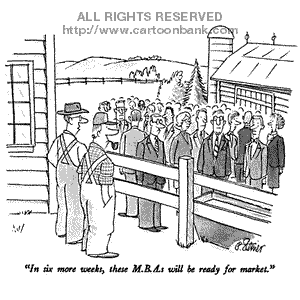
Note to the cartoon: “In six more weeks, these M.B.A.s will be ready for market.” (Farmers talking about a bunch of ‘suits’ corralled outside their barn.)


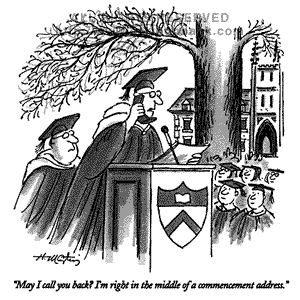
Note to the cartoon: “May I call you back? I’m right in the middle of a commencement address.” (Dean of University into cell-phone.)

It’s been interesting to walk around campus this afternoon, as when I went to Princeton things were completely different. This chapel, for instance—I remember when it was just a clearing, cordoned off with sharp sticks. Prayer was compulsory back then, and you couldn’t just fake it by moving your lips; you had to know the words, and really mean them. I’m dating myself, but this was before Jesus Christ. We worshipped a God named Sashatiba, who had five eyes, including one right here, on the Adam’s apple. None of us ever met him, but word had it that he might appear at any moment, so we were always at the ready. Whatever you do, don’t look at his neck, I used to tell myself.

It’s funny now, but I thought about it a lot. Some people thought about it a little too much, and it really affected their academic performance. Again, I date myself, but back then we were on a pass-fail system. If you passed, you got to live, and if you failed you were burned alive on a pyre that’s now the Transgender Studies Building. Following the first grading period, the air was so thick with smoke you could barely find your way across campus. There were those who said that it smelled like meat, no different from a barbecue, but I could tell the difference. I mean, really. Since when do you grill hair? Or those ugly, chunky shoes we all used to wear?

It kept you on your toes, though, I’ll say that much. If I’d been burned alive because of bad grades, my parents would have killed me, especially my father, who meant well but was just a little too gung ho for my taste. He had the whole outfit: Princeton breastplate, Princeton nightcap; he even got the velvet cape with the tiger head hanging like a rucksack from between the shoulder blades. In those days, the mascot was a sabretooth, so you can imagine how silly it looked, and how painful it was to sit down. Then, there was his wagon, completely covered with decals and bumper stickers: “I hold my horses for Ivy League schools,” “My son was accepted at the best university in the United States and all I got was a bill for a hundred and sixty-eight thousand dollars.” On and on, which was just so . . . wrong.

One of the things they did back then was start you off with a modesty seminar, an eight-hour session that all the freshmen had to sit through. It might be different today, but in my time it took the form of a role-playing exercise, my classmates and I pretending to be graduates, and the teacher assuming the part of an average citizen: the soldier, the bloodletter, the whore with a heart of gold.

“Tell me, young man. Did you attend a university of higher learning?”

To anyone holding a tool or a weapon, we were trained to respond, “What? Me go to college?” If, on the other hand, the character held a degree, you were allowed to say, “Sort of,” or, sometimes, “I think so.”
“So where do you sort of think you went?”
And it was the next bit that you had to get just right. Inflection was everything, and it took the foreign students forever to master it.
“Where do you sort of think you went?”

And we’d say, “Umm, Princeton?”—as if it were an oral exam, and we weren’t quite sure that this was the correct answer.
“Princeton, my goodness,” the teacher would say. “That must have been quite something!”

You had to let him get it out, but once he started in on how brilliant and committed you must be it was time to hold up your hands, saying, “Oh, it isn’t that hard to get into.”

Then he’d say, “Really? But I heard—”
“Wrong,” you’d tell him. “You heard wrong. It’s not that great of a school.”
This was the way it had to be done—you had to play it down, which wasn’t easy when your dad was out there, reading your acceptance letter into a bullhorn.

I needed to temper my dad’s enthusiasm a bit, and so I announced that I would be majoring in patricide. The Princeton program was very strong back then, the best in the country, but it wasn’t the sort of thing your father could get too worked up about. Or, at least, most fathers wouldn’t. Mine was over the moon. “Killed by a Princeton graduate!” he said. “And my own son, no less.”
My mom was actually jealous. “So what’s wrong with matricide?” she asked. “What, I’m not good enough to murder?”

They started bickering, so in order to make peace I promised to consider a double major.
“And how much more is that going to cost us?” they said.
Those last few months at home were pretty tough, but then I started my freshman year, and got caught up in the life of the mind. My idol-worship class was the best, but my dad didn’t get it. “What the hell does that have to do with patricide?” he asked.

And I said, “Umm. Everything?”

He didn’t understand that it’s all connected, that one subject leads to another and forms a kind of chain that raises its head and nods like a cobra when you’re sucking on a bong after three days of no sleep. On acid it’s even wilder, and appears to eat things. But, not having gone to college, my dad had no concept of a well-rounded liberal-arts education. He thought that all my classes should be murder-related, with no lunch breaks or anything. Fortunately, it doesn’t work that way.

In truth, I had no idea what I wanted to study, so for the first few years I took everything that came my way. I enjoyed pillaging and astrology, but the thing that ultimately stuck was comparative literature. There wasn’t much of it to compare back then, no more than a handful of epic poems and one novel about a lady detective, but that’s part of what I liked about it. The field was new, and full of possibilities, but try telling that to my parents.

“You mean you won’t be killing us?” my mother said. “But I told everyone you were going for that double major.”

Dad followed his “I’m so disappointed” speech with a lecture on career opportunities. “You’re going to study literature and get a job doing what?” he said. “Literaturizing?”

We spent my entire vacation arguing; then, just before I went back to school, my father approached me in my bedroom. “Promise me you’ll keep an open mind,” he said. And, as he left, he slipped an engraved dagger into my book bag.

I had many fine teachers during my years at Princeton, but the one I think of most often was my fortune-telling professor—a complete hag with wild gray hair, warts the size of new potatoes, the whole nine yards. She taught us to forecast the weather up to two weeks in advance, but ask her for anything weightier and you were likely to be disappointed.

The alchemy majors wanted to know how much money they’d be making after graduation. “Just give us an approximate figure,” they’d say, and the professor would shake her head and cover her crystal ball with a little cozy given to her by one of her previous classes. When it came to our futures, she drew the line, no matter how hard we begged—and, I mean, we really tried. I was as let down as the next guy, but, in retrospect, I can see that she acted in our best interests. Look at yourself on the day that you graduated from college, then look at yourself today. I did that recently, and it was, like, “What the hell happened?”

The answer, of course, is life. What the hag chose not to foretell—and what we, in our certainty, could not have fathomed—is that stuff comes up. Weird doors open. People fall into things. Maybe the engineering whiz will wind up brewing cider, not because he has to but because he finds it challenging. Who knows? Maybe the athlete will bring peace to all nations, or the class moron will go on to become the President of the United States—though that’s more likely to happen at Harvard or Yale, schools that will pretty much let in anybody.

There were those who left Princeton and soared like arrows into the bosoms of power and finance, but I was not one of them. My path was a winding one, with plenty of obstacles along the way. When school was finished, I went back home, an Ivy League graduate with four years’ worth of dirty laundry and his whole life ahead of him. “What are you going to do now?” my parents asked.

And I said, “Well, I was thinking of washing some of these underpants.”
That took six months. Then I moved on to the shirts.
“Now what?” my parents asked.

And, when I told them I didn’t know, they lost what little patience they had left. “What kind of a community-college answer is that?” my mother said. “You went to the best school there is—how can you not know something?”

And I said, “I don’t know.”
In time, my father stopped wearing his Princeton gear. My mother stopped talking about my “potential,” and she and my dad got themselves a brown-and-white puppy. In terms of intelligence, it was just average, but they couldn’t see that at all. “Aren’t you just the smartest dog in the world?” they’d ask, and the puppy would shake their hands just like I used to do.

My first alumni weekend cheered me up a bit. It was nice to know that I wasn’t the only unemployed graduate in the world, but the warm feeling evaporated when I got back home and saw that my parents had given the dog my bedroom. In place of the Princeton pennant they’d bought for my first birthday was a banner reading, “Westminster or bust.”

I could see which way the wind was blowing, and so I left, and moved to the city, where a former classmate, a philosophy major, got me a job on his rag-picking crew. When the industry moved overseas—this the doing of another former classmate—I stayed put, and eventually found work skinning hides for a ratcatcher, a thin, serious man with the longest beard I had ever seen.

At night, I read and reread the handful of books I’d taken with me when I left home, and eventually, out of boredom as much as anything else, I started to write myself. It wasn’t much, at first: character sketches, accounts of my day, parodies of articles in the alumni newsletter. Then, in time, I became more ambitious, and began crafting little stories about my family. I read one of them out loud to the ratcatcher, who’d never laughed at anything but roared at the description of my mother and her puppy. “My mom was just the same,” he said. “I graduated from Brown, and two weeks later she was raising falcons on my top bunk!” The story about my dad defecating in his neighbor’s well pleased my boss so much that he asked for a copy, and sent it to his own father.

This gave me the confidence to continue, and in time I completed an entire book, which was subsequently published. I presented a first edition to my parents, who started with the story about our neighbor’s well, and then got up to close the drapes. Fifty pages later, they were boarding up the door and looking for ways to disguise themselves. Other people had loved my writing, but these two didn’t get it at all. “What’s wrong?” I asked.

My father adjusted his makeshift turban, and sketched a mustache on my mother’s upper lip. “What’s wrong?” he said. “I’ll tell you what’s wrong: you’re killing us.”

“But I thought that’s what you wanted?”

“We did,” my mother wept, “but not this way.”

It hadn’t occurred to me until that moment, but I seemed to have come full circle. What started as a dodge had inadvertently become my life’s work, an irony I never could have appreciated had my extraordinary parents not put me through Princeton.

Saturday, June 17, 2006

The National Entertainment State, 2006 (the editors at the Nation and Jeffrey Chester, the Nation)


link to this year's media map

The National Entertainment State, 2006

[from the July 3, 2006 issue]

Where do Americans get their news and who controls what they consume? Ten years ago, when The Nation first charted a map of the National Entertainment State, four colossal conglomerates spread across the media landscape. Today, that map has significantly changed, because of the rise of new media and a vigorous reform movement, but the old corporate giants still hold most of the cards. Google, Yahoo! and Microsoft are quickly rising, but are not included in this chart because they do not own--not yet, anyway--the major television networks, which remain Americans' #1 source of news.


Illustration by Peter Ahlberg. Research: Emily Biuso, Sarah Goldstein.


The National Entertainment State (Forum)

[from the July 3, 2006 issue]

Ten years ago, just after the passage of the Telecommunications Act of 1996, The Nation published a special issue on the National Entertainment State. The issue featured a centerfold chart depicting the tentacles of four colossal conglomerates that were increasingly responsible for determining how Americans got their news--Time Warner, General Electric, Disney/Cap Cities and Westinghouse. And essays by Norman Lear, Walter Cronkite and Mark Crispin Miller, among others, looked ahead to a period of no-holds-barred consolidation green-lighted by the new legislation. Today, after a decade of strategic mergers, impulsive couplings and messy divorces--not to mention the birth of "new media" as well as a vigorous media reform movement--the landscape is considerably more complex, though it still bears the oversized footprints of a few
giants. This is reflected not only in the detailed fold-out map that appears in this issue but in the range of contributions to this year's forum.

The centerfold is an invitation to step back from the outrage of the moment--be it over Rush Limbaugh's addled ranting, Bill O'Reilly's spin or the White House press corps's inability to distinguish between journalism and stenography--and see the big picture in gruesome detail. It reminds us that while we might hate the rigid recitation of conservative talking points on Fox News programs and love the Internet frontier reached via MySpace.com, both Fox and MySpace are owned by Rupert Murdoch's News Corporation. It tells us that when we are wondering whether we should trust an NBC Nightly News report on the greening of nuclear power, it is important to keep in mind that NBC's owner, General Electric, has a more than passing interest in the development and operation of nuclear power plants. And the chart also reminds us that GE owns Universal Pictures and Universal Studios, making it a major player in the creation of the culture--the TV shows and movies--that goes so far to define what Americans think and do.

It is the power that a handful of corporations continue to wield over the media we consume--even the new media of a supposedly liberating Internet--that ought to concern us as citizens. It is not enough to hope that the Internet will set us free. Yes, the World Wide Web is evolving in ways that few anticipated a decade ago, and yes, as the optimism of Markos Moulitsas Zúniga and the skepticism of Mark Crispin Miller illustrate, there are differing views among progressives of what that
evolution is likely to mean. It is a good bet, however, that another forum participant, Rebecca MacKinnon, is right when she argues that new-media companies such as Google, Yahoo! and Microsoft will in relatively short order either displace some of the old-media companies on the chart or acquire or merge with them. (Those entities do not appear on this year's chart simply because they do not own major television networks--not yet, anyway--and the Internet has yet to surpass television as Americans' number-one source for news.) But the vast frontiers of new media are being colonized by big players of old media, which just won round one in the fight over "net neutrality" with the House's passage of the COPE Act, legislation that would allow commercial sites to dominate the net. With the FCC preparing another attempt to strike down rules that guard against local media monopolies, we are entering a period of intense struggle over the fundamental questions for both old and new media: Who will own what, and will the rules regulating ownership be written to benefit the owners or the rest of us? The powerhouses of today's National Entertainment State stand ready to answer those questions as they always have, by using all their might to make sure that the new boss is the same as the old boss.

But the past need not be prologue. As Robert W. McChesney, Jeffrey Chester and others explain in this issue, the media reform movement that has taken shape over the past decade can do far more than merely police the margins of this Big Media map. It can, and must, chart a course of activism that makes real the promise of new media, that confronts the problems of old media and that recognizes the necessity of creating
genuine diversity of media ownership and communicative opportunity, anchored by civic rather than commercial values. If this movement realizes its potential, the next chart of the National Entertainment State will be a map of our media, not theirs.


A Ten-Point Plan for Media Democracy
by JEFFREY CHESTER

[from the July 3, 2006 issue]

Ten years after the passage of the Telecommunications Act of 1996, digital technologies are rapidly reshaping the country's communications system. It will be the most powerful media environment ever created--always "on" with connections via PCs, digital TVs and an array of mobile devices, delivering a torrent of personalized, interactive and virtual content, much of it coming from the nation's most powerful traditional and new media companies (e.g., AT&T, Comcast, Google, Microsoft). The next several years are critical to insure that the promise of what we now experience online--and its vast potential to help build a just civil society--is fulfilled. With Congress poised to pass legislation that rewrites key parts of the
Telecom Act, the following ten action items should be on any media reform agenda.

1. Media Ownership

The GOP-controlled FCC wants to eliminate key media ownership restrictions affecting TV and radio stations, cable systems and newspapers. Expect fewer owners of our most powerful outlets and a further decrease in journalism budgets.

Action: Join the new "Stopbigmedia" coalition (www.stopbigmedia.com) to promote diversity of media ownership and content. Also, work against the renomination of FCC chair Kevin Martin.


2. Mergers

Sprawling new media powerhouses are emerging, in which offline and digital content and distribution, advertising and marketing are tied to the same multinational giants. For example, the pending AT&T and BellSouth merger will create a colossus spanning voice, broadband and video.

Action: Join with Media Access Project (www.mediaaccess.org) to fight the AT&T/BellSouth merger. Push for new laws to restore our trust in antitrust.

3. Network Neutrality

We can't permit the Internet to come under the control of phone and cable companies, like Comcast and AT&T, that want to transform it into a toll road, with fast lanes for corporate media and a digital dirt road for everyone else.

Action: Join the "strange bedfellows" coalition, which includes MoveOn.org, the American Library Association and the Christian Coalition, pressing Congress to pass "network neutrality" rules to protect the principles of nondiscrimination and open access. Join Save the Internet (www.savetheinternet.com).

4. Spectrum Management

The wireless Internet (Wi-Fi) has been an unprecedented success, with more than 35,000 hot spots (many of them free) operating in the United States. But for the wireless broadband revolution to continue, it needs new unlicensed spectrum. Big communications companies, including broadcasters, want to keep for themselves what should be the public's airwaves.

Action: Urge the FCC to set aside additional spectrum for unlicensed use and support legislation currently in Congress that will make unused TV spectrum available for Wi-Fi applications. The New America Foundation (www.newamerica.net) has been leading the charge for enlightened spectrum management.

5. Community Broadband

Municipal wireless systems represent the most promising alternative to the two-fisted stranglehold that cable and telephone companies currently have over the broadband Internet. Fourteen states, acting at the behest of the cable and telco lobbies, have passed laws limiting these efforts, and others are considering such restrictions.

Action: Urge your Representatives to support federal legislation (e.g., the municipal broadband provision in the otherwise objectionable Communications Opportunity, Promotion and Enhancement [COPE] Act) that will restore the right of cities to undertake their own broadband projects. See Free Press's Community Internet page
(www.freepress.net/communityinternet/=US).

6. Privacy

As the recent furor over NSA access to millions of private telephone records makes clear, we need to update privacy protections for the digital age. Such protections should extend into the commercial arena too, where new data-collection and -mining technologies, coupled with personalized marketing campaigns, represent a new threat to our personal privacy.

Action: Call for a thorough overhaul of existing privacy regulations, beginning with a requirement for "affirmative consent" before personal data can be collected, and covering the latest developments in digital data collection and analysis. See the EPIC website (www.epic.org).

7. Intellectual Property

Just as privacy protection must move from the analog to the digital domain, so must copyright law reflect the reality of networked computers and other personal devices. Congress's initial effort in this regard, the Digital Millennium Copyright Act, went way overboard in its desire to protect content owners (namely, the entertainment industry), and the principle of "fair use" suffered accordingly.

Action: Urge your Representative to reject the Bush-backed Intellectual Property Protection Act (which compounds the DMCA's excesses) in favor of legislation that preserves fair use. See www.publicknowledge.org.

8. Universal Digital Service

Millions of Americans still lack basic Internet, let alone broadband. We need new approaches to achieving "universal service," the policy that sought to make telephone service affordable for low-income and rural Americans.

Action: Call for Congress to expand the Universal Service Fund in the digital era, and support efforts to bridge the digital divide through municipal Wi-Fi and community networking projects.

9. Diverse Broadband Content

The phone industry is building a new system that will deliver interactive TV programming and broadband content (e.g., Verizon's FiOS and AT&T's Project Lightspeed). Cable is also expanding its network offerings. Progressive media must make sure their content is on these networks. We must also build and expand new media services, including digital TV programming channels, broadband websites and mobile networks.

Action: Urge phone and cable companies to open their system to progressive, alternative and diversely owned content. Funders must support an independent digital infrastructure.

10. Minority Ownership

African-Americans, Hispanics and others have fared poorly in the media business, owning only a handful of radio and TV stations. Most of the cable outlets aimed at minorities are owned by corporate giants (e.g., Viacom now owns BET and Comcast controls the new TV One service for African-Americans).

Action: Civil rights groups need to take a more adversarial approach to the media monopoly--seeking minority ownership of local and national broadband outlets.

about Jeffrey Chester
Jeffrey Chester is executive director of the Center for Digital Democracy (www.democraticmedia.org), a Washington-based nonprofit organization dedicated to maintaining the diversity and openness of the new broadband communications systems. He is the author of the forthcoming Digital Destiny: New Media and the Future of Democracy, to be published in late fall by The New Press.

Thursday, June 15, 2006

The Literary Guide to the World (Salon & Travel Channel)


What is the Literary Guide to the World?

By Hillary Frey

Looking for the best novel about Zimbabwe? Or just want to take a virtual trip to Martha's Vineyard? On this literary journey, everything is first-class.


A few years ago, I went to Delhi to visit a friend. On the long flight to India, I worked my way through the American magazines I was bringing as a gift, and Ian McEwan's "Enduring Love" (very good airplane reading). Once I had settled in my friend's white-tiled apartment in the quaint Nizamuddin district, I wanted to take in something that seemed better suited to my destination. Not a travel guide -- those I had already read and dog-eared. Rather, a book that could thrill and educate me all at once, a book that would enhance my visit rather than distract me from it.

My friend handed me a beat-up paperback edition of "City of Djinns: A Year in Delhi" by the British writer William Dalrymple. The taxiwallahs, the shrines, the Khan market immediately came to life in a whole different way. Dalrymple, whose book I toted all over Delhi, became my traveling companion -- pointing out the sites, teaching me Delhi's complicated and storied history, cracking jokes that were much funnier in India than at home. Dalrymple, even more than Mr. Vijay, who ran our very necessary car service, showed me the city. His book was indispensable -- and a delight.

After that trip, I started thinking: Wouldn't it be cool if there was a travel guide devoted not to restaurants, hotels and museums, but to the literature of a place? Yes, it would. So here it is: Salon's Literary Guide to the World. It's a grand name, to be sure, but one that suits. From Turkey to Togo, D.C. to L.A., Rio to Russia and beyond, the Guide promises to recommend the best books -- fiction, history, memoir or otherwise -- to take with you on your travels. And if there's a place that you've always dreamed of seeing, but won't visit in the foreseeable future, the Literary Guide will point you to the books that offer the best virtual tours around.

Our writers know their stuff: The first group of eight includes Booker Prize-winning Irish novelist John Banville on his homeland; New York Times bestselling author Alexandra Fuller on her childhood home of Zimbabwe (formerly Rhodesia); frequent Salon contributor -- and once-Togo resident -- Matt Steinglass on the small West African nation he used to call home; and the lauded young novelist Tony D'Souza on Havana, where he had a very good time.

Throughout the summer, the Literary Guide will feature two new locations a week; in autumn we'll continue with one a week. There's much to look forward to, including pieces from National Book Award winner William Vollmann (Norway), Salon favorite Garrison Keillor (Minnesota) and "Divine Secrets of the Ya-Ya Sisterhood" author Rebecca Wells (Louisiana). We'll take you as far as Papua New Guinea and South Africa, but we've also got the books to read if you're staying closer to home -- in Martha's Vineyard, say, or the Jersey Shore. And you can make your own suggestions, too. We hope you'll use Salon's letters feature to comment on our writers' choices, and to make some suggestions of your own.

Welcome to the Literary Guide to the World -- we hope you have a great trip!

the project cover page