Sunday, April 02, 2006

Getting Fresh With Mozart (By Gavin Borchert, the Seattle Weekly)


Note to the caption: Man of the moment.

He wrote about 650 pieces; why do we always hear the same old six?


March 29, 2006


It's Mozart's 250th birthday, and almost as prevalent as concerts of his music are complaints by critics that everyone plays Mozart all the time anyway. How do you keep standard repertory fresh and bring in audiences in such a situation? With Mozart's birth (1756) and death (1791) both celebrated every 50 years, we've barely had time to get over the 1991 party.


Any music festival's first responsibility in programming, I suppose, is to justify itself—to convince concertgoers that saturation bombing of Composer X (or Period Y or Geographic Region Z) is warranted. Among a somewhat halfhearted collection of standard-repertory symphonies and concertos, the Seattle Symphony's January Mozart festival took an oddly funereal tone with a performance of his Requiem. No doubt, there were some concertgoers puzzled that it was his birth, not his death, that was being observed—not to mention that the SSO plays the work every year anyway, and it's only half by Mozart.


On the other hand, its Feb. 2 concert told us something new: Opulent, Technicolor arrangements of Mozart's music by Tchaikovsky (a few obscure piano pieces) and Richard Strauss (an ensemble from the opera Idomeneo) showed us how two arch-Romantics reworked Wolfgang in their own image. Their admiration for him didn't prevent them from tinkering with holy writ, revealing that our culture's own worshipful attitude toward Mozart is a recent development.


Yet the essential Mozart in these reworkings survives and shines through—just as it did in an even more daring reimagining, the big-band version of Symphony No. 40 that, as played by the UW Studio Jazz Ensemble, made a fantastic climax to the School of Music's Feb. 9 all-Mozart evening. Witty without being shticky, it demonstrated how little you had to alter (a ninth chord here, a syncopation there) to twist one idiom into another, and how thin and fragile are the walls we build to compartmentalize musical genres.


The Northwest Sinfonietta put Mozart in historical context by placing his music next to that of a typical 18th-century journeyman like Antonio Salieri. The two sinfonias played on its Feb. 17 program were snappy little numbers, but alongside Mozart's Symphony No. 36—richer, more imaginative, and more compelling—the difference between craftsmanship and genius becomes clearer. And remember which one had the fame, the money, and the cushy Kapellmeister post; ponder the relationship between immediate popularity and lasting artistic value, and you may pause a moment the next time you're inclined to dismiss an "inaccessible" piece of new music.


Yet why pick on Salieri? Mozart's peaks can be put into perspective as well by his own lesser works. Earlier this month, the Seattle Symphony did a salutary service in this season of reverence by presenting a rare Mozartean misfire: the Adagio and Fugue, K. 546, a leaden, charm-free string version of an earlier work for two pianos. Wolfgang could turn out four-voice counterpoint like nobody's business, but he sure didn't have Bach's skill at keeping things moving along.


Even with a composer this beloved, programmers still gravitate to the greatest hits. It was already a problem in 1891, when George Bernard Shaw griped about the unadventurous death-centennial observances: "The Crystal Palace committed itself to the 'Jupiter' Symphony and the Requiem; the Albert Hall, by way of varying the entertainment, announced the Requiem and the 'Jupiter' Symphony."


But back then, much of his music was still unexplored. Exhibit A, Cosí fan tutte, Seattle Opera's contribution to this Mozart season (Feb. 25–March 11) was ignored in the 19th century and didn't earn warhorse status until the 1970s. (Strauss sugared up Idomeneo to make it go down easy for a 1937 audience.) But what's left to discover, and where do we go from here?


Myself, I've always wanted to hear an unfinished Requiem—a performance confined strictly to the notes Mozart left, without any cobbling up by Süssmayr, even if some passages are just first-violin/bass skeletons, even if others trail off midphrase. After all, wouldn't that be more poignant? Here Death stayed the Master's hand. . . . 


Then there are the oddball pieces Mozart devoted more time to than maybe any other famous composer. Chamber music for glass harmonica. Divertimenti for two flutes, five trumpets, and timpani. The proto-Cagean Musical Dice Game, 16 bars in minuet tempo that can be played in any order. Or his overture to the ballet Les petits riens, the best Mozart overture you've never heard. Perhaps some choir could take up the vocal canons on naughty texts, like "Leck mich im Arsch," K. 231, which means in English exactly what it sounds like in German.


Asked about her ideal Mozart commemoration, Seattle Baroque violinist Ingrid Matthews confessed to voice envy: "The way Mozart spins a tune in his vocal writing, to me, is something every violinist should study! Then there is the sorcererlike ability to evoke and manipulate human emotions." Or, alternately, "It wouldn't be bad to be locked up in a room with a feather bed and a dessert tray and listen to all the piano concertos one after another."


Conductor Roupen Shakarian's dream concert? "Tough call, but . . . a wind Serenade, the Sinfonia Concertante, the C-minor Mass." And Adam Stern's Mozart wish runs counter to current musical correctness: "Any and all Mozart is always welcome—so long as it's not played on period instruments."


The Beat Arts writer Gavin Borchert reviews new classical CDs with Dave Beck, every other Tuesday at 2:50 on KUOW-FM (94.9).

link to the original posting

Bosses in love with claptrap and blinded by ideologies (by Simon Caulkin, the Observer)


Sunday March 12, 2006


Heroic leaders are a disaster. Seventy per cent of mergers fail. In most organisations, financial incentives cause more problems than they solve. There is no connection between high executive pay and company performance (well, there is - the wider the pay differentials, the lower the commitment of the less well paid). The main result of many consultancy assignments is another consultancy assignment. All 'silver bullet' or 'big ideas' on their own are wrong.

These are not theories, but facts. Yet companies trip over themselves to buy others, launch change initiatives, introduce pay for performance, flit from one big idea to the next - and pay their CEOs stratospherically. It's hardly surprising so many go belly up. If doctors were as cavalier with the evidence, a lot of their patients would be dead and many medics would be behind bars.

The last is a line from what bids fair to be one of the management books of the year. Hard Facts, Dangerous Half-Truths and Total Nonsense (Harvard Business School Press), by Stanford professors Jeffrey Pfeffer and Robert Sutton, is a compelling tour of management conventional wisdom and why it so often turns out to be unwise, untrue and a stranger to fact - bollocks, in fact. Every potential manager should be made to read it before they are allowed to be in charge of anything, even a whelk stall.

So why don't managers make judgments on evidence, as doctors at least try to do? The book pinpoints a number of factors, many of which come down to the human factors economic theorists carefully exclude. They overestimate power, fail to cut losses, underestimate cost and difficulty, and ignore the lessons of failure. They put too much faith in superficial impressions and repeat what worked in the past. Or they fall back on unexamined but deeply held ideologies. (An unqualified belief in anything, except the likelihood of being wrong, is a certain predictor of tears ahead.)

Another factor is the messiness of the market for ideas, not least the quantity of information and the self-serving interest of gurus in talking up successes and downplaying the side effects of their prescriptions. People prefer simple solutions, even if there aren't any: 'If someone tells you they have the answer,' one candid guru noted, 'they probably haven't understood the question.'

Less obvious is the effect of facts on conventional leadership. If only the facts matter, it shouldn't matter where they come from. That undercuts the traditional justification for hierarchy: that the boss knows best. Facts force the boss to choose between being 'in control' and being right. Many choose the former.

All this sets up a bizarre corporate amnesia - a kind of conspiracy not to learn in which organisations find new ways of repeating mistakes in an endless loop. They are suckers for half-truths - more dangerous than total nonsense because they are not entirely wrong, except when treated as whole truths, in which case they become total bollocks. Pfeffer and Sutton line up a number of these, often naming names, showing how some of management's ingrained habits of thought cause them to undermine their own organisations.

Thus, leaders do make a difference, but not as much as you might think, and more on the downside. Yes, strategy and recruiting good people are important. But strategy is usually overrated, to the detriment of implementation; and overestimating raw talent can impede learning. It's no use putting good people to work in a crappy system; conversely, putting people in a good system and expecting them to improve increases their individual and group capabilities - another example of the (ignored) self-fulfilling nature of so many assumptions.

Incentives do incentivise - but be careful what you wish for. As W Edwards Deming said, people with sharp enough targets will probably meet them even if they have to destroy the company to do so. And what about change or die?The trouble, they say, is that companies are so bad at it that 'empirically it is change and die'.

It's a weird paradox. Despite management's obsession with hard numbers, many organisations are a fact-free zone, swirling with untested assumptions. Horrifying sums of money are committed on superstition or whim. Thus, fact-based management is really triple-distilled common sense. It's hard. It requires judgment, practice, help, humanity and wisdom. It needs scepticism and experimentation. It needs reasoned optimism and learning, and, as F Scott Fitzgerald put it, the ability to function while holding two contradictory ideas in your head at the same time.

Ironically, applying such honed common sense is a great recipe for competitive advantage because so few do it. Despite the heroic efforts of the professors, this will almost certainly continue. As Peter Drucker says: 'Thinking is very hard work. And management fashions are a great substitute for thinking.'

Which is why most companies and managers will continue to ignore the facts, make the same mistakes and perpetrate the same old bollocks: not fact-based so much as voodoo management.


Harvard Business Online link to Hard Facts, Dangerous Half-Truths And Total Nonsense: Profiting From Evidence-Based Management, by Jeffrey Pfeffer, Robert I. Sutton

link to the original posting

The Housekeeper of a World-Shattering Theory (by Jenny Diski, London Review of Books)


Martha Freud: A Biography by Katja Behling trans. R.D.V. Glasgow · Polity, 206 pp.


In the membership roll of the worshipful guild of enabling wives, the name of Martha Freud ranks with the greatest: Mrs Noah, Mrs Darwin, Mrs Marx, Mrs Joyce, Mrs Nabokov, Mrs Clinton, and their honorary fellows, Mr Woolf and Mr Cookson. Wives, of either sex, are what keep the universe orderly and quiet enough for the great to think their thoughts, complete their travels, write their books and change the world. Martha Freud was a paragon among wives. There is nothing more liberating from domestic drudgery and the guilt that comes of avoiding it than having a cleaning lady who loves cleaning, a child-carer who’s content with child-care, a homebody who wants nothing more than to be at home. And Martha Freud was all those things. Quite why she was those things is something that her husband might have been the very person to investigate, but Freud was nobody’s fool and knew when to leave well alone in the murkier regions of his personal life – especially that dark continent in his mind concerning women. Freud mentioned in passing in a letter to his friend Wilhelm Fleiss (to whom he wrote that no woman had ever replaced the male comrade in his life), that at the age of 34, after the birth of her sixth child in eight years, Martha was suffering from writer’s block. Impossible to imagine why. But like other mysteries about Martha’s life, this new biography does not (or perhaps cannot because some of the source material remains unavailable) elaborate on what she might have been trying to write. A shopping list, I expect. Unless it was that book about interesting new ways she had thought of for interpreting her dreams, which she worked on in those odd moments when the children weren’t down with chickenpox or needing their stockings mended.

History tells of Mrs Freud – the wife – as a devoted domestic, and there is little in Katja Behling’s biography to suggest we adjust our view of her. The big idea seems to be that we must value her contribution to the development of psychoanalysis as the provider of a peaceful home life for its founder. The sine qua non of radical thought is someone else changing the baby’s nappy. In his foreword to the book, Anton Freud, a grandson, puts it with incontestable logic:

Would he have had the time and opportunity to write this foundational work if he had had, say, to take his daughter to her dancing classes and his son to his riding lessons twice a week? . . . His youngest daughter was born in 1895. When she cried in the night, was it Sigmund who got up to comfort her? . . . If Martha had been less efficient or unwilling to devote her life to her husband in this way, the flow of Sigmund’s early ideas would have dried to a trickle before they could converge into a great sea. Martha always saw to it that her husband’s energies were not squandered.

And if Freud had comforted his daughter when she cried in the night, would Anna have been so desperate for her father’s attention as to devote her life to publishing his papers and continuing his work? Apostles need more than ordinary unhappiness to fit them for their task.

Juliet Mitchell, in praise of the new biography, berates those who dismiss Martha Freud as a stereotypical Hausfrau rather than seeing in her ‘a highly ethical and decent human being’, though it isn’t at all clear to me that they are mutually exclusive descriptions. As to dismissing her, on the contrary, one wrings one’s hands and weeps over her, or would if she didn’t seem to have been perfectly content with her existence. In his biography of Freud, Peter Gay quotes Martha’s reply to a letter of condolence after Freud’s death that it was ‘a feeble consolation that in the 53 years of our marriage there was not a single angry word between us, and that I always tried as much as possible to remove the misère of everyday life from his path’. Like strange sex between consenting adults, there’s nothing to be said against contentment and a division of labour which both parties are happy about. We must read and wonder at the good fortune that each should have found the other. Which of us would not wish for a Martha of our own to take care of the misère in our daily life while we sit in our study or silently at the lunch table bubbling up enlightenment for the world? Then again, who among us would wish to be Martha, no matter how essential her biographer might claim her to be in the production of the grand idea? To be a muse, an inspiration, might, I suppose, have its attractions; but to be the housekeeper of a world-shattering theory isn’t quite the same.

There’s no point in pretending in the light of 53 years’ evidence that there was a great originator in Martha struggling to get out. But you can’t help wondering how it could be that she wanted only this of herself, a woman who at her marriage was neither thoughtless nor completely self-effacing. Martha was a voracious reader of John Stuart Mill, Dickens and Cervantes, though her husband-to-be warned her against the rude bits unsuitable for a woman in Don Quixote. She was interested in music and painting, and had no shortage of suitors. When Freud became obsessively suspicious of her brother (and the husband of Freud’s sister), Eli, who controlled the Bernays’s finances, he insisted, on pain of ending their relationship, that she break with him completely. She held her own, firmly reflected Freud’s ultimatum back at him, and maintained her relationship with Eli. She travelled to northern Germany to holiday with only her younger sister for company and had a wonderful time in spite of her fiancé’s suspiciously heavy-handed use of ironic exclamation marks: ‘Fancy, Lübeck! Should that be allowed? Two single girls travelling alone in North Germany! This is a revolt against the male prerogative!’ But as soon as they were married Freud forbade his devoutly Orthodox Jewish wife to light the sabbath candles. It wasn’t until the first Friday after her husband’s death that she lit them again. What do women want is one thing, but the real question is what made Martha run: run the household, the children, the travel arrangements, the servants, and with never a word of complaint except a mildly expressed bafflement at her husband’s choice of profession. ‘I must admit that if I did not realise how seriously my husband takes his treatments, I should think that psychoanalysis is a form of pornography.’

Marriage, they say, changes people, and it does look as if Martha Bernays might have had the makings of another woman – at any rate, another life – altogether. What this otherwise rather dutiful biography (the mirror of its subject, perhaps) does offer us is a glimpse (but sadly very little more) of the by no means uninteresting Bernays family and their oldest daughter, Martha, before she became the other Mrs Freud. Three of Martha’s six siblings died in infancy; her oldest brother, Isaac, was born with a severe hip disorder and walked on crutches; and the next brother, Eli, was not much liked by his mother. When Martha was six, her father, Berman Bernays, was imprisoned for fraudulent bankruptcy after some shady dealings on the stock market. Two years later, the family moved away from the public shame in Hamburg to Vienna, and Martha recalled hearing the ‘sizzling of her mother’s tears as they landed on the hot cooking stove’. She was teased at her new school for her German diction. Isaac died when Martha was 11, and seven years later Berman collapsed in the street, dying of ‘paralysis of the heart’ and leaving the family without an income. Berman’s brothers had to support them, and Eli took over his father’s job in order to help out. Not an uneventful childhood, not lacking in trauma to be lived through. There are all sorts of pain and difficulty there, yet Martha did not take to her bed and succumb to the vapours. There is not the slightest indication that she lost the use of her legs, or found herself unable to speak. And this is all the more remarkable in view of the fact that when her father died, her mother appointed as her temporary guardian none other than the father of Bertha Pappenheim, later better known as Anna O., who might have told her a thing or two about the proper way to react to family loss. Nor is there any indication that her positively neurotic lack of neurotic symptoms (unless you count obsessive compulsive caring for her husband’s welfare) struck the father of psychoanalysis as worth a paper or two.

What Sigmund and Martha had in common were families embroiled in shadowy financial scandals. Freud’s uncle was imprisoned for trading in counterfeit roubles, and persistent rumour had it that his father was implicated in the scam. The way both dealt with the discomfort of public shame and lived happily ever after together was by embracing a perfect 19th-century bourgeois existence, provided you don’t include Sigmund’s incessant thoughts about child sexuality, seduction theory, the Oedipus complex, penis envy and the death drive – or perhaps even if you do. Presumably it was precisely that exemplary bourgeois surface, the formal suits, the heavy, glossy furniture, the rigid table manners, ordered nursery and bustling regularity, that made it possible for those deeper, hardly thinkable thoughts to be had and developed into something that looked like a scientific theory. By polishing that surface and keeping the clocks ticking in unison, Martha was as essential to the development of Freudian thought as Dora or the Rat Man. It’s just that she didn’t have the time to put her feet up on the couch, and Sigmund never cared to wonder what all that polishing and timekeeping was about. Martha was not there in order to be understood; she was there so that he might learn to understand others.

Not that women weren’t interesting. Anna O. and Dora were fascinating. Minna, Martha’s younger sister, who lived with them, was someone to whom, when no serious man was around, Freud could talk about intellectual things. Who could have been more stimulating than Lou Andreas-Salomé, Marie Bonaparte, Hilda Doolittle, Helene Deutsch or Joan Riviere? But they were none of them his wife. It is the woman’s place, Freud said to his oldest daughter, Mathilde, to make man’s life more pleasant. Intellectual companionship was to be found elsewhere. The more intelligent young men look for a wife with ‘gentleness, cheerfulness, and the talent to make their life easier and more beautiful’. (Not Lou, then.) In 1936 he spoke to Marie Bonaparte of his married life: ‘It was really not a bad solution of the marriage problem, and she is still today tender, healthy and active.’ He expressed his relief to his son-in-law Max Halberstadt, ‘for the children who have turned out so well, and for the fact that she’ – Martha – ‘has neither been very abnormal nor very often ill’.

In fact, it was precisely Martha’s sturdy, if somewhat timekeeping and cleanliness-fixated nature that Freud found most attractive, according to Behling. She was the lodestone, the quintessence, the elixir to which his life’s work was ostensibly devoted. He was the Doctor and she was what the cured would look like. She was normal. Obviously, it would have been extremely trying had Anna or Dora or the Wolf Man been like her. But in his world of psychical distortion, Martha represented what no one who takes his works seriously could ever really believe in: the ordinary, undamaged specimen. According to Ernest Jones, ‘her personality was fully developed and well integrated: it would well deserve the psychoanalysts’ highest compliment of being “normal”.’ No problem for Martha coming to terms with her missing penis at the right stage of her development, no big deal about transferring her Oedipal desire for the mother to the father. She had adapted nicely to her castration, and although it meant her superego was a flimsy thing compared to that of a man (woman ‘shows less sense of justice than man, less inclination to submission to the great exigencies of life, is more often led in her decisions by tender or hostile feelings’), it served well enough for Freud’s purposes. Imagine if Freudian analysis had gone quite another way and the master had studied the normality he apparently had so close to home instead of its deformation. What was it that Emmeline (whose bossiness and self-absorption Freud hated) and Berman Bernays did so right? How could he not have been in a rage to know? But what intellectual innovator would want to give up interesting for ordinary, especially when ordinary, if left to its own devices and sublimation of desires, arranged such a comfortable life for him?

Behling suggests that Martha’s great value to Freud was her very existence, which prevented him from getting too depressed about the nature of human nature. He was able to see in her ‘someone who stood apart from what he learned about humankind in general’. She was not part of the ‘rabble’, as Oscar Pfister explained, of ‘good-for-nothing’ mankind. So not only did he not study her, he did not communicate any of his professional thoughts to her. ‘Freud did not wish to share the blackest depths of his knowledge with Martha, but rather to protect her from them,’ Behling writes. Or perhaps, more likely, to protect himself. During their engagement Freud was taken ‘greatly by surprise when she once admitted that at times she had to suppress bad or evil thoughts’.

Martha’s sunny nature, so very different apparently from human nature, was encouraged if not carefully tutored by her fiancé during their epic four-year engagement. Martha’s mother had set her face against the marriage of her daughter to an impoverished researcher, and they were reduced to writing letters and stealing occasional meetings. It seems to have been Freud’s single stab at passion and he went at it with all the will of an adored son. He must have found it alarming, because the heavy curtains of contentment came down as soon as the wedding was over. Before that, he raged with jealousy at the mention of other men, demanding, for example, that Martha stop calling her interesting painter cousin by his first name. ‘Dear Martha, how you have changed my life,’ he said in his first letter to her. And when they were engaged and he was battling against her mother for Martha he explained: ‘Marty, you cannot fight against it; no matter how much they love you I will not leave you to anyone, and no one deserves you; no one else’s love compares with mine.’ Clearly the time for the master’s self-analysis had not yet come, so he was free to wish to give his fiancée a fashionable gold snake bangle and write how sorry he was that in the circumstances she would have to settle for ‘a small silver snake’. He wanted her well turned out so it would ‘never occur to a soul that she could have married anyone but a prince’. But his letters also made other things clear. Martha’s nose and mouth, he told her, were shaped ‘more characteristically than beautifully, with an almost masculine expression, so unmaidenly in its decisiveness’. It was as if nature wanted to save her ‘from the danger of being merely beautiful’. Even so the romance was powerful: the two young lovers exchanged flowering almond branches, and Freud told her that his addiction to cigars was due to her absence: ‘Smoking is indispensable if one has nothing to kiss.’ But in describing his views on the state of marriage he explained that ‘despite all love and unity, the help each person had found in the other ceases. The husband looks again for friends, frequents an inn, finds general outside interests.’ Martha, who would apologise each time she screamed during her labour, had been warned.

After his death, Martha did not run wild, aside from lighting the shabbos candles, but sat on a chair on the half-landing between the first and second floors of the house in Maresfield Gardens and took to reading again, though only, she assured a correspondent in case she was accused of idleness, in the evenings. Life, she said, had ‘lost its sense and meaning’ without her husband, but she quite enjoyed receiving the grand visitors who came to the house to pay homage. Anna took over her father’s work and Martha suddenly began to take an interest in it. Her daughter found Martha far too inquisitive about the patients who came and went. Martha even expressed a view: ‘You’d be amazed what it costs, this child analysis!’

Freud blamed Martha for preventing him from gaining early recognition in the world of medical science. ‘I may here recount, looking back, that it was my fiancée’s fault if I did not become famous in those early years,’ he wrote in his self-portrait. His experiments with cocaine in the 1880s were taken up and elaborated by others. What the late Princess Margaret knew as ‘naughty salt’ was found to have a beneficial effect as a local anaesthetic, a use Freud inexplicably hadn’t thought of and which he had omitted to mention in his paper ‘On Coca’. It was an unexpected opportunity to visit Martha that had distracted him from fully exploiting the potential of his discovery, he claimed in old age, but was generous enough to excuse his wife since, as Behling puts it, ‘49 years of wedlock had compensated him for missing out on fame in his youth.’ But here’s a thought, an unconsidered key, perhaps, to understanding Martha. While Freud was making his experiments with cocaine, he sent several vials of it to his fiancée extolling its effect on vitality, with instructions on how to divide the doses and administer it. Martha wrote and thanked him, saying that although she didn’t think she needed it, she would take some as he suggested. She reported back to her fiancé that she found it helpful in moments of emotional strain. From time to time, Behling says, Martha ‘enhanced her sense of well-being with an invigorating pinch of cocaine’. For how long she continued to do this is unknown, but it does suggest an altogether different way of viewing the devoted, domestically driven Martha Freud, who for half a century went about her frantically busy daily round of cleaning, caring, tidying, managing and arranging all the minute details of her husband’s life with a fixed and unfaltering smile.


Jenny Diski’s non-fiction book, On Trying to Keep Still, will be published in April. She is the author of Only Human, about a patriarch and his wife, among other novels.


link to the original posting

The striking idiocy of youth (by Theodore Dalrymple, the Times)


Note to the caption: Clashes between police and students during a protest in Rennes against a new labour law (Vincent Michel/AP)
link to the image source and related news

French students should go back to class to learn some economics


THE SIGHT OF MILLIONS of Frenchmen, predominantly young, demonstrating in deep sympathy and solidarity with themselves, is one that will cause amusement and satisfaction on the English side of the Channel. Everyone enjoys the troubles of his neighbours. And at least our public service strikers just stay away from work, and spend the day peacefully performing the rites of their religion, DIY, and not making a terrible nuisance of themselves. In fact, many of them are probably less of a public nuisance if they stay at home than if they go to work.

Of course, demonstrating in huge numbers is what the French do from time to time. We should never forget that to break a shop window for the good of humanity is one of the greatest pleasures known to Man. Trying to topple governments by shouting insults is also great fun.

We like to think of France as having a deplorably statist and centrally controlled economy, while the French like to think of Britain as a land of savage liberalism (in French parlance, the two words are as inseparable as Siamese twins), divided unequally between plutocrats and beggars. In fact, the two countries differ far less than is often supposed. While it is true that there remain some differences — despite Gordon Brown’s best efforts, the British labour market is still more flexible than the French — the similarities grow daily more striking (as it were).

The ultimate cause of the demonstrations and strikes in the two countries is the same: the State has made promises that it is increasingly unable to keep. It has pursued policies that were bound in the end to produce not just cracks but fissures that could no longer be papered over. The main difference is that while Dominque de Villepin is tentatively dragging France, albeit kicking and screaming, and with every likelihood of failure, in the right direction, Mr Brown is still stuck on the royal road to disaster, for which the British people, but not of course Mr Brown, will ultimately pay very dearly. When the crash comes, the social dislocation in Britain will make French disaffection seem positively genteel.

Whether they know it or not, the people on the streets in France were demonstrating to keep the youth of the banlieues — who recently so amused the world for an entire fortnight with their arsonist antics — exactly where they are, namely hopeless, unemployed and feeling betrayed. For unless the French labour market is liberalised, they will never find employment and therefore integration into French society. You have only to speak to a few small businessmen or artisans in France — the petits bourgeois so vehemently despised by the snobbish intellectuals — to find out why this should be so. The French labour regulations make employment of untried persons completely uneconomic for them.

It is often pointed out that French unemployment under the age of 26 is the highest in Europe, running at about 25 per cent. Moreover, in the banlieues it is 50 per cent. These banlieues are homes to millions of people, disproportionately young. It follows — does it not? — that there must be a considerable section of the young population in which unemployment is less than a quarter, actually much less. One would hardly have to be de Tocqueville to guess in which section of the young population the unemployment was less: the section from which the demonstrators, or at least their leaders and agents provocateurs, are drawn. In an increasingly desperate situation, the demonstrators are so afraid of the future that they want to hang on to their privileges and job security by hook or by crook, even if it means that the youth of the banlieues will eventually have to be kept in order by the Compagnies Républicaines de Sécurité, the much-feared riot police, the CRS. There is nothing idealistic or generous about the demonstrators, just as there wasn’t in 1968.

There are of course deeper but intangible problems that are even more difficult to solve than the inflexibility of the labour market. If you speak to small businessmen in France, they will tell you that the young in any case do not want to do the kind of work of which there is no shortage. At a time of such high unemployment, artisans have no one willing to be trained by them, even if they are willing to take the risk by taking them on. This is even though such artisans are so overwhelmed by work that a carpenter, for example, is booked up for more than a year in advance and can charge almost anything he likes.

We have no reason to condescend to the French, however, for the British are in fundamentally the same boat, with a few extra problems of our own. The vast and fraudulent expansion of tertiary education, which leaves students indebted for their own useless education, is merely a means by which the Government disguises youth unemployment and keeps young people off the streets. Contrary to government propaganda, unemployment is not low in Britain: but it is now called sickness.

Our economy is corruptly creating public service jobs — endless co-ordinators of facilitation and facilitators of co-ordination — but not many in the private sector, the only true measure of economic health and growth. Any fool can create public sector jobs, and Mr Brown has done so: but not even the most brilliant man can make them economically productive in the long term.

The British economy has all the brilliance of a fish rotting by moonlight, and eventually — to change the metaphor slightly — the bill will come in. And since so large a proportion of the population is now dependent, wholly or partly, on the State, the bill will be a large one, not only in financial terms but in social terms as well. We will need our very own CRS.

It can’t be said either that we won’t deserve what we get. It is we, after all, who have listened to the urgings of demagogic confidence tricksters, and believed their promises of irreconcilable goods. We should have paid attention instead to the wise words of Benjamin Franklin that apply as much to economics as to politics. He who gives up freedom for security, he said, will end up with neither.


link to the original posting

Wednesday, March 29, 2006

Hail Caesar (by Candy Sagon, the Washington Post)


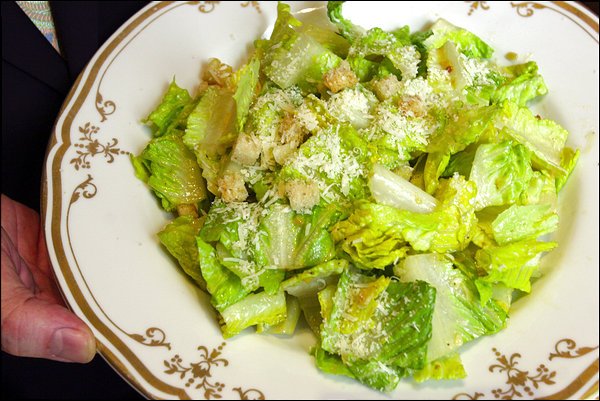
Note to the caption: .FD-CAESAR Date: 03-23-06 Photographer: Susan Biddle/TWP Neg#178645 Location: Washington, DC Summary: Caesar salad as prepared at the Willard Room in Willard Hotel by Willard Room Director Francisco Nieto. The completed salad. StaffPhoto imported to Merlin on Thu Mar 23 20:44:02 2006 Photo Credit: Twp Photo

The Salad That Conquered the Country


Wednesday, March 29, 2006; F01

America cannot get enough of the Caesar salad. In the last two decades, the simple combination of romaine lettuce, creamy dressing and Parmesan cheese has:

· Become America's most popular main-dish salad, showing up virtually everywhere from fast-food chains to white-tablecloth restaurants to the takeout counter in the supermarket.

· Dramatically altered the lettuce industry as the demand for romaine has skyrocketed.

· Turned the chicken-topped Caesar into the chicken item most frequently found on restaurant menus -- more often than wings or even that perennial kid favorite, chicken fingers.

And still we want more.

Three-fourths of all full-service restaurants now offer a Caesar salad, compared with 57 percent just a year ago, according to a new survey of the country's top 500 restaurants by market research firm Technomic.

Dole Foods, which introduced the bagged Caesar salad kit 12 years ago, says sales of its classic Caesar kit continue to grow each year, despite competition from other companies and Dole's own eight other bagged salad kits. "Americans just don't get tired of that flavor," says Eric Schwartz, president of Dole's fresh vegetable division.

Although the Caesar may seem like the all-American salad, it actually was invented in 1924 by an Italian immigrant in Mexico.

Caesar Cardini, owner of a popular Tijuana restaurant, concocted the salad one night for some late-partying Hollywood guests, most food historians agree. He used romaine, then considered an uncommon delicacy, and just six ingredients to make a creamy dressing: garlic, olive oil, lemon, egg, Worcestershire sauce and Parmesan cheese.

The salad was prepared tableside, and posh restaurants in Los Angeles soon began offering it as well.

"The ingredients today don't impress us, but back then they were much more expensive and difficult to find. The Caesar, when it was first introduced, was considered exotic," says Vogue magazine food critic and author Jeffrey Steingarten.

As ingredients like olive oil and Parmesan cheese became more common, however, the Caesar made the jump from upper-class rarity to mass-culture staple.

Demand for the salad grew and the effect began to be felt in the lettuce industry. Over the past 15 years, romaine has gone from a tiny portion of the nation's lettuce crop to one of the fastest-growing vegetables to be produced, consumed and exported, according to the U.S. Department of Agriculture's Economic Research Service.

Romaine production has soared so dramatically that in 2002, for the first time, the USDA's agricultural census gave romaine its own category. According to the government's figures, California, the country's largest lettuce producer, grew romaine on 15,500 acres in 1992. By 2004, that had quadrupled to 64,000 acres.

The Caesar also has proved a boon to the poultry industry, thanks to the idea of topping the salad with strips of chicken to turn it into an entree.

A 2003 survey of about 1,400 restaurants conducted for the National Chicken Council found that the chicken Caesar was on 66 percent of restaurant menus; chicken fingers showed up on 50 percent. "We were surprised. We thought wings or tenders would be higher [than the Caesar]. But I guess it's the universal chicken dish," says council spokesman Richard Lobb.

The popularity of the Caesar, particularly as an entree salad topped with chicken, beef or fish, is expected to keep on growing.

The National Restaurant Association's 2005 restaurant industry forecast showed entree-salad orders registering the largest increase of all menu items at both full-service and quick-service restaurants. Nearly 80 percent of quick-service places reported that customers are ordering entree salads, such as the Caesar, more often.

And it's not popular only in the United States. When Didier Armand, chef at the Paris La Defense hotel, was named Renaissance Hotels' chef of the year in 2005, he noted at a luncheon that no matter what he put on the hotel's lunch menu, "the chicken Caesar always outsells everything."

Who says it's only for rabbits?

Consumption of all lettuce varieties has been increasing since 1960. Iceberg remains the most popular, but we're eating less of it and more of romaine. In 1985, per capita consumption of romaine was less than one pound. By 2004, that had increased to 8.1 pounds, nearly doubling between 2001 and 2004, due in part to the increased popularity of the Caesar salad.

(Source: USDA Economic Research Service)

Get dressed

Although ranch dressing is the most popular at home, Caesar is the dressing most likely to appear on restaurant menus.

(Source: Mintel menu monitor base, 2005)

By calories and pounds

It may be a salad, but it's not necessarily low-calorie. Some examples, with dressing: A nine-ounce chicken Caesar from Au Bon Pain is 920 calories (60 grams of fat); a 14-ounce salad from Panera is 560 calories (34 grams fat); and an 11-ounce salad from McDonald's is 470 calories (25 grams fat).

For its 861 hotels in North America that serve Caesar salads, Marriott International in 2005 bought nearly 2 million pounds of romaine lettuce.

(Source: Restaurant Web sites; Marriott International)

link to the original posting

Monday, March 27, 2006

Writer, Edit Thyself (By Jen Weiss, Mediabistro.com)


How can a writer and editor edit her own writing? A book editor and freelance writer gives tips on how she does it.

– February 11, 2004

Editors don't often call themselves writers, and vice versa, because writing and editing are two largely different skill sets that don't always live under the same roof. So where does that leave writers who want to edit their own work a bit, people who prefer to polish their drafts before turning them in? It's possible to edit yourself, but it's not always easy: Editing one's own writing requires the ability to chisel away at work one created and labored over.

Editing yourself—forgive the metaphor—is like making a good split-pea soup. You've got to skim away the yummy chunks, the tasty herbs, all those great ideas you threw in at the get-go—and then blend, blend, skim, and blend, for that nice, smooth finished product. You're sad to do it, because you chose all those good ingredients in the first place, but you also remember that when the finished, blended soup is good, it's really good. Well-edited writing, similarly, is beautiful, and it's worth it to make that first, painful, editing pass on your own.

Good self-editing can start even before the writing does, with good outlines. Many of us writers put together some sort of outline before plunging into writing a piece. But how many of us stick to it? I tend to create an outline and revise it to death—at which point I just write my piece. Perhaps I'm using outlining as a way to procrastinate, but I prefer to think of it as laying a strong framework and base for my piece. Sometimes whatever I end up writing is only inspired by my original outline, containing a hint of the outline that gave birth to it. This risky endeavor sometimes leads to greatness, a piece stronger than I could ever have imagined in the 20th draft of outlining. But usually what I get is a mess of writing that needs a lot of polish before it'll be understood by anyone other than me. But when I actually use my outline as a roadmap, following it point-by-point through the piece, I tend to end up with work that is near-final, needing only minor tweaking and no major structural changes. And this is always helpful when working on a tight deadline. Pre-editing—and sticking to that pre-edit—works.

Once you've cracked into the piece, you might feel compelled to edit as you go. I've heard some writers talk about how they spend lots of time on each sentence, rolling it over and over on their tongues before moving on, making sure everything about it, and about the way it links to the next, is perfect before moving on. For writers who work that way, it often means that once they finish writing, they're finished. Having actively and aggressively edited as they worked, they tend to be quite happy with the end product. But, on the other hand, it's taken them a lot longer to get there, and it's a disaster if you find you're not happy with the end product after all the work you've put in. It's also tough to do this. Those who can edit as they work have a rare talent; they can instantly step back from writing they're extremely close to and look at it from an objective standpoint. I prefer to spew a whole bunch of thoughts onto a page in some sort of order, and then sculpt my creation—but if you can edit on the spot, go for it. Though it might be time-consuming, it usually means less work for you in the end.

Though I can't edit as I go, when writing articles, I do always think about a question often posed by a favorite professor of mine in college: “So what?” It's a simple question, but oh-so-helpful when trying to make a point in writing—and trying to make that point clearly. The technique for applying it is simple: as you work your way through each paragraph, ask yourself what your point is. Become a pain in your own butt about it. You might find yourself a tad cranky and annoyed after going through this exercise, but I promise it'll lead to a stronger piece than you would have written had you not asked the question.

You might also try mapping your writing, especially if you didn't stick to your original outline. I do this when editing other people's writing, and sometimes I'll do it with my own. It helps me figure out the shape of the piece, what should stay and what should go. Basically what you're doing is outlining in reverse; examining your piece and plotting out the shape it's taken, paragraph by paragraph. When I'm looking at just the skeleton of the piece I've written, it's much easier for me to see what belongs and what doesn't than when I'm reading and re-reading the entire piece.

Once you've finished writing, try putting it away for a while. A day, a week—however long it'll take you to nearly forget about it. Most writers I know agree that this is the only way they're able to hack into their writing effectively. This sort of skill is especially handy when you need to somehow hack your 5,000-word masterpiece down to the 2,500 words you've been assigned. You'll have to be able to look at your own writing—your baby—objectively to do it. Revise those metaphors you thought were beautiful when you wrote them but don't mean a darned thing, lose paragraphs that you felt at the time were essential to your line of reasoning but aren't in the least. I can't possibly lose chunks of my writing immediately after finishing; I'm too close to it. If I thought anything I wrote wasn't important, why did I write it? But once I've put it away for a while, and perhaps have started writing something else, it's much easier to get in there. Of course, this takes some advance planning. If you're working against a tight deadline, you might not be able to afford more time away than a bathroom break. But, even so, a bathroom break is worth it. Pause for any amount of time you can take.

And what about doing those 2,500 words of cuts? How to even get started on that? A good place: Take a second look at your original first few paragraphs (or more, depending on how long the piece is), and see if they're necessary. I've seen countless cases of writers taking a long time to get to their point. There's nothing wrong with a nice, entertaining lede, but hooking your reader is key—and a long way to get to your point might cause your reader to lose interest. Try cutting the first paragraph or two, and see what you've got. You might be surprised to find a new, snappier introduction to your piece.

And also be sure to focus on the finale. Ask yourself whether the conclusion satisfies the needs of the rest of the piece and if it will satisfy the reader. There are few things more irritating than too abrupt an ending, or one that doesn't seem to finish a piece at all. Your aim, when crafting the conclusion, is to close up the piece—or, if you plan on writing a sequel, closing up what you've written and leaving a few question for the reader that will pleasantly linger in his/her head. So before you turn your piece in to your editor, make sure you've got this nailed. You'll probably have to nail it sooner or later—few editors will let a weak ending get by.

By doing all this editorial work before your piece goes to Editorial—if you can do it well—not only will you ensure that your piece looks in print much as it did when you turned it in, but you should get more work. Because the cleaner a piece comes in, the less work an editor needs to do on it. And this makes a happy editor—who'll want to keep you on board.

Jen Weiss is a freelance writer and children's book editor in New York.

Wednesday, March 22, 2006

Dancing to the rhythms of a violent history (by Amanda Hopkinson, the Independent)


The Tango Singer, by Tomas Eloy Martinez trans Anne McLean


Published: 10 February 2006

Madonna performed it in Evita. Sally Potter directed it in The Tango Lesson. Hundreds, mainly women of uncertain age, dance it across British cities. And the Argentines, who claim to have choreographed it - although the roots lie in the male partnerships of Cuban sailors improvising on the rhythms of the habañera - have written about it. Even Borges's brief "History of the Tango" opens by paying homage to the many histories that precede his. And British visitors to La Boca (the port where tango emerged) write glamorous accounts of their encounters.

Tomas Eloy Martinez takes a less glamorous approach. The novelist is interested in tango's myth and mystique, related through the lyrics rather than the movements of this lament that balances on a knife-edge between consummate control and intense passion. As with The Peron Novel and Santa Evita, The Tango Singer is about the Buenos Aires of his youth, before a right-wing bomb ousted Martinez from his newspaper and brought exile in the US.

The eponymous singer is Julio Martel, discovered by a North American PhD student during a chance conversation with the cultural historian Jean Franco. Again, this mingling of actual and fictitious protagonists belongs to a Latin American genre of "meta-historical fiction".

Bruno Cadogan's quest for Martel leads him to Buenos Aires, where he is led to the house that was the original site of Borges' kabbalistic tale, "The Aleph". From there he pursues Martel across the city, attempting to divine the connections between the odd occasions when the crippled singer makes erratic appearances and sings in a strange voice between a tenor and a falsetto. Martel refused to record: the only way to hear him is to see him, although an early fairground recording precipitates a national furore.

Martel's repertoire includes laments from the earliest and lewdest period of immigration to the city, in the late 19th century. But the year now is 2001, when the Argentine economy collapsed. Graphic descriptions abound of a city under siege by the migratory poor, camped on the streets, desperately attempting to find food or beg a living - a city of ragged shadows and bonfires on corners, of a political structure in crisis. The city that Martel maps out for Cadogan is an even bleaker one, superimposed on an even blacker past. It is this recent history that Cadogan explores through a variety of subplots.

The Tango Singer delivers on every Buenos Aires myth, but goes well beyond the familiar. This is the city in which ghostly legends - Peron, Evita, Borges, Gardel - haunt everyday reality. It is also where the secrets of a recent past cannot be contained. The legend of the charismatic singer "with sunshine in his throat", vocalising the "long roll of thunder" unleashed under Peronism and military dictatorship, gives a sharper, more urgent voice to the tango. From being merely a sexy and exportable dance craze, it translates as the popular history of a nation in violent change.

Amanda Hopkinson is director of the British Centre for Literary Translation at UEA

link to the original posting

Monday, March 06, 2006

'Crash' is a stunner (By John Horn and Susan King, the Los Angeles Times)


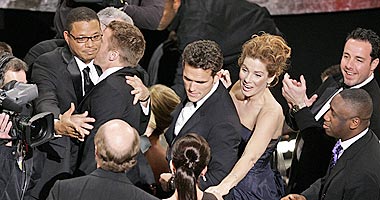
Note to the image: The cast of "Crash," including Sandra Bullock, right, Matt Dillon, second from right, and Terrence Howard, left, celebrate the film's best picture win.
(Timothy A. Clary / Getty Images)


Note to the image:
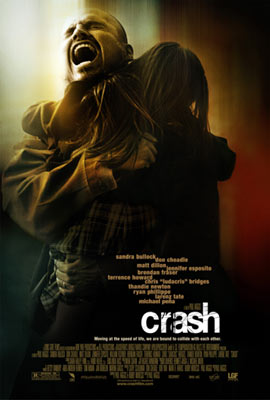
Lions Gate Films' Crash - 2005


Racial drama pulls off best picture upset; Ang Lee grabs director honors for 'Brokeback.'


March 5, 2006

It split audiences, divided critics and even left its own producers warring. But "Crash" ultimately unified the one constituency that matters most in Hollywood: Academy Award voters.

In one of the biggest upsets in recent Academy Award history, "Crash" defeated "Brokeback Mountain" for the best picture Oscar on Sunday, also winning in the categories of best original screenplay and editing.

Though the provocative ensemble drama about race relations in Los Angeles dealt a blow to the heavily favored "Brokeback Mountain," the ascension of "Crash" symbolized not only the rise of independently financed movies but also this award season's emphasis on personal stories about divisive social issues.

"What an amazing night!" one of "Crash's" two credited producers, Cathy Schulman, said after the film's win was greeted by astonishment and applause inside the Kodak Theatre. Addressing her fellow best picture nominees, she said: "You have made this year one of the most breathtaking and stunning maverick years in American cinema."

"Brokeback Mountain," which had cleaned up at awards shows leading up to the 78th annual Oscars and was among the year's best-reviewed films, did win an Oscar for Ang Lee, the first non-white director to win the industry's top filmmaking prize. The controversial movie about cowboys in love also won trophies for adapted screenplay and score.

In upsetting "Brokeback Mountain" for best picture, "Crash" delivered as big a shock as when "Shakespeare in Love" toppled "Saving Private Ryan" seven years ago.

In choosing "Crash" over "Brokeback Mountain," the academy was picking between two small movies dealing with prejudice and intolerance. "Crash" isn't playing in theaters anymore, having been released on DVD in September. Not one of this year's best picture nominees has grossed more than $80 million in theaters; only "Brokeback Mountain" has come close.

Even though its win was unexpected, "Crash" represents an Academy Award trend. For the fourth consecutive year, none of the major Hollywood studios could claim credit for making and releasing a best picture winner — a span stretching back to Universal Pictures' "A Beautiful Mind." (Last year's winner, "Million Dollar Baby," was distributed by Warner Bros. but financed by independent Lakeshore Entertainment.)

And unlike past independent best film winners, which were fully financed by specialized companies such as Miramax Films, this year's non-studio films were bankrolled by a patchwork of private investors.

Of the best picture nominees, "Capote," whose Philip Seymour Hoffman took the best actor Oscar, was partially financed by a German investment fund and Canadian tax credits; "Good Night, and Good Luck" attracted deep-pocketed patrons in Dallas Mavericks owner Mark Cuban and EBay co-founder Jeff Skoll; "Brokeback Mountain" was helped to the screen by Bill Pohlad, whose family owns the Minnesota Twins; and "Crash" was bankrolled by a German media fund, the Blockbuster video chain and a bank loan.

Only "Munich" was 100% underwritten by a studio, but had not Steven Spielberg been at the helm it is unlikely that Universal — or any other studio, for that matter — would have backed the production about the aftermath of the massacre at the 1972 Munich Olympics.

Prominent movie critics were sharply split on "Crash's" artistic merits, and audiences fell into two sharply polarized camps: those who loved the $7.5-million film, and those who loathed it. When the film was released in May, it carried the names of six separate producers, but only two — Schulman and the film's co-writer and director, Paul Haggis — were deemed eligible for the best picture trophy.

Financier Bob Yari, the film's first Hollywood supporter and one of the four delisted producers, has sued Schulman and the Academy of Motion Picture Arts and Sciences as part of the credit dispute, and Schulman has sued Yari. Schulman did, however, thank Yari in her acceptance speech.

Yari wasn't invited to the show, and watched the ceremony with colleagues at a Burbank burger joint. He said the controversy over the producing credit tainted his ability to enjoy the Oscars, but that the win gave him hope.

"It almost takes away all the hesitation I have to continue," he said.

Many of the other best picture nominees also split audiences along political, religious and aesthetic lines — and their box office returns suffered as a result. Eric Bana, who starred in "Munich" and was a presenter Sunday night, said the Oscars helped draw attention to movies some ticket buyers dismissed out of hand.

"There were a few films this year where people made up their minds without actually seeing the films or knowing much about them," Bana said as he entered the Kodak Theatre.

The ceremony's first award — a best supporting actor win for George Clooney in "Syriana" — was indicative of the evening's slate of nominees. Released by Warner Bros., the political thriller about oil and terrorism was subsidized by Skoll's Participant Productions; Clooney himself waived his up-front salary in order to get the outspoken movie made.

"This is not an industry that says OK. It has to be about big business and big budgets," Clooney said backstage after his win. "I think the beauty of the academy is that it finds little moments to say, 'Let's talk about these films and let's talk about things that maybe the rest of the mainstream doesn't get a chance to see.' "

Neither "Syriana" nor "The Constant Gardener," a drama about pharmaceutical corruption in Africa that won a best supporting actress Oscar for Rachel Weisz, sold nearly as many tickets as the winner for documentary feature, "March of the Penguins," which grossed $77.4 million.

Actor William H. Macy, whose wife, Felicity Huffman, was nominated for best actress in "Transamerica," said before the ceremony that he was encouraged by the kinds of movies Oscar voters singled out, and that they had performed well relative to their costs.

"The [best picture nominees] this year were not blockbusters but they were movies of depth," Macy said. "These films were successful too, and that's not getting enough attention."

Some Oscar-winning movies that were conceived as fully financed studio films were different animals by the time they hit theaters. "Memoirs of a Geisha," which won Academy Awards for costume design, art direction and cinematography, was developed at Sony Pictures, but the nervous studio sold a hefty share of the film to Spyglass Entertainment.

Even the specialized film companies that distributed four of the five best picture nominees are not immune to the relentless business pressures that make daring filmmaking increasingly difficult. Focus Features, which released "Brokeback Mountain," adheres to a rigid model that balances a film's artistic merit against its foreign sales potential. That formula prevented Focus from making 2004's "Sideways," which went on to be a critical triumph, win the adapted screenplay Oscar and turn into an art house smash, grossing more than $71 million.

The ceremony's honorary Oscar was presented to maverick director Robert Altman, recognizing a filmmaker who often works outside of — and has often expressed his open disdain for — the big studios.

Those studios could take some solace in the three wins collected by "King Kong" and the best actress trophy for Reese Witherspoon of "Walk the Line."

The show was hosted by Jon Stewart of the satirical news program "The Daily Show," the fourth Oscar host in as many years. Ratings for last year's show, for which Chris Rock was host, were down 3% from the previous year, and Oscar organizers worried that television viewership might be down again this year because so few people had seen the five best picture nominees.

But these movies were never intended to be blockbusters. They just had something to say. Noted Yari as he drove away from Mo's Restaurant to celebrate his film's unexpected triumph, "No matter how much we want to believe important messages drive Hollywood decisions, the greatest driver is financial potential."

Times staff writers Robert W. Welkos and Geoff Boucher contributed to this report

link to the original posting

Thursday, March 02, 2006

Can Artists Ever Truly Be Modest? (By Eric Gibson, In Character)


Among the virtues commonly attributed to artists, modesty, it can confidently be said, is not to be found. In their professional capacity, painters and sculptors may be described as “visionary,” “innovative,” and the like. As human beings, however, they are almost always spoken of in pejorative terms. As Rudolf and Margot Wittkower observe in their 1963 book, Born Under Saturn: The Character and Conduct of Artists, “There is an almost unanimous belief among [laymen] that artists are, and always have been, egocentric, temperamental, neurotic, rebellious, unreliable, licentious, extravagant, obsessed by their work, and altogether difficult to live with.”

They might have added “vain.” Through the ages artists have honored modesty more in the breach than the observance. The Wittkowers point to the example of the architect of the Pisa Cathedral, who identified himself as the builder (in a Latin inscription on the wall of the cathedral) in no uncertain terms: “Rainaldo, the skillful workman and master builder, executed this wonderful, costly work, and did so with amazing skill and ingenuity.”

Peter Paul Rubens, though widely considered one of the few true gentlemen in the history of art, was not immune to displays of ego. Like all artists-in-training until the twentieth century, he served his apprenticeship by copying the masters. But instead of striving to create a meticulous reproduction, Rubens would sometimes go one better, by taking it on himself to improve on the work of an artistic forebear.


This became clear in a superb exhibition in 2005 of Rubens drawings at the Metropolitan Museum of Art in New York. The show included Rubens’s 1601 copy of Michelangelo’s Libyan Sibyl on the ceiling of the Sistine Chapel – that famously muscled woman seen with her back exposed to us as she turns to lift a large book off a shelf in the background. Most young artists – Rubens was in his early thirties – would have been properly cowed by the prospect of matching their skills against so august a personage, and may have dared no more than a respectable line-for-line facsimile. Not Rubens. He adjusts the Sibyl’s pose, making her lean forward more and giving a more pronounced tilt to her head.

Minor details perhaps. But those two small changes transform the image. In Michelangelo’s painting, the Sibyl seems lost in reverie, somewhat absent-mindedly picking up her heavy tome. Rubens’s adjustments sharpen and clarify the action. In his hands the Sibyl becomes charged with greater energy, more mentally and physically engaged in her task.

Contemporary painter Julian Schnabel, one of the Young Turks who helped define the 1980s art scene in New York, once blithely told an interviewer that he believed his peers to be “Duccio, Giotto, and van Gogh.” The jury is still out on that one.

Perhaps we should not be surprised by such displays of immodesty. Artists are in the business of drawing attention to themselves. Their work is intended for public exhibition; they record their likenesses for posterity – sometimes, like Rembrandt, van Gogh, and Picasso, many times over. And, lest we confuse their achievements with someone else’s, they affix their names to their work, always prominently, occasionally ostentatiously. In “The Arnolfini Wedding,” for example, an interior scene of a couple holding hands, the artist’s signature on the rear wall is in script so large and florid that it threatens to upstage the actors in the scene: “Jan van Eyck was here, 1434.”

A robust ego is necessary to a successful artist. Until the end of the Middle Ages, artists belonged to guilds, or unions. In the social pecking order, they were simple laborers, no different from bricklayers, carpenters, and silversmiths, generally guaranteed steady work. This changed during the Renaissance when society began to recognize artists as creative individuals in their own right. This new status brought with it a new set of challenges that had to be overcome if they were to be able to earn a living. It fell to artists to secure commissions and sell their work, cultivating patrons in the church and aristocracy and, after the nineteenth century, among private individuals, corporations, and governments.

The onset of the modern era created new difficulties, as art’s forms and subjects ceased to be grounded in ideas and values common to society at large and instead were invented by the artist to express subjective values. The artist now faced the more difficult task of persuading an often hostile and uncomprehending public of the seriousness and merit of his work. Finally, of course, there is the challenge faced by the artist since the beginning of time, of giving visible form to the elusive mental image. Small wonder that success, when it comes, occasions Rainaldo-like displays of self-praise.

But if artists tend not to be modest in the conventional sense – in their day-to-day relations with other human beings – it does not mean that we cannot speak of them as modest in some respects. Artists lead two lives, one outside the studio, and one in it. And it is in the life within what one writer describes as “imagination’s chamber” – with the blank canvas, the bucket of cold clay, or the virgin block of stone – that ego falls away.

Consider Michelangelo. The great sculptor, painter, architect, and poet was not a man unduly afflicted with modesty. He claimed he was self-taught and in debt to no one for his magnificent skills. So upset was he when, in 1550, Giorgio Vasari wrote in The Lives of the Artists that the young Michelangelo had served as an apprentice to a pupil of Donatello’s as well as to the painter Domenico Ghirlandaio, that he published a ghostwritten autobiography restating the Virgin-birth theory of his artistic development.

Nonetheless, his Pietà reveals a somewhat different attitude to self. Michelangelo carved the statue, a life-size sculpture of the Virgin Mary holding the dead Christ across her lap, in 1499. It won instant acclaim when it was unveiled in St. Peter’s Basilica the following year. Over the centuries, of course, it has established itself as one of the preeminent artworks of all time.

But the artist himself wasn’t so sure of its worth. On the band that runs diagonally across the Virgin’s robed torso, where it could not be missed, he chiseled the words: “Michael Angelus Bonarotus Florent Facieba” (Michelangeo Buonarroti of Florence Created This). As James Hall tells us in his recent book, Michelangelo and the Reinvention of the Human Body, the inscription is grammatically incorrect, but intentionally so. “The incomplete ‘facieba[t]’ writes Mr. Hall, “was a revival of an ancient method of signing artworks. By saying that the artist ‘was making,’ rather than ‘made’ the artwork, it suggested he had stopped before the work was finished. This demonstrated the humility of the artist (‘my work is imperfect and so it cannot be regarded as finished’) as well as the enormity of the task.”

Such forthright public acknowledgment by an artist of his limitations is the exception rather than the rule, however. Normally such knowledge comes to us indirectly, through biographers, memoirists, intimates, and other privileged witnesses to the creative process, and even then only in passing, in a sentence or two snatched from a letter or conversation. Thus we know from a late letter to the symbolist painter Emile Bernard that Cézanne considered himself merely “the primitive of the way which I’ve discovered”; we learn from a comment made to amanuensis Hélène Parmelin that Picasso equated painting with “death in the [bull] ring”; from biographer Hilary Spurling we find that Matisse regarded the act of painting as “a rape,” and, from a poem Michelangelo wrote while working on the ceiling of the Sistine Chapel, we find this thought: “I am not ... a painter.”

A slender volume published forty years ago by the Museum of Modern Art gives us an in-depth look at an artist’s modesty. In A Giacometti Portrait, a diary kept by American expatriate James Lord, the author’s own observations are combined with direct quotes from Giacometti himself, making this the nearest thing we have to a first-person account by an artist about his work.

Giacometti had originally planned “a quick portrait sketch” of Lord, the work of an afternoon. But the project lasted almost three weeks. At the time Giacometti was in his mid-sixties. Renowned the world over for his sculpted and painted portraits, he was eagerly sought out by collectors, the media, and hangers-on. Major museums around the world displayed his work. In spite of all this, his worldly station was the last thing on his mind when it came to the task of creating. Throughout Lord’s book, Giacometti is depicted as invariably unhappy with what he has done, feeling that his work is falling short – almost as a matter of destiny – of what he wants it to be. A passage from his first session with Lord sets the tone:


A number of times he remarked that he was hungry, as he hadn’t had anything but coffee since getting up several hours before. Again I suggested that we stop, but he refused.


“We can’t stop now. I thought I’d stop when it was going well. But now it’s going very badly. It’s too late. We can’t stop now.”


Finally, though, he admitted that he was tired. His back ached. He had been working then for a little more than two hours. “That’s enough,” he said. Taking the canvas from the easel, he placed it at the back of the studio .... After studying the picture for several minutes, he said, “The head isn’t too bad. It has volume. This is a beginning, at least.”


“A beginning?” I asked. “But I thought we were going to work only once.’”


“It’s too late for that now,” he said. “It’s gone too far and at the same time not far enough. We can’t stop now .... If only I could accomplish something in drawing or painting or sculpture, it wouldn’t be so bad. If I could just do a head, one head, just once, then maybe I’d have a chance of doing the rest, a landscape, a still life. But it’s impossible.”


I argued that what seemed impossible to him might seem to other people not only to have been possible – since, after all, it had been done – but fine and satisfying as well. That, however, was no consolation to him. The opinions of other people concerning his work, though of interest to him, are naturally unrelated to his own feelings.


“It’s impossible to paint a portrait,” he said.


Giacometti’s remark, “But it’s going very badly .... We can’t stop now,” hints at a deeper dimension of artistic modesty than simple humility before the task at hand. It’s not uncommon for artists, once at work, to unquestioningly follow in whatever direction their art may lead them, however mysterious or absurd, and no matter what price they have to pay in terms of public acceptance or material well-being. This posture of self-abnegation and suppression of the ego is a unique expression of modesty. Once again, the example of Giacometti is instructive.

Giacometti had begun his career as a surrealist. Starting in the mid-1920s, he made quasi-abstract, erotically charged figures and objects whose forms were drawn entirely from his imagination and dreams. He made a respectable living and a considerable reputation with these sculptures. Then, in the mid-1930s, believing such works were becoming glib and superficial, he began working from nature, primarily from live models. He was after something more elusive than a faithful record of a person’s physical attributes. He wanted to explore how we see and understand reality – reality in this case being defined as the appearance of a person within his spatial environment in a moment of perception.

It should have been a simple matter. After all, artists had been working from nature for millennia. Indeed, so fundamental was the idea of “I paint what I see” that, in art circles in Paris in the 1930s, it was deemed passé. As a result, the art world regarded Giacometti (as they did Matisse) as a burned-out case at best and at worst a traitor, someone who had turned his back on the ideals of advanced art in favor of the comforting certainties of conventional representation. Photography, the argument went, had eliminated the need to replicate nature, so the artist was now free to articulate deeper levels of reality through his own invented language of forms. Indeed, if he was to be considered truly “modern,” he was required to. To do otherwise was to be a bourgeois reactionary.

Giacometti’s challenge to this idea would ultimately yield the tall, slender, scabrous bronze figures for which he is primarily known today. Not surprisingly, the process of their creation was fraught with difficulty. It wasn’t just that the form itself was hard to bring forth, it was that he quickly lost control of the process. Then he resorted to the paradoxical strategy of surrendering himself completely to the work in an attempt to regain control over it and bring it to fruition. Art, not the artist, was to be the master.

In the biography he published twenty years after A Giacometti Portrait, James Lord vividly describes the quandary Giacometti now found himself in:


Working directly in plaster [Giacometti] started with a figure about eighteen inches high, representing a nude woman standing with her arms at her sides. As he worked, he found to his amazement, and to his consternation, that the sculpture grew smaller and smaller. The smaller it grew, the more troubled he became; yet he could not keep it from shrinking. The sculpture itself seemed to have determined in advance its appropriate size, would accept no other, and compelled the sculptor to comply .... Bewildered, alarmed, he began again with a figure the same size as the first. Again it shrank while he worked on it, growing smaller and smaller despite his reluctance and distaste, finally ending as tiny as the first. Again he began. Again the outcome was the same .... Sometimes the figure grew so minuscule that the last touch of the sculptor’s knife would send it crumbling into dust.


With the outbreak of the Second World War and the occupation of Paris, Giacometti moved to Geneva, living in a hotel. There he continued his quest, with similarly frustrating results. Lord observed, “Change of scene had not changed the sculptor’s predicament. His figures kept on shrinking.”

A measure of what this cost Giacometti personally, and of his determination to press on regardless, can be seen from an incident that took place before his flight to Geneva. In 1939, his brother Bruno, an architect, had secured an invitation for Alberto, whose career was now in a rut, to show one of his sculptures at an outdoor trade fair in Zurich. Lord describes what happened next:


The artist arrived in Zurich well in advance of the opening of the exhibition. A man in charge of installations told him that a truck was ready to go to the railway station to fetch his sculpture. Alberto said, “There’s no need. I have it with me.” From one of his pockets he produced a largish matchbox and took from it a tiny plaster figurine not more than two inches high. The architects, including Bruno, were surprised – unpleasantly. They argued that a sculpture so small on a large pedestal in the center of a large courtyard made no sense visually, since it would be virtually invisible .... Alberto insisted that the sculpture should remain. The architects insisted that it must not .... The architects had their way.


Yet Giacometti persisted. It was not until the war ended and he returned to Paris that the importance of this work was recognized. In the meantime, in Geneva, he continued working in the face of a greater humiliation than that which he had experienced in Zurich, greater because it was intensely personal and ongoing.

With no work to sell and no other means of support, Giacometti had to turn to his mother Annetta for money – a man in early middle age dependent on his aged mother for support. Annetta didn’t make it easy for him. She considered her son self-indulgent and adrift, and she registered her disapproval of his choice not by withholding money, but by a more psychologically potent method – rationing. As Lord describes it, she “gave only a little at a time, compelling him constantly to appeal for more, to acknowledge his dependence while at the same time asserting his will, but showing his gratitude and even, perhaps, in the labyrinthine tangle of contradictory emotions, making a kind of tacit admission that she was right because he could not do without her.” Giacometti surely had not envisioned this future for his art, yet when it presented itself he surrendered to it, sacrificing everything, including his own ego, on the altar of his creative impulse.

A skeptic might argue that artists’ modesty before the task of making art is no more than garden-variety anxiety, the same faced by people in other walks of life – athletes, actors, film directors, writers – who have to produce a succession of one-of-a-kind creations or performances. Their predicament is summed up by the phrase, “You’re only as good as your last [insert name of endeavor here].”

This may be true, but it only takes us so far. In fact, the modesty that artists display about their work derives from something deeper and more powerful, from what T.S. Eliot, in his celebrated essay “Tradition and the Individual Talent,” called “the historical sense.” Eliot defined this as “a perception, not only of the pastness of the past but of its presence.” Eliot was speaking of poets, but his words apply equally to artists: “The historical sense compels a man to write not merely with his own generation in his bones but with a feeling that the whole of the literature of Europe from Homer and within it the whole of literature of his own country has a simultaneous existence and composes a simultaneous order.”

It is here, in relation to the past and their sense of their place in the history of art, that artists exhibit modesty in the truest sense of the term. It’s not uncommon to see, on an artist’s studio wall, a small gallery of reproductions of favorite works of art. One might expect these galleries to be exact mirrors of the artist’s own aesthetic sense – that an abstract painter would have only reproductions of works by Mondrian, Malevich, Pollock and others on his wall. On the contrary, not only are they always startlingly eclectic in terms of style, period, date, and civilization, but they often contain examples of the very type of art the artist has repudiated in his own work – a narrative painting on a biblical subject by an Old Master in the studio of a contemporary abstract painter, for example.

These aren’t just souvenirs or decorations; they’re a pantheon, a partial catalogue of the artists and objects he admires and against which he wants his work to measure up. The rest of the catalogue might be in the artist’s head, in his library, and, if he is fortunate, on the walls of his home. “No poet, no artist of any art, has his complete meaning alone,” writes Eliot. “His significance, his appreciation is the appreciation of his relation to the dead poets and artists. You cannot value him alone; you must set him, for contrast and comparison, among the dead.”

Artists know this instinctively. Because art history tends to dwell on the influence older artists have on younger ones in the early stages of their development, we assume that once an artist has reached maturity – formulated a distinctive personal style, in other words – the art of the past ceases to be an important consideration. In fact, artists are engaged in a constant dialogue with the past. It is the only standard that really matters to them. This is the point of James Lord’s observation: “The opinions of other people concerning his work, though of interest to him, are naturally unrelated to his own feelings.”

The British sculptor Henry Moore was both a prolific draftsman and a student of drawing. Among other artists, he cited Seurat as an important influence on his work in two dimensions. Among the books Moore owned was Otto Benesch’s six-volume catalog of Rembrandt’s drawings, published in the 1950s. According to the detailed inventory of his library published by the Henry Moore Foundation in the 1990s, Moore lavished a good deal of attention on this set, signing his full name (something he rarely did), inserting page-markers and – most significant of all – inserting six of his own drawings into the volumes. Alas, we don’t know which drawings he chose to insert, nor where. But we can be fairly certain that the purpose was to have a conversation with a revered predecessor, juxtaposing examples of his work against Rembrandt reproductions and comparing the two.

Perhaps the most vivid and moving example of an artist’s “historical sense” comes from an unlikely source: Pablo Picasso. Picasso was famously arrogant and egotistical in his dealings with fellow artists, never missing an opportunity to deliver a backhanded compliment or, more often, an out-and-out putdown – anything, that is, to make certain other artists understood who was superior.

But in his relation to the past there was a lingering anxiety that played itself out in an incident recorded by Pierre Cabanne, one of Picasso’s many biographers. In the early 1950s Picasso gave a number of paintings to Paris’s Musée National d’Art Moderne (now part of the Pompidou Center). He asked if they could be placed next to some of the Louvre’s masterpieces. No other artist would be allowed such a privilege (and few would dare request it). But Picasso being Picasso, he got his wish:


Pablo got there with Françoise [Gilot, his common-law wife] at 11:00 a.m., an unusually early hour for him. [Museum official Georges] Salles tells of taking him to where his paintings were and how the guards then carried them down to the various halls. “Put them near some Zurburans,” said Picasso, in a voice trembling with emotion. Several were set up near St. Bonaventure on His Bier, one of the Spanish golden-century works that meant most to Don Pablo. Nearby were the Velázquezes, the Murillos, the Goyas. He looked them all over, silently, while those present tried to divine the reaction in his intensely impressive eyes. Finally, in a quiet, as if pacified voice, he said, “See, they’re the same thing.” And repeated, “The very same thing.”


For Picasso, the past was the only altar before which he would bow in humility.

“The rich are different,” goes the saying. So are artists. On the surface they may swagger and show off. But in their innermost selves, perhaps buried in some part of their DNA, is a deeply felt modesty that informs their work. Would that we could say the same about the rest of society.

.....

Eric Gibson is the Leisure & Arts Features Editor of The Wall Street Journal.
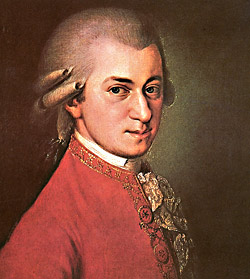
Brokeback Spoofs: Tough Guys Unmasked(By Virginia Heffernan, the New York Times)

This summary is not available. Please click here to view the post.