Wednesday, February 15, 2006

Reconstructing Woody (By Peter Biskind, Vanity Fair)


Note to the caption: Premiere: Woody Allen at the New York premiere of Dreamworks' Hollywood Ending - 4/23/2002 Photo: Kevin Mazur/Wireimage.com
link to the image source


Through scandal, legal battles, and critical censure, Woody Allen keeps adding to an extraordinary film legacy. In his first exhaustive interview in years, Allen talks about his love life, chasing the money to London while protecting his independence, and Match Point, the movie that has brought both box-office redemption and an Oscar nomination (from V.F., December 2005)


It's been a long time since Alvy Singer wooed Annie Hall: on December 1, Woody Allen will be 70. But while that may make his boomer audience feel old, he himself isn't giving much ground to the Grim Reaper. You can still set your watch by his production schedule: almost every year for nearly four decades he has written and directed a new picture—the Joyce Carol Oates of the movies—and this year has been no different. He is set to release his latest in December, the excellent Match Point, a moral thriller, featuring Scarlett Johansson, Emily Mortimer, and Jonathan Rhys-Meyers, which he shot in London during the summer of 2004.


And on a dull August morning in 2005, he is in London again, on Craven Terrace in Bayswater, reshooting a scene from Scoop, his 36th feature as a writer-director, which will be released sometime next year. It's a newspaper comedy, also starring Johansson, along with Hugh Jackman, Ian McShane, of Deadwood fame, and Allen himself. (He won't divulge the plot, but says it's not based on the Evelyn Waugh novel of the same name.) The scene in question, first attempted some days earlier, was marred by a sentence of dialogue Allen doesn't like, and so the crew has returned to the street for another try. It's an extended walking-talking shot in which Allen is caught in animated conversation with Johansson, who is wearing an open white shirt over a gray tank top. The scene ends up inside a launderette. Switching back to director mode, Allen says "Cut!" and then, "Good take, but the mike popped out of her cleavage, so we didn't get sound. We have to do it again."


Dressed down and wearing spectacles, Johansson looks like an altogether different person from the bombshell she plays in Match Point. At the end of their second collaboration, she and Allen have achieved an easy camaraderie. Full of energy, she bounces up and down in front of him. He steps backward in mock alarm, muttering, "Watch it—I'm fragile." She even has an array of affectionate nicknames for him, variations on "Woody," like "Woodrow," and "Woodness." Despite his attempts to make her look like a normal human being, she radiates beauty and youth. Under a slate sky, her blond hair fairly shimmers and throbs; she looks like a visitor from another, better world, plopped down into this drab London neighborhood populated mostly by Middle Eastern immigrants. Allen blends into the street scene rather more easily, but that doesn't stop a considerable number of locals from recognizing him. They flock around him, requesting autographs and photo ops, which he grants with considerable grace. It is clear his appeal extends well beyond the borders of Manhattan, famously his natural habitat.


There are financial reasons this quintessential New York filmmaker has been shooting in London, but the move also feels karmically apt, a kind of symbolic exile. His American audience has dwindled over the last decade, the Hollywood studios that once treated him like a prince have turned cold, and even New York film critics, heretofore his staunchest allies—the hometown fans—seem to greet each new picture with a collective yawn. It's as if this filmmaker, who in the 1970s and 80s and well into the 90s seemed to connect effortlessly with an influential if rarefied slice of urban America, has slid into irrelevancy.


All of this was dramatized in an extraordinary and venomous front-page piece printed three years ago by The New York Times. The paper's culture pages had once functioned as a virtual Allen house organ, but on June 5, 2002, under the headline "Curse of the Jaded Audience: Woody Allen, in Art and Life," two Times reporters with no particular expertise in film drew readers' attention to the fact that "a grand total of eight people showed up yesterday for the matinee of Woody Allen's latest movie, 'Hollywood Ending,' one month out of the box and now playing in exactly one theater in Manhattan, a $4.95-a-ticket discount house in Times Square." The ostensible occasion for the piece was a lawsuit Allen had filed against his former longtime friend and producer, Jean Doumanian, for an alleged $12 million owed him. But the article's prominence and snarky, gloves-off tone seemed to suggest a larger agenda: to take Allen down. The reporters quoted the opinions of various courthouse hangers-on—"His sense of humor is sort of frozen in the 70's. He appeals to an older crowd"—and even made fun of his physical infirmities. They concluded that "for Mr. Allen … after more than 30 years as the on-screen embodiment of angst-ridden, urbane New York, his long moment as cultural icon may be over." Within Manhattan's hothouse film and media circles—the world which Allen both lives in and often skewers in his films—this was the equivalent of a stoning in the public square.


Allen has become an artist without honor in his own country—not, unfortunately, an anomalous situation. Many of his heroes have shared this fate. Akira Kurosawa found it nearly impossible to obtain Japanese financing in the twilight of his career; feeling himself shabbily treated by the Swedish government for a few years in the 1970s, Ingmar Bergman refused to make pictures in his homeland; and in two of the most egregious American examples, Charlie Chaplin found it expedient to leave the country altogether in the early 1950s, one step ahead of Red-hunting squads baying at his heels, while Orson Welles in his later years was reduced to shilling for Gallo wine. Still, one would hope that in most countries a national treasure like Allen, especially one who toils in a profession wherein selling or burning out is an all too common occupational hazard, would be showered with distinctions, lionized, and fêted.


After all, Allen's body of work is without precedent in quality and quantity, not measured against just other American filmmakers but worldwide. At the risk of hyperbole, or of sounding like a lunatic, it could be said that there is no such thing as a bad Woody Allen film—weaker ones, certainly, pictures that do not work consistently from beginning to end, comedies that aren't quite funny enough, dramas that are solemn and lugubrious, but never a stupid picture, one that is begging to be walked out on. Even his aesthetically unsuccessful films are better than most of the pictures that come out of Hollywood. If you play the parlor game How Few Outstanding Films Are Necessary to Create the Reputation for Being a Great Director, you arrive at a surprisingly low number. Look at some of Allen's contemporaries: Bob Rafelson, one (Five Easy Pieces); Peter Bogdanovich, two (The Last Picture Show, Paper Moon); William Friedkin, two (The French Connection, The Exorcist); Robert Altman, four (M*A*S*H, McCabe & Mrs. Miller, Nashville, The Player); and so on. Even Allen's beloved François Truffaut directed only three masterpieces, all early in his career: The 400 Blows, Jules and Jim, and Shoot the Piano Player. By this standard, Allen is an auteur among auteurs. Among his 35 films, there are a good 10 that can hold their own against any of those just mentioned: Annie Hall, Manhattan, The Purple Rose of Cairo, Broadway Danny Rose, Zelig, Hannah and Her Sisters, Crimes and Misdemeanors, Husbands and Wives, Bullets over Broadway, Deconstructing Harry, and now Match Point, not to mention a slew of very good second-tier films and one-offs, such as "Oedipus Wrecks," the only true gem in the anthology film New York Stories.


But perhaps it's all for the best that Allen hasn't been embalmed by the Kennedy Center or dubbed an American Master on PBS. He insists that although he doesn't read his reviews, good, bad, or indifferent, he's aware the ardor that once burned hot in the breasts of the Times and the national critics has at best cooled, and at worst been extinguished, but that he doesn't care: "All you can say about that is, when you're in the public eye, that's what happens. And you know, there's nothing you can do." Except, in his case, make another movie.


If Woody Allen is philosophical about the vagaries of his reputation, he's not so happy about getting old. His 70th birthday weighs heavily upon him, although it's impossible to guess his age from looking at him. His once red hair is graying, and he has a bald spot on the crown of his head, growing, I imagine, like the hole in the ozone layer, but his face is unlined, and he looks a good 10 years younger than he is, maybe more. In the early evening, after a day on the set of Scoop, he is sitting on a sofa in the living room of his rented home in tony Belgravia, just south of Hyde Park. It's an odd-looking place on the outside, perhaps originally a carriage house for an estate that no longer exists, a wide, low, white stuccoed building with a flat roof topped by a balustrade that looks as if it was supplied by one of those American roadside garden emporiums with plaster-of-Paris fountains and pink flamingos out front. It wouldn't be out of place on a back lot—some hack studio designer's idea of a Spanish or Italianate villa. Inside, though, it's light and spacious, with a swimming pool in the basement, an obvious draw for Allen and his wife Soon-Yi's two daughters, Bechet, 6, and Manzie, 5.


"Aging is a terrible thing," he says, dourly. "The diminution of options and opportunities. It's all just bad news. You deteriorate physically and die! I was an extremely good athlete as a child. I can't maintain that. I mean, my eyesight's not anywhere near as good. I've lost some of my hearing. All the crap that they tell you about—you know, dandling your grandchildren on your knee, and getting joy, and having a kind of wisdom in your golden years—it's all tripe. I've gained no wisdom, no insight, no mellowing. I would make all the same mistakes again, today."


Allen's own judgment of his films is probably tougher than his detractors would imagine. "I've made, oh, perfectly decent films," he says. "But not 8 ½, not The Seventh Seal, The 400 Blows, or L'Avventura—ones that to me really proclaim cinema as art, on the highest level. If I was the teacher, I'd give myself a B." As late as 1992, Allen expressed the hope that he might still make a film that could hold its own with those of the great auteur directors. "One of the things that happens as I get older is that I realize that I'm not going to do it," he says. "That real, real genius is in very few people in any art form, in any business, in any area. Whether you're a surgeon, or a painter, or whatever. When you're younger, you've got decades to make films, and so you strive for greatness, because you haven't proven, yet, that it's not going to happen; the final results are not in. I'm going to be 70, and maybe I'll get lucky, maybe something will come up that's really extraordinary. But I feel that level of greatness is just not in me. Because I see no evidence of it, after a very, very fair try. It may just be not in the genes, or I just don't have the humanity to do it—the depth of humanity to do that. But I'm resigned to the fact that it's not going to happen. And I can live with it because, you know, what can I do?"


"That's a depressing thought," I say.


"No, it's not a depressing thought. What happens is that—let's say I'm in a room with Bergman or Kurosawa, and they have achieved this [greatness], but ultimately they're going to the same place I'm going to. You understand that art doesn't save you. It doesn't save me. So then I think to myself, What's the value? After Kurosawa sits back and says, 'Yes, Rashomon—I did a very fine job there,' what happens? He still has to come home, you know, and eat his bowl of rice, and down the line, they bury him. It's not that I'm losing my passport to paradise. I'm not. There are a lot of things in life I'm not going to have. I'm not going to play like Michael Jordan. I also will not make films like Kurosawa or Bergman."


There was a time, which lasted a good two decades, when it seemed as if there were no limit to his talent. His success was aided and abetted by friends in high places: the group of studio executives—including the legendary Arthur Krim—who gave him complete creative freedom, first at United Artists, then at Orion Pictures; his agent Sam Cohn, once one of the most powerful in the business; and the influential New York film critics who used to dominate the national media and who framed the reception of Allen's early work. They squabbled about everything—except Woody Allen. Pauline Kael and Andrew Sarris, as well as the Time and Newsweek reviewers—all agreed that he was a comic genius, and they helped bring his brand of urban humor out of the New York art-house ghetto to places such as Toledo and Oklahoma City.


Chief among Allen's admirers was Vincent Canby, the influential lead critic of The New York Times. Unstinting in his praise, he never met a Woody Allen picture he didn't like. In fact, it's no exaggeration to say that Canby played a key role at the beginning of Allen's film career by making the first picture Allen directed by himself, the mock caper movie Take the Money and Run, into a modest hit with a glowing review. From that point on, Canby gave the filmmaker unblinking support. When The Purple Rose of Cairo came out, in 1985, Canby wrote that it "again demonstrates that Woody Allen is our premier film maker … I'd even go so far as to rank it with two acknowledged classics, Luis Buñuel's The Discreet Charm of the Bourgeoisie and Buster Keaton's Sherlock Junior." Two years later, on the release of Radio Days, he added, "I can't think of any film maker of Mr. Allen's generation with whom he can be compared," and when Husbands and Wives opened, in 1992, after bracketing him with Bergman, Truffaut, and Fellini, Canby wrote, "The entire Allen canon … represents a kind of personal cinema for which there is no precedent in modern American movies."


Canby's enthusiasm was buoyed by Allen's romance with New York, expressed most lyrically in his valentine to the city, Manhattan, with its iconic shot of Allen and Diane Keaton sitting on a bench by the East River just south of the 59th Street Bridge, but present to one degree or another in almost all his movies. New Yorkers loved him back. Not only had he captured the nervous rhythms of late-20th-century urban life, he had portrayed the city as New Yorkers wished it were, invested with the glow of nostalgia for a time that passed so quickly it was over before it really happened, leaving an ache of sadness in its stead.


Few cities—Fellini's Rome?—have ever belonged to a filmmaker as fully as New York has to Allen. To find a comparable relationship between place and artist, we have to look to the great 19th-century novelists: the London of Dickens, the Paris of Balzac, the St. Petersburg of Dostoyevsky. Allen was the closest thing New York City ever had to a poet laureate.


But in 1992 he abruptly fell to earth. His longtime companion and lead actress, Mia Farrow, found his nude Polaroids of 21-year-old Soon-Yi Farrow Previn, one of her adopted children (with former husband André Previn), on the mantelpiece in his living room, and the subsequent scandal burst into the headlines like a nuclear fireball. Farrow accused Allen of sexually abusing their adopted daughter, Dylan, then seven. Allen indignantly denied her charges. "I never did anything. I would never molest a child," he said during a hearing. He was cleared by a panel of doctors from Yale New Haven Hospital, but Farrow eventually won full custody of Dylan as well as the couple's biological son, Satchel, then 4, and their adopted son, Moses, 14. The judge in the case accused Allen of being "self-absorbed" and decried what he saw as Allen's inability to comprehend the negative impact on his children of his and Soon-Yi's relationship. Allen was ultimately denied visitation rights with Dylan and allowed to see Satchel only under supervision; Moses, being older, was given a choice and declined to see his father.


Amid the scandalous headlines and the flurry of suits and countersuits, Allen, whose worst sin up to that point had been shunning the Oscar ceremony, was reviled and pilloried on all sides, although most of his close friends stood beside him. ("I love him. He's a very important person in my life," says his old friend and occasional collaborator Marshall Brickman.) He gave an interview to Time magazine in which he didn't help his cause, declaring, with seeming cold-bloodedness, that "the heart wants what the heart wants." Pundits predicted that his career was over. After all, for most of his films to work, audiences had to love him, and now they didn't.


Recalling his assertion that he would make the same mistakes all over again, I ask if this is true regarding Farrow. "I'm sure there are things that I might have done differently," he replies, soberly. "Probably in retrospect I should have bowed out of that relationship much earlier than I did."


"You must have discussed your problems with the relationship in your therapy."


"I did. I was a chronic whiner in therapy about everything in my life. I did certainly whine about that. I did."


"What do you think would have happened had you not left those pictures of Soon-Yi on the mantel?"


"I don't know. But it was just one of the fortuitous events, one of the great pieces of luck in my life."


"Didn't Freud say there's no such thing as luck? It was either intentional or one of the most flagrant Freudian slips in the history of the world."


"Right. Although Freud also said that sometimes a cigar is just a cigar."


"Or sometimes nude pictures are just nude pictures?"


"I feel this is a case of a cigar being a cigar. It was a turning point in my life for the better."


He answers every question readily, without blinking or dodging, his eyes unwavering behind his trademark glasses with their emphatic black frames. I ask if he ever sees his and Farrow's children.


"No, no."


"How do you feel about that?"


"Well, I feel terrible about it. I spent millions of dollars and fought in court for years to do it, but could not swing it."


Despite the Sturm und Drang in the tabloid press, the lurid accusations against him and so forth, in the scandal's immediate wake Allen carried on, professionally speaking, as if nothing had happened, which is to say that over the next year, he made two films, wrote a play, and never skipped his Monday-night gig playing his clarinet at Michael's Pub. "Having a stable family life is very nice," he says, "but I can work under unstable conditions, too, because—this is not a skill, this is probably a shortcoming—I'm a compartmentalizer. [While writing a screenplay] I'm thinking, Oh, this is a great joke, and God, if I bring [a character] in here, I screwed up the first act—I've gotta go back and fix that. The phone might ring, and it could be my lawyer saying, 'Do you know that they said that you smacked the kid on the top of the head with a ball-peen hammer? You didn't, did you?' And I say, 'No, of course not.' But I don't sit there and think, That bitch, she said I hit him on the head with a ball-peen. I ignore it.


"The height of compartmentalization was when I was making Mighty Aphrodite, right after [in 1994]. We couldn't think of an actress to play my wife. I needed someone who was slightly older, like in her 30s, and sophisticated. [Casting director] Juliet Taylor was saying, 'We'll have to use an English actress, because there's just no American actress available that's right for that.' And I said to her, 'Let's get Mia.'"


According to Allen, the rest of the conversation went like this:


Taylor: "What are you, nuts?"


Allen: "Why not? She's perfect for this."


Taylor: "You must be kidding."


Allen: "No. You know, it won't bother me at all. I mean, this is work. One thing has nothing to do with the other.… She's a very good actress. She'll be very professional. She'll know her lines and give a good performance, because she'll want to. I don't have to socialize with her. I don't talk to the cast, usually, anyhow."


Taylor: "I would never let you do that. I mean, that's the craziest thing—I wouldn't hear of that."


Needless to say, Farrow wasn't offered the part (Helena Bonham Carter got it), but Allen still insists the notion had merits. "Now, to me, I want to get the best casting. The fact that Mia and I had been terribly contentious and had a terrible experience—yes, that's true. But, you know, that doesn't mean that she shouldn't play the part. I'm just not the kind of person that thinks, Well, you did a terrible thing to me in my life, and so I'm not working with you. I'm not going to cut off my nose and spite my face. I mean, there's a line that you draw. I wouldn't put, you know, Hermann Göring in a part, but short of Nuremberg crimes … "


It's hard to assess the impact that the Farrow scandal had on his subsequent fortunes. During the next few years he made some of his best films, including Bullets over Broadway (1994), written with Douglas McGrath, which earned him Oscar nominations for directing and screenwriting and won Dianne Wiest an Oscar for best supporting actress (her second under Allen's direction, after Hannah and Her Sisters). But it's safe to say the scandal didn't help Allen's career. His longtime co-producer Charles Joffe admits, "It hurt him." As Allen himself puts it, "There are people that just were never crazy about me. Then, when I hit the newspapers with all of that, they said, 'See? I was right.' So now, whatever I do is bad. I could make, you know, Grand Illusion or The Bicycle Thief and they'll find fault with the movie."


In the wake of the scandal, when Husbands and Wives and its follow-up, Manhattan Murder Mystery, didn't perform as well as hoped for by Tri-Star—the last link in the studio daisy chain that had financed his movies for more than two decades (Tri-Star head Mike Medavoy had been a co-founder at Orion)—Allen just shrugged and seamlessly moved on to Sweetland, an independent production company run by his old friend Jean Doumanian, best known for her disastrous one-year tenure at Saturday Night Live in the early 80s.


At the same time, Allen's cozy relationship with the critics took a hit. Back in 1993, just when the director needed him most, Canby moved to the theater beat of the Times. He was succeeded by Janet Maslin, who liked Allen's films and treated the filmmaker with respect. But when she left the film page in 1999, she was succeeded by a troika that included two younger men, A. O. Scott and Elvis Mitchell. While they didn't have any particular agendas, it seemed like a generation gap had opened between them and Allen; they were not about to give him the benefit of the doubt.


The relationship with Doumanian came apart in 2000 when she reportedly told Allen, only a month before the start date for The Curse of the Jade Scorpion, that she was pulling the plug, giving him 48 hours to find alternative financing. Allen sued Doumanian later for unpaid profits, and they eventually settled, reportedly for a substantial sum. (Doumanian's office referred my calls to her lawyer, who declined to comment because the settlement remains sealed.) Nevertheless, Allen's suit triggered yet another avalanche of bad press, including the page-one "Jaded Audience" smackdown in the Times. (That piece was so vitriolic that even some people at the paper blanched. "I thought at the time, This is outrageous," says Maslin. "It was an unusually spiteful and vindictive piece. All I could think about was that if Vincent Canby had been alive, he would have gone berserk.… There are people who'll never forgive Allen for the Farrow scandal, who won't even see his movies anymore.")


Allen's probably right in his oft stated conviction that drama has a gravitas that comedy, which comes more easily to him, doesn't. But the problem with his work, if there is one, may have more to do with the rate of his output than with the shallowness of his soul. Anyone who writes at the furious pace he does is bound to repeat himself, bound to get tired or stale. Which brings us to the sticky subject of his most recent group of films, the ones that have taken a drubbing from the critics, more or less starting with Small Time Crooks, in 2000, and followed by The Curse of the Jade Scorpion, Hollywood Ending, Anything Else, and Melinda and Melinda. He has had slumps before—every filmmaker has. The real problem with the recent pictures is not that they're bad—they're not—it's that they're slight. His truly great films are dense dramas or social comedies, alive with anger and irony. Most of all, they are how-we-live-now films that give you a shock of recognition; in his characters you see your friends or people like your friends or, if you're unlucky, yourself. They jump off the screen—the anxious lovers in Annie Hall, the conflicted family members in Hannah and Her Sisters, the broken middle-aged spouses in Husbands and Wives—and you find yourself saying, "Yes, that's how it is, that's how we are!" By way of contrast, many of the more recent films feel like cerebral exercises, extended stand-up routines that play out ingenious premises—"what if" pictures such as Melinda and Melinda (the same story told twice, as comedy and tragedy) or, more successfully, the underrated Hollywood Ending (a film director struck by hysterical blindness and hiding it from his producer). By Allen's own admission, he has been avoiding the richly hued tapestries that made his reputation: "I have not been attempting to do that kind of film. It has not interested me that much." Why this is, he will not or cannot say. Marshall Brickman offers one guess: "It could be that he got exhausted emotionally from all the things that happened with Mia, the new marriage, and so on. I can't believe that that emotional roller coaster doesn't take its toll. You can't write a movie like Crimes and Misdemeanors or Hannah without really pulling stuff out of your gut. At a certain point you need a rest."


It could be true, too, that he's tired of people reading his serious films autobiographically, usually to his disadvantage. For example, he often portrays artists of one stripe or another wreaking havoc on the lives of those close to them, as in Deconstructing Harry (in which he played the title character, a narcissistic writer) and Sweet and Lowdown (starring Sean Penn and loosely inspired by the life of the jazz guitarist Django Reinhardt). Allen invariably denies that these characters have anything to do with himself. But, says Brickman, "it's inevitable that people are going to identify his characters in his movies, especially if he's playing them, as à clef in some way, because that's the way he made his mark initially, talking about himself as a stand-up comic. He can deny it, but it's certainly true."


One reason critics and audiences mine his movies for scraps of biographical detritus is that Allen is so private. He doesn't—or hardly ever—make the talk-show circuit, doesn't open his home to Architectural Digest or InStyle. Even those who have worked with him closely don't pretend to understand him. Says Richard Brick, who co-produced Sweet and Lowdown, Deconstructing Harry, and Celebrity, "He's the proverbial enigma wrapped in a mystique."


There's also the question, raised by some reviewers, of whether Allen has lost touch with contemporary life and culture. His own private life has always been circumscribed. Unlike most of his peers, for instance, he never did drugs, even in the days when joints were more common than cigarettes. "I was in the thick of it, in the 60s, because I was a nightclub comic who worked with jazz musicians," he says. "I worked with acts that couldn't walk onstage, they were so high. I remember being with Jack Benny, who was much older than me, and a very staid, Beverly Hills, Jewish comic. And he was saying to me, 'I've got to try marijuana—I'm just dying to try it.' I've never had a puff of marijuana. I've never had cocaine. I've never had speed. I've never had heroin. I've never in my life had a sleeping pill. I don't have drug curiosity. I don't have travel curiosity. I don't have any curiosity. That's part of my symptoms. It's kind of a low-level depression. It's not the kind of depression that sends you into the hospital, or makes you want to kill yourself, or something. It's kind of like part of or half a depression. Maybe it would be better for me if I did feel extremes a little more, and I was irate, or a letter writer, or broken up when I was treated unfairly, or experienced great joy and fun when—but this has just not been my personality. My shrink said to me, a long time ago, 'When you came here, I thought it was going to be extremely interesting and kind of fascinating, but it's like, you know, listening to an accountant or something.' My life has been very dull."


It's so dull that around the time he started seeing Soon-Yi he finally ended the on-again, off-again psychotherapy that had run like a thread through most of his adult life and served as fodder for countless jokes, although he never did get rid of his celebrated phobias. He is still claustrophobic and agoraphobic. He won't go through tunnels. He doesn't like the country after dark, or showers with drains in the center of the floor. ("Who knows what's down there? I've seen water bugs come out of drains.") The way he describes it, in a manner somewhere between serious and ironic, there's a ritualistic quality to his behavior: "I don't like to change the pants that I wear when I'm working on something. I do it with great trepidation, only if I spill something really nauseating on them. I have the same breakfast, every day: skim milk with Cheerios, raisins, banana. I always cut the banana into seven slices. And I count them and re-count them to make sure that there's seven. Because my life has gone well with seven slices, and I don't want to tempt fate and have six or eight."


There's an abstemious quality to Allen's life as well. As one close friend says, "He lives to deny himself." If this is really true, it makes his string of great films all the more remarkable—they should give dullness a new cachet. But paring down his life is key to his preternatural focus on work. When he's not in production, each day is the same: he's on the treadmill first thing, takes his kids to school, writes much of the day in longhand sitting on his bed until he doesn't feel like it anymore, practices the clarinet, eats dinner at home or sometimes out at Elaine's, watches a ball game, and goes to bed early. This is at once his greatest strength and his greatest weakness; the price he pays for his intense focus—his ability to "compartmentalize"—is perhaps its flip side: tunnel vision. "You exclude things that might be helpful to you artistically if you don't open that door to new experiences," says Brickman. "There's no free lunch. What happened with Woody is that he needed to re-adjust his on-screen persona to stories and material that were age-appropriate, move on to the problems of middle and older age in the films he appears in as a character."


Despite the self-graded B, Allen defends his recent work, but he also acknowledges that there are themes he returns to again and again—like the paranoia about anti-Semitism his characters give vent to in Annie Hall and Anything Else, or the epiphanies about the consolations of art or love in the face of existential despair that have climaxed so many of his films—and that this can pose a problem for some viewers.


"I've been around a long time, and some people may just get tired of me, which I can understand," he says. "I've tried to keep my films different over the years, but it's like they complain, 'We've eaten Chinese food every day this week.' I want to say, 'Well, yes, but you had a shrimp meal and you had a pork meal and you had a chicken meal.' They say, 'Yes, yes, but it's all Chinese food.' That's the way I feel about myself. I have a certain amount of obsessive themes and a certain amount of things that I'm interested in and no matter how different the film is, whether it's Small Time Crooks here or Zelig there, you find in the end that it's Chinese food. If you're not in the mood for my obsessions, then you may not be in the mood for my film. Now, hopefully, if I make enough films, some of them will come out fresh, but there's no guarantee. It's a crapshoot every time I make one. It could come out interesting or you might get the feeling that, God, I've heard this kvetch before—I don't know."


Back in the U.S.A., a few weeks later, we are sitting in Allen's screening room in an apartment building on the Upper East Side. He is dressed much the same as he was when I last saw him, in a pale-blue long-sleeved shirt and khaki pants. The room, done in muted greens and browns, with heavy velvet drapes, and a half-dozen or so easy chairs, settees, and couches scattered about, is a tad frayed around the edges, lending it a comfortable but funky look, like the lobby of the Algonquin Hotel before it was refurbished. Next door is a small editing room, where editing has begun on Scoop.


Allen, pleased to be back in Manhattan, is apprehensive about the movie's first cut, which he will look at in a day or so. "That's the time the cold shower sets in," he says. "That's when your heart says to you, My God, this thing is too long and too slow and this joke doesn't work, and that performance doesn't hang together. Then you have to do the real work, the real sweating."


We begin talking about finances, Hollywood's and his own. While Allen continues to enjoy a privileged, nearly unique place in American film—he doesn't have to brook creative interference from the suits—he now has to do what everyone else in the film business has done from year zero: chase the money. In the old days, his films may not have made a huge dent at the American box office (his biggest grosser was 1986's Hannah and Her Sisters, which took in $40 million), but his audience was passionate and loyal and he could rely on foreign grosses, often as much as or more than his American box office, to make up any shortfall and even ice the cake. Plus, for his longtime studio backers there was the bonus of being associated with a filmmaker of quality. But since Deconstructing Harry, which earned $10.6 million, Allen's grosses have dipped to about $5 million a picture, against budgets that have averaged about $20 million. Fox Searchlight, which had financed his previous movie, Melinda and Melinda, did not even bother to bid on distributing Match Point because of Melinda and Melinda's numbers: $3.8 million domestic gross and $16 million foreign. Says another distributor who passed on the new film, "Match Point is wonderful, but they were asking $7 million for it and, as I recall, a lot of the foreign rights had been sold off." (Eventually, the film was picked up by DreamWorks.)


And so Allen has discovered that money, at least American money, now comes with a great many strings attached. "In recent years, the studios' attitude has changed," he explains. "It's 'Look, we're not just the bank. You can't just come to us and say, "Give us the money," and then we don't see it till it's finished. We'd like to have input.' I don't feel that they're qualified to give the input. They wouldn't know a good script from a problem script or how to cast a picture, not the first thing about it. That's not the way I want to make films. It would've been tough for me to go in and pitch Match Point to someone. They wouldn't make it, just as they wouldn't make three-quarters of my pictures." In England, on the other hand, the money, in this case furnished by a consortium of investors including the BBC, comes with no strings, or, more accurately, strings he can live with: a largely British cast and crew, and British locations. Allen likes working in the U.K. "The stars don't deem it any kind of a comedown to do a three-line part. I'm able to work on a low budget there and it doesn't look like a low budget. If I made Match Point in New York, it would have cost me more money."


Like Match Point, the cost of Scoop is about $15 million, a bit cheaper than most of his recent films. According to Allen, he's always been frugal where budgets are concerned. "I've worked cheaply so I could have my freedom. If I needed two weeks of reshooting, if I wanted to get this actress, if I wanted to have that expensive Cole Porter song—I had to pay half of the costs from my salary.… There were times where I ate my entire salary up. I've never gotten rich making movies."


I bring up the duplex penthouse he used to own on Fifth Avenue.


"When I bought my penthouse on Fifth Avenue, in the 1970s, I was a nightclub comic and just starting to make films. I paid a song for it. It was like $600,000." Twenty years later, when he sold it because it was small for a family with two young kids, he got $13 million. Then in 1999 he and Soon-Yi bought a town house for $17.9 million in the Upper East Side's Carnegie Hill neighborhood—a big town house, 20,000 square feet, because of his claustrophobia. They put in 29 telephones, he says. But it turned out to be way more space than they needed, so he turned around and sold that in 2004 for $24 million. The family is currently renting on the Upper East Side, pending the purchase of a new home.


"I made more money in real estate than I've ever made from movies," Allen continues. "Compared to my contemporaries, it's relatively nothing. Barbra Streisand could be in a movie, or someone could direct a movie, and make on one picture what I make in five. I wish I had more money. Take a look at my offices, for example, and take a look at Marty Scorsese's place up the block. I've got these two rooms, with rented editing equipment, and he's got—I'm not saying he doesn't deserve it, he does—he's got archives and screening rooms and conference rooms. It looks like an opulent law firm. It's beautiful.


"Now, I'm not crying poverty. By the standards of my sister, who worked for years as a teacher, or her husband, who worked as a principal, or my mother, who worked in a flower shop—forget it. Show-business salaries are so inflated that next to a normal salary it's like a pasha or something. It's unbelievable. But I'm not Hollywood wealthy. I've never taken advantage of the sellout opportunities I've had. I've never agreed to do Annie Hall II. I've never really cared that much about money." (He has in fact been approached "all the time" about doing an Annie Hall sequel.)


In recent years, Allen has become quite the family man, and he is uncharacteristically upbeat about it.


I ask him what it's like, at nearly 70, to be married to a woman as young as Soon-Yi?


"If somebody told me when I was younger, 'You're going to wind up married to a girl 35 years younger than you and a Korean, not in show business, not having any real interest in show business,' I would have said, 'You're completely crazy.' Because all the women that I went out with were basically my age. Two years younger. Ten years was the maximum. Now, here, it just works like magic. The very inequality of me being older and much more accomplished, much more experienced, takes away any real meaningful conflict. So when there's disagreement, it's never an adversarial thing. I don't ever feel that I'm with a hostile or threatening person. It's got a more paternal feeling to it. I love to do things to make her happy. She loves to do things to make me happy. It just works out great. It was just completely fortuitous. One of the truly lucky things that happened to me in my life."


"There must be a Pygmalion-esque dimension to it? The way Alvy forced books on Annie Hall and dragged her to The Sorrow and the Pity?"


"No. I do not mold Soon-Yi into anything. She's very self-possessed and she runs the house and the kids and our life. She runs it better than I could ever run it because she's interested in it. She will check the accountant's statements, and she will deal with health issues, and she will structure the kids' lessons after school and their playdates. And I am free to work and have a great time with her and have a great time with the kids. As I say, it was like two people that you would have thought, Are you kidding? Forget it—it's the craziest thing in the world. And just by sheer accident, it worked out just delightfully."


The conversation returns to Match Point, which is a departure from Allen's recent films in that it is a thriller with a whiff of Fatal Attraction as well as a good dose of the usual existential angst. The main character is an impecunious tennis pro at a posh club in London who insinuates himself into the heart of a wealthy family and is then forced to make desperate moral choices when his new position is threatened. Generating good buzz, the film has already been hailed by The New York Times. A. O. Scott, who has been tough on Allen in the past, reviewed the new film last May after its premiere at Cannes and called it "first-rate" and "both a departure and a return to form." Allen says it is just the kind of movie his fans have missed: "It's a serious picture and I haven't done a serious picture in a long time. To me, it is strictly about luck. Life is such a terrifying experience—it's very important to feel, 'I don't believe in luck. Well, I make my luck.' Well, the truth of the matter is, you don't make your luck. So I wanted to show that here was a guy—and I symbolically made him a tennis player—who's a pretty bad guy, and yet my feeling is, in life, if you get the breaks—if the luck bounces your way, you know—you can not only get by, you can flourish in the same way that I felt Marty Landau could in Crimes and Misdemeanors, where he killed that airline stewardess he was having the affair with, Anjelica Huston. If you can kill somebody—if you have no moral sense—there's no God out there that's suddenly going to hit you with lightning. Because I don't believe in God. So this is what was on my mind: the enormous unfairness of the world, the enormous injustice of the world, the sense that every day people get away with the worst kinds of crimes. So it's a pessimistic film, in that sense. But I've always been accused of being either cynical or pessimistic—misanthropic, that's another one—and I never felt I was misanthropic or cynical. But I am definitely pessimistic."


"Pessimism, cynicism, and misanthropy. The trifecta of Jewish misery, neurosis, or whatever."


"Yeah. The realists' trifecta. I feel a cynic is what they call a realist—you know what I mean? Mark Twain was pessimistic. Freud was pessimistic. So what? That's just a point of view of life."


Match Point is indeed a pessimistic movie, shocking even, for the violence that shatters the veneer of its upper-class world, but it doesn't feel like it, because of the pleasure that a well-made movie conveys. And for all its Englishness, it seems pleasantly familiar, like a homecoming; the irony, of course, is that Allen had to go away so that he could return. My guess is that the audiences will embrace this picture; they're ready for him to return. As Brickman puts it, "Americans are unforgiving, but it's also true for Americans there is nothing that is as delicious as the cycle of redemption."


And Allen? Despite himself, he can't help but pierce the darkness of advancing age with a frail ray of light. He admits, "I'm kind of, secretly, in the back of my mind, counting on living a long time. My father lived to a hundred. My mother lived to 95, almost 96. If there is anything to heredity, I should be able to make films for another 17 years." Maybe he'll join Kurosawa yet. But then he adds, "You never know. A piano could drop on my head."


Peter Biskind is a Vanity Fair contributing editor and the author of Easy Riders, Raging Bulls. His most recent book is Down and Dirty Pictures: Miramax, Sundance, and the Rise of Independent Film (Simon & Schuster).


link to the original posting

Monday, February 13, 2006

Departure at Getty Trust Highlights Intrinsic Flaws (By Michael Kimmelman, the New York Times)


Note to the image: Velazquez, The Pope´s Barber, 1650, Oil on canvas, Museo del Prado, Madrid.
link to the image source


February 13, 2006
Critic's Notebook


The resignation last week of Barry Munitz, the embattled president and chief executive of the Getty Trust, the country's biggest art philanthropy, is the latest proof that there's a problem built into the whole enterprise. It's been there since the trust was founded nearly a quarter of a century ago to administer the estate that J. Paul Getty left behind.

Call it a failure of institutional will.

The trust was a posthumous invention of the moneymen and politicos who took over the estate, knew next to nothing about art and distrusted a museum to handle hundreds of millions of dollars. Things were set up so that the Getty Museum had to compete with other divisions of the trust for resources — a research center, a conservation institute and a grant program, which acted as a meal ticket for innumerable institutions and scholars, who in turn became noticeably reticent to second-guess the Getty.

I recall a while ago finding a Velázquez on loan at the museum, whose trustees were contemplating its purchase. It was a portrait of the pope's barber from the period when Velázquez painted "Juan de Pareja," the Metropolitan Museum's great portrait. This one wasn't so sublime, but it was very fine, and the Getty had no Velázquez.

Later, I wasn't surprised to hear that the museum didn't buy it — the Prado did. Evidently it was good enough for a museum with the world's greatest collection of Velázquez paintings, but not good enough for the Getty — just as the Getty didn't end up buying a supreme Rubens that came up for sale recently, or the divine little Duccio that the Met just acquired, not to mention that it never landed Norton Simon's collection, which was floated as a possibility early in the Getty's history.

Museums win some, lose some. But over the years, the Getty has lost more than makes sense. The sports analogy for New Yorkers is the Knicks: rich, plagued by internal conflicts, infuriating, forever failing to meet sky-high expectations.

But change is opportunity. The Getty should now go on a mission. Notwithstanding the brouhaha over looted objects, the wide acclaim that has greeted the just-reopened Getty Villa, J. Paul Getty's original building — refurbished, reconceived as a spanking new center for Greek and Roman antiquities — proves what can happen when the Getty actually does what it should always have done, and what the public has always expected of it, which is do everything possible to be a great museum.

Is it too late to be great? That was the mantra 150 years ago, before the creation of all the great American museums, from Boston, Philadelphia, Washington and Chicago to Baltimore, Minneapolis, Detroit, Toledo, Cleveland, St. Louis, Kansas City, Pittsburgh and Fort Worth. Even the Met's founders figured it was too late to compete with the royal and aristocratic European collections.

So the Met showed plaster copies at first. Modeled after the Great Exhibition at the Crystal Palace in London in 1851, and in a mid-19th-century progressive spirit of cultural welfare and social improvement, the Met conceived its mission as the advancement of middle-class taste and the improvement of local art and design. For a while the museum taught plumbing.

But by the turn of the last century, partly thanks to voracious and uncompromising trustees like J. P. Morgan who obsessed about art, the Met realized that collecting was still very much possible, that the museum could aspire to be among the world's greatest.

The Met of the 20th century is what the Getty should be for the 21st. J. Paul Getty left behind his kitschy, weirdly lovable villa, an uneven, tendentious art collection and a fortune. The choice for his successors was whether to keep the focus of the collection only on his interests (antiquities, old masters, European decorative arts) or to broaden out.

Typically, the trustees equivocated. The museum branched into areas like photography and illuminated manuscripts but stayed clear of modern painting and sculpture and non-Western art. The new collections were sublime, but there was no logic or consistency, no clear mission that the public could grasp, in the absence of which, and with all the money the Getty had, there arose, and came to stick, a perception of mediocrity, confusion and missed opportunities.

Meanwhile, with its Orwellian, disconnected administration, the Getty, at staggering cost and at little or no obvious benefit to the general public, directed millions to new programs.

Similar programs exist at other American museums yet don't need a parent trust to run them. Fellowships, lectures, symposiums, performances, libraries, conservation departments: they're all part of the mission of a place like the Met, which operates under a director whose clear priority is the collection and the public.

There never really was any good reason at the Getty to make the museum just one division competing for money with other divisions. Trustees' suspicion of curators, born of ignorance, unease about the costs of all-out collecting, misplaced reticence about being perceived globally as too aggressive in the marketplace (but how else have great collections ever been built?) and pandering to academic fads partly explained it.

In retrospect, maybe the main factor was a desire to wield power, separate from the power of the museum, which derives from public interest. The museum, lurchingly, almost covertly, improved through the will of its best curators and in general got much better than people generally thought. But with all those billions, the question was still, inevitably, shouldn't the Getty be even better?

And the answer is yes. If you're an executive, it's easy to enshrine your authority in a billion-dollar-plus corporate-village hilltop of travertine buildings, more costly than all the art the museum has ever bought — a campus that conspicuously allows no room for the museum to expand, no space for big exhibitions. It all speaks to administrative hubris and hostility to the power of art. Tourists love the tram and the views, whose distractions symbolize the way the institution is cut off — has cut itself off — from the city below it.

In The Los Angeles Times, Christopher Knight, the paper's art critic, has lately suggested that the Getty think more globally by acting locally, starting with a town hall meeting for people to vent and dream.

So here's what I might ask. Why doesn't the Getty think big?

Next time get the Rubens. Pay whatever it takes, and competitors might not bother to compete in the future. Broaden the collection. Los Angeles doesn't have Byzantine art to speak of. It also doesn't have a place with enough room and firepower to import landmark exhibitions like the Met's Byzantine extravaganzas. The Getty could provide both.

And why not broker an all-out merger with the Museum of Contemporary Art in Los Angeles, which while using the Getty's deeper pockets would provide a perch downtown, not on a fancy Westside hilltop? MoCA's collection, exhibitions and expertise would instantly add luster and zip to the Getty and move it decisively into the 20th and 21st centuries of art.

It's a start. A fresh one.

link to the original posting

Saturday, February 11, 2006

The Right to Be Offended (By Gary Younge, the Nation)


Note to the image:
A veiled woman holds up a holy Koran during a Muslim demonstration in front of the Danish embassy in Berlin to protest against cartoons depicting the Prophet Mohammad, February 11, 2006. REUTERS/Michael Dalder

link to the image source


[from the February 27, 2006 issue]


In April 2003 Danish illustrator Christoffer Zieler submitted a series of unsolicited cartoons offering a lighthearted take on the resurrection of Christ to the Danish newspaper Jyllands-Posten. Zieler received an e-mail from the paper's Sunday editor, Jens Kaiser, saying: "I don't think Jyllands-Posten's readers will enjoy the drawings. As a matter of fact, I think they will provoke an outcry. Therefore I will not use them." Two years later the same paper published twelve cartoons of Muhammad, including one with him wearing a turban shaped like a bomb with a burning fuse. Predictably enough, it created an outcry. How we got from there to talk of "the Muslim threat" to the immutable European traditions of secularism and freedom of speech, while Scandinavian embassies burn in the Arab world, is illuminating.


Four months after the cartoons were published, Jyllands-Posten's editor apologized. In the intervening time Muslims engaged in mostly peaceful protests. Several Arab and Muslim nations withdrew their ambassadors from Denmark while demonstrators picketed embassies. According to Denmark's consul in Dubai, a boycott of Danish products in the Gulf would cost the country $27 million in sales.


All of this went largely unnoticed in the West, apart from critics who characterized the protests as evidence of a "clash of civilizations." In their attempt to limit free speech, went the argument, the demonstrators proved that Islam and Western democracy were incompatible.


Even on its own terms this logic is disingenuous. The right to offend must come with at least one consequent right and one subsequent responsibility. People must have the right to be offended, and those bold enough to knowingly cause offense should be bold enough to weather the consequences, so long as the aggrieved respond within the law. Muslims were in effect being vilified twice--once through the original cartoons and then again for having the gall to protest them. Such logic recalls the words of the late South African black nationalist Steve Biko: "Not only are whites kicking us; they are telling us how to react to being kicked."


Nonetheless, the "clash of civilizations" rhetoric framed the discussion for the almost inevitable violence to come. For as criticism mounted, other European newspapers decided to reprint the cartoons in solidarity with Jyllands-Posten. This was clearly inflammatory. Now the flames have reached all the way to the Middle East, where Danish and Norwegian embassies have been burned down. And the violence has been characterized as evidence that Muslims are plain uncivilized.


There seems to be almost universal agreement that these cartoons are offensive. There should also be universal agreement that the paper has a right to publish them without fear of violent reprisal. When it comes to freedom of speech, the liberal/left should not sacrifice its values one inch to those who seek censorship on religious grounds. But the right to freedom of speech equates to neither an obligation to offend nor a duty to be insensitive. If our commitment to free speech is important, our belief in antiracism should be no less so. Neither the cartoons nor the violence has emerged from a vacuum. They are steeped in and have contributed to an increasingly recriminatory atmosphere shaped by, among other things, war, intolerance and historic injustices. According to the Danish Institute for Human Rights, racially motivated crimes doubled in Denmark between 2004 and '05. These cartoons only served to compound Muslims' sense of alienation and vulnerability. The Jerusalem Post has now published the cartoons. Iranian newspaper Hamshari is calling for illustrators to ridicule the Holocaust. The race to the gutter is on.


The acts of violence, including death threats to Jyllands-Posten's editor, should be condemned. The fact remains, however, that the overwhelming swath of protests, particularly in Europe, where crass banners and suicide-bomber attire were the worst offenses, have so far been peaceful. But those who see this episode as freighted with weightier cultural meanings have another agenda. "This is a far bigger story than just the question of twelve cartoons in a small Danish newspaper," Flemming Rose, Jyllands-Posten's culture editor, told the New York Times. Too right, but it is not the story Rose thinks it is. Rose claims that "this is about the question of integration and how compatible is the religion of Islam with a modern secular society." In the mistaken belief that Europe is a monoethnic continent to which nonwhite people have just arrived, Rose is not alone in refracting every protest by a minority through a racial, ethnic or religious lens.


In so doing he displays his ignorance of both modern secular society and the role of all religions within it. Without anything as explicit as a First Amendment, Europe's freedom of speech laws are far more piecemeal than those of the United States. Many were adopted as a result of the Holocaust--the most potent reminder of just how fragile and recent this liberal secular tradition truly is in Europe. Last year the French daily Le Monde was found guilty of "racist defamation" against Israel and the Jewish people. Madonna's book Sex was only unbanned in Ireland in 2004. Even as this debate rages, David Irving sits in jail in Austria charged with Holocaust denial over a speech he made seventeen years ago, Islamist cleric Abu Hamza has been convicted in London for incitement to murder and racial hatred and Louis Farrakhan remains banned from Britain because his arrival "would not be conducive to the public good." Even here in America school boards routinely ban the works of authors like Alice Walker and J.K. Rowling. Such actions should be opposed; but no one claims Protestant, Catholic or Jewish values are incompatible with democracy.


Which brings us back to Zieler. We will never know what the response to his Christ cartoons would have been because they were never published. (The paper's announced plan to reprint some cartoons about Christ fails to mitigate its double standard.) That fact alone shows that the question has never been whether you draw a line under what is or isn't acceptable to publish, but where you draw it. There is nothing courageous about using your freedom of speech to ridicule the beliefs of one of the weakest sections of your society. But Rose and others like him clearly believe Muslims, by virtue of their religion, exist on the wrong side of the line. That exclusion finds its reflection in the Islamist rejection of all things Western. And so the secularists and antiracists in both the West and the Middle East find their space for maneuver limited, while dogma masquerades as principle, and Islamists and Islamophobes are confirmed in their own vile prejudices.


link to the original posting

This is George Bush. Is Anders Rasmussen Available? (By Daniel Engber, the Slate.com)


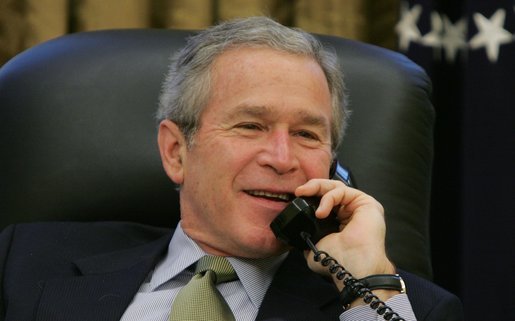
Note to the image: President George W. Bush talks on the phone with Canadian Prime Minister-elect Stephen Harper, in the Oval Office, Wednesday morning, Jan. 25, 2006. White House photo by Paul Morse

link to the image source

How world leaders make phone calls.

By Daniel Engber
Posted Friday, Feb. 10, 2006, at 6:23 PM ET

President Bush called the prime minister of Denmark this week to offer moral support as anti-Danish riots continued throughout the world. Last week, he called to congratulate Evo Morales, the newly elected president of Bolivia. The week before that, Bush had the new prime minister of Canada on the horn. How does the president call up other world leaders?

He has his people call their people. White House operators are known for being able to get hold of just about anyone. If Bush needs to talk to Tony Blair, his situation room operators get in touch with the staff at 10 Downing Street. They set up a time to chat and patch through the call when that time comes.

White House operators have special phone numbers for some world leaders. They might use the cell-phone number of a leader's aide in one place, and call the number for a situation room in another. In some cases, they could go through the main switchboards like everybody else.

Some leader-to-leader calls apparently do arrive via the listed phone numbers. On Jan. 27, Jacques Chirac received a call from a radio DJ in Quebec who had convinced the French operators that he was Canadian Prime Minister Stephen Harper. According to the DJ, he called Chirac's office and was told that the president would call him back. Chirac did so half an hour later.

World leaders have to put up with prank calls all the time. As a general practice, one leader's staff members will arrange to call back the staff members of another. (If someone claiming to be from the White House called Buckingham Palace, for example, the queen's staff could call the White House back to confirm.)

This verification process doesn't always work. In 2003, a pair of radio DJs in Miami had a woman with a Cuban accent call for Venezuelan President Hugo Chavez. She claimed she was one of Fidel Castro's operators, and that Castro was at a secret location where he couldn't be called back. It took about 10 tries to get through, but the DJs finally weaseled a direct number out of a Venezuelan officer. (A few months later they successfully called Castro, posing as Chavez.)

In 1990, then-President George Bush returned a phone call to a man posing as the president of Iran. "We were suspicious and began checking," said White House spokesman Marlin Fitzwater, "but, ultimately, the president needed to make the call as part of the check."

Sometimes a legitimate call from a world leader doesn't go through. Following the Soviet coup in 1991, newspapers reported that President Bush made at least two attempts to check in with Mikhail Gorbachev by phone. The operator at the Kremlin told the one at the White House that Gorby wasn't available.

Bonus Explainer: For calls to Russia, there's always the famous "red phone." President Kennedy first suggested "the hotline" after the Cuban Missile Crisis. A direct teletype link to Moscow was set up in 1963. The hotline didn't include a true telephone until the early 1970s, and even then communications were almost always sent in written form.

Got a question about today's news? Ask the Explainer.

Explainer thanks reader Sean Gailmard for asking the question.

Daniel Engber is a regular contributor to Slate.

Friday, February 10, 2006

Toast of the TV in Russian Eyes: It's Solzhenitsyn (By Steven Lee Myers, the New York Times)


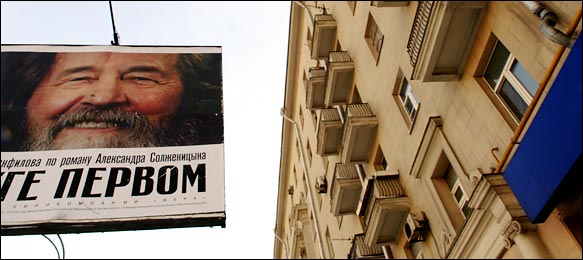
Note to the image: Solzhenitsyn, long a nonperson in communist Russia, beams down from a billlboard advertising "The First Circle" above a street in downtown Moscow. By James Hill for The New York Times


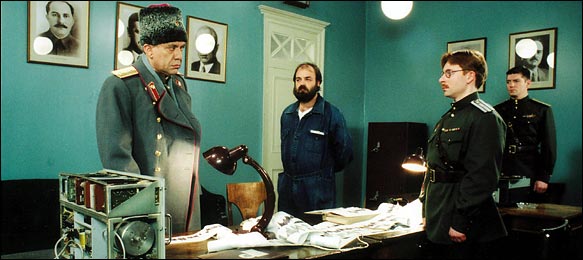
Note to the image: In a scene from the televised version of Solzhenitsyn's "First Circle," an inmate in one of Stalin's "special prisons" is played by Aleksei Kolubkov, center. The work deals with some of the Soviet era's darkest episodes.

By STEVEN LEE MYERS
Published: February 9, 2006


MOSCOW, Feb. 8 — A grandfatherly figure, his bearded face wrinkled into a smile, peers down from billboards around town.


It is surprise enough that the man is Aleksandr I. Solzhenitsyn, the once-exiled writer, Nobel Prize winner and, of late, octogenarian scold. It is even more so that the billboards advertise his adaptation — broadcast on state television, no less — of one of his fiercely anti-Soviet novels, "The First Circle."


Solzhenitsyn has been called the conscience of the nation, but his reputation has risen and fallen as tumultuously as Russia itself since the collapse of the Soviet Union. "First Circle" has once again placed him on the national stage, reaching an audience that would have been inconceivable to him four decades ago, when he smuggled the book out of the Soviet Union.


The show, a 10-part series that began Jan. 29 and ends Thursday, is part of an industry here catering to what seems to be a growing interest in adaptations of the great works of Russian literature, some of them books that were banned in Soviet times. It began with Dostoyevsky's "Idiot" in 2004, includes less familiar Soviet-era works like "Master and Margarita" and "The Golden Calf," and will reach a climax of sorts this spring with the broadcast of a Russian adaptation of "Doctor Zhivago."


The first episode of "The First Circle" was the most watched program in the nation last week, narrowly edging out "Terminator 3," according to TNS Gallup Media. By this week, though, it had slipped to fifth place, at least in Moscow — national figures were not yet available. But it was still attracting 15 million viewers a night.


Solzhenitsyn was greeted as a prodigal son when he returned from exile in 1994, only to see his later works — "Russia in Collapse," an apocalyptic political attack on society's ills in 1998, and "Two Hundred Years Together," on Judaism in Russia in 2004 — met with public indifference. He once had his own talk show, until it was canceled because of low ratings.


"This would-be prophet has played no significant role in Russia's political dialogue since coming back," a commentator for the official Russian Information Agency, Anatoly Korolev, wrote in August 2004.


Now, 18 months later, in the twilight of an immeasurably influential career, he is back before the public in a society that has not always known what to make of its most famous living writer.


"I assumed that bringing it to the screen would be possible in 300 years," the director, Gleb Panfilov, said in a television interview, recalling his desire to make the film after first reading "The First Circle" while it was still banned, some 30 years ago. "But it happened earlier."


The series is the first Russian film based on Solzhenitsyn's writings. In a country where attitudes toward the Soviet history remain deeply conflicted, it amounts to the popularization of some of the darkest episodes.


"The young people today say: 'Oh, he is not a good writer. Communism is over. He is not so interesting,' " the writer Viktor Yerofeyev said in a telephone interview. "In the history of Russia, he is in the first place."


"It is like Germany after the war," Mr. Yerofeyev added. "In two or three generations people really start thinking about what happened in their country."


Solzhenitsyn, now 87, is credited as the screenwriter and narrates long passages. He also served as a consultant during filming, advising the crew on how to recreate the claustrophobic atmosphere of the network of forced labor camps known as the Gulag, where he served eight years after criticizing Stalin in 1945. "There is not one drop of falsehood," his wife, Natalya, told Izvestia.


As reclusive as he was when he lived in exile in Vermont for 18 years, he has not discussed the series publicly, but Mr. Panfilov reported that he had tears in his eyes when he saw the edited version.


"The First Circle," first published in the West in 1968, chronicles three days in the lives of prisoners at Mavrino, a "special prison" set up in a country estate outside Moscow in the aftermath of World War II. The political prisoners there, chosen for their expertise, work on two projects: a secure telephone for Stalin and a method of voice recognition needed to identify a suspected traitor.


The title is a reference to Dante's concentric circles of hell in "The Divine Comedy." Mavrino is a fictionalization of the camp where Solzhenitsyn served his sentence, Marfino.


Boris N. Pasternak, director of the publishing house Vremya, which next month will publish the first of 30 volumes of Solzhenitsyn's complete works, said that Russians were still absorbing the banned literature of the Soviet era.


"I cannot say that millions of people have digested it profoundly," said Mr. Pasternak, who is not related to the author of "Doctor Zhivago," another famously banned work. "Now there is another means of making an impact on people's brains: the television serial."


The series — seven and a half hours in all, shown without commercial breaks — is appearing on Rossiya, one of Russia's two state-owned television networks. Given the Kremlin's influence over what is broadcast, many here have interpreted the production as a signal of a new willingness to examine Stalin's legacy critically, if not to embrace Solzhenitsyn per se.


"As my mother said, 'Stalin is shown like a bastard,' " Mr. Yerofeyev said. "It means the Kremlin's power is not, let's say, monolithic."


While the film scrupulously recreates the period, Solzhenitsyn altered at least some aspects of the story.


In the book, a Foreign Ministry official becomes ensnared by the M.G.B., as the K.G.B was then known, after trying to warn an old family doctor not to pass medicine to a colleague in France. In the film, the official calls the American Embassy to warn about a Soviet intelligence ploy to steal nuclear secrets, a less ambiguous betrayal.


Viktor A. Moskvin, director of the Russian Abroad Foundation, a cultural center created by Solzhenitsyn, said the screenplay amounted to a distinct new work by an author, born in 1918, whose life spanned the entire Soviet era and now the beginning of another, different one.


"It is an important work at the beginning of the 21st century," he said. "It will help develop democracy."


It has at least prompted debate. The Communist Party leader, Gennadi A. Zyuganov, denounced the series as "an absolutely sideways glance at Soviet history." Others drew unflattering parallels to more recent events, from the conviction of Mikhail B. Khodorkovsky, the former owner of Yukos Oil, to political attacks on human rights organizations.


Ernst I. Cherny of the Citizens' Committee in Defense of Scientists likened the events depicted in the series to accusations against several scientists, including a physicist, Valentin V. Danilov, who was convicted in 2004 on charges of selling satellite technology to the Chinese that his lawyers said was publicly available. Today's security services, he said, have learned nothing from Solzhenitsyn's indictment of Stalin's capricious justice.


"They see nothing strange in what they are doing today," Mr. Cherny said at a news conference last week, "and in the way it was all described by Solzhenitsyn."


It remains to be seen whether the television version will ignite new interest in Solzhenitsyn's works. Book sales have skyrocketed after other television adaptations, including one in December of Mikhail Bulgakov's "Master and Margarita."


"He is really fascinating, but we are just not interested in things like that," Aleksandr V. Belonogov, 27, an insurance agent, said of Solzhenitsyn as he passed through the subway beneath Pushkin Square on Wednesday. "We do not exactly entertain ourselves by reading Solzhenitsyn."


Rachel Thorner contributed reporting for this article.


link to the original link

Thursday, February 09, 2006

Can You Fear Me Now? (By Bryan Curtis, Slate.com)


the middlebrow - Dissecting the mainstream.


The cell phone goes from annoying to evil.

By Bryan Curtis
Posted Wednesday, Feb. 8, 2006, at 3:45 PM ET

In your right hand, you hold the source of all the evil in the world. A few days ago, it was the source of some medium-sized evil—a stray ring in a movie theater or a mournful text message to an ex-girlfriend after midnight. But things have changed with your cell phone. It is no longer just a nuisance. It is death incarnate.

In the recent months, cell phones have become newly terrifying. Our once-mundane cellular-inspired fears—of brain cancer, of terrorists using them to detonate remote devices—have been replaced by more gruesome visions. Horror maestros from Stephen King to Takashi Miike have taken our ambivalent post-9/11 feelings about cell phones (they played a crucial role in nearly staving off a terrorist attack, but they were also the source of incredibly painful goodbyes) and reworked them into a vehicle for evil—ghosts, plagues, and rampaging psychos. The cell phone, in their hands, is not a tool of empowerment but another instrument of terror. Humanity's going to hell, and you don't dare call your mother.

Stephen King's Cell, which sits at No. 1 on the New York Times best-seller list, is the bloodiest encapsulation of this worldview. A pulse sent out over cell phones by someone—Islamic terrorists? disgruntled hackers?—turns cell-toting humans into predators who bite one another's necks and club one another's children. Soon, the zombified masses are roaming the streets by day and pausing to "recharge" by night—lying side-by-side in moonlit stadiums, like a thousand Nokias resting in their cradles. It's up to a crusty band of outsiders—read: Luddites who cling to land lines—to battle their way out of the cities and regroup in wireless-free zones up north. "What's the market penetration?" one of them asks, surely the first time those words have been uttered in a Stephen King novel. So despicably evil is the cell phone that the survivors rarely speak its name—they indicate it with a sad gesture, a thumb at the ear and a pinky held at the mouth.

Cell-phone terror rules the cinema, too. In When a Stranger Calls, a remake of a 1979 horror movie that opened on top of the box office last weekend, a teenage girl is forced into indentured babysitting for going "over plan" by 800 minutes. While looking after two children in a giant house, she's terrorized by a cell-phone-wielding maniac—Hollywood's favorite villain, it seems, since similar psychos appeared in Hostel (2005) and the Scream trilogy before that.

The apogee of mobile-phone horror is Takashi Miike's One Missed Call, a 2003 Japanese film released in the United States last year. In it, Japanese teenagers robotically swap numbers and text messages the way their horror-movie predecessors used to trade sexual favors. One by one, their phones emit an unfamiliar ring tone indicating that they've received a message. The message, dated a few days in the future, is their own voice—a recording of their desperate last moments on earth.

To be sure, the cell phone is merely the latest piece of demonic hardware. It follows the evil computer (2001: A Space Odyssey) and the evil car (King's own Christine), to name just two. And its scariness springs from some of the same sources—it's a pedestrian object hiding in plain sight, and humanity is perhaps too reliant on it for its own good. But because of the eerie way it mixes the public and private, the cell phone, perhaps more than anything to come before it, seems like an ideal instrument for horror.

After all, we already hate cell phones. We hate the reception, hate other users, and hate our billing plans, and it comes as no surprise when the above are revealed to be the work of a demonic force from the beyond. But what really bugs us is that cell phones clumsily merge the public and private spheres—what sociologist Hans Geser has called a "transspatial version of particularistic communalism," and what the rest of us call rudeness. In Cell, King takes the usual complaint about cell phones to a new level. Before the phone plague, King depicts a woman ordering a sundae from a Mister Softee ice cream truck while absent-mindedly babbling into her phone. It was an "act which would have once been considered almost insufferably rude," he writes, and as the woman becomes infected and tries to take a bite out of the ice-cream man, it seems like only a slight loss of civility. Likewise, King's zombified hordes resemble the cell-phone users plodding down urban sidewalks, each grunting to his own tune and oblivious to the world around him.

Moreover, as King notes, the cell phone is the only truly populist menace. For all the attention lavished on the dark corners of the Internet, the Web remains a fairly rarefied domain. Cell phones reach across race, class, and gender—they're an equal-opportunity device. If cell phones make bourgeois life all the more livable, they also enable drug dealers and prostitutes who used to rely on pay phones and beepers. One of the delights of Cell is watching professional women in power suits join ranks with the criminal class, dopey teenagers, construction workers, and the elderly to create a roiling, multilayered zombie class—as King puts it, "the Tower of Babel all over again … and on nothing but electronic cobwebs."

On the level of plotting, cell phones can make a horror story more difficult to conceive. Andrew Klavan, who is writing the American remake of One Missed Call, says, "If I had to pick two things that have changed the world of genre writing, one would be the fall of the Berlin Wall, which eliminated a whole genre of fiction. And the other would be cell phones. The question everybody asks about crime stories is, 'Why don't they just call they police?' And now, with cell phones, you have to come up with a pretty good explanation."

But on the flip side, cell phones have dragged horror into the light. The old idea of fear was being trapped in a dark house alone. The new fear is of interconnectedness, of being perilously joined to the rest of humanity. In Arthur C. Clarke's 1964 story "Dial F for Frankenstein," the world's land lines all ring at the same moment, signaling that the phone system had gained consciousness and was rising up to enslave humanity. "For homo sapiens, the telephone bell had tolled," Clarke wrote, and these days, market penetration being what it is, Armageddon is more likely to announce itself with a custom ring tone. The final gruesome twist of One Missed Call is that every time a teen dies, the demon spirit selects a fresh victim from his "contacts" list. It's enough to make you rethink your weekend nights. You seem nice, baby, but do you have to program me into your phone? Can't we do it like the old days and use a cocktail napkin?

Bryan Curtis is a Slate staff writer. You can e-mail him at curtisb@slate.com.

link to the original posting

Wednesday, February 08, 2006

War and Words (by Hendrik Hertzberg, the New Yorker)


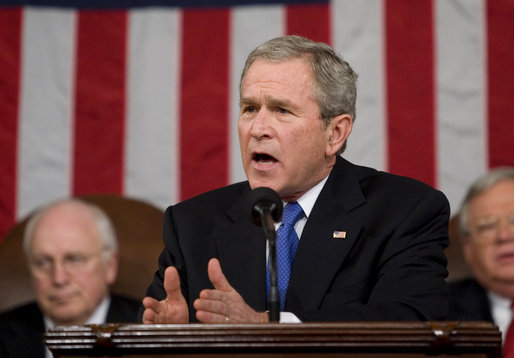
Note to the image: President George W. Bush reacts to applause during his State of the Union Address at the Capitol, Tuesday, Jan. 31, 2006. White House photo by Eric Draper

link to the image source: the White House Website

The Talk of the Town
COMMENT
by Hendrik Hertzberg
Issue of 2006-02-13
Posted 2006-02-06


A President is well advised to choose his words carefully. This is something the incumbent, left to his own devices, is not always capable of doing. A State of the Union speech finesses that difficulty. The speaker speaks off the teleprompter, not the cuff. And the words that scroll down on the angled reflectors to his left and his right are as carefully—or, at any rate, as exhaustively—considered as bureaucratic thoroughness can make them. Every prepared Presidential address has multiple authors, but a State of the Union is the product of whole buildings full of them. The text that George W. Bush recited last Tuesday night had gone through thirty drafts.


It’s safe to assume, therefore, that the President was not speaking casually when he identified America’s mortal enemy as “radical Islam.” This is the latest milestone in a wandering terminological journey that began shortly after September 11, 2001. “War on terror” has always been problematic, at both ends. The word “war” has the requisite urgency, and it has proved useful in intimidating the political opposition at home. But, as we have seen in Iraq and elsewhere, its associations—pitched battles, clashing states, disciplined armies with general staffs—can invite actions that are, at best, beside the point. “Terror” is not a conquerable enemy, or an end in itself. It is a method of achieving some political goal, however outlandish or unrealizable—an ugly and frightening method, as was the bombing of civilian populations in the Second World War. But “war on terror” is a chimerical circle, like “war to end all wars.” Woodrow Wilson’s war to end all wars defeated imperial Germany, but it did not, and could not, defeat war. Nor can a war on terror defeat terror.


Now and then over the past couple of years, the Administration has halfheartedly tried to shed the straitjacket of its own slogan. “We actually misnamed the war on terror,” Bush mused in the summer of 2004. “It ought to be ‘the struggle against ideological extremists who do not believe in free societies who happen to use terror as a weapon to try to shake the conscience of the free world.’ ” A year later, Secretary of Defense Donald Rumsfeld made a run at substituting the catchier “global struggle against violent extremism.” It didn’t fly. Bush, who had decided that he wants to be a war President, not a struggle President, shot it down. But “struggle” would at least have acknowledged that warfare is not the sole solution, and “violent extremism” would have recognized a motive behind the method.


Last October, speaking at the National Endowment for Democracy, the President returned to the topic, floating more names for the “focussed ideology” that brought down the Twin Towers. “Some call this evil Islamic radicalism,” he said. “Others, militant jihadism; still others, Islamofascism.” As of last week, he seemed to have settled on “radical Islam.” It’s a bad choice, reminiscent of his early talk of a “crusade.” Violent jihadism, yes. Islamist (as distinct from Islamic) terrorism, yes. But not Islam, radical or otherwise.


There’s no doubt, of course, that terrorists of the Al Qaeda ilk are drawn from the ranks of adherents of “radical”—which is to say, extreme or fundamentalist—Islam. But radical Islam is a far broader and more variegated phenomenon than the terrorist virus that infects it. Its incarnations range from Al Qaeda to the clerical and legal establishments of Saudi Arabia. In virtually every iteration, it demands the subordination of women, the stunting of education, and the curbing of the freedom of speech, of the press, and of religion. It should be opposed, as part of America’s thirty-year-old campaign against violations of human rights. But it is not in and of itself a casus belli. Violence and terrorism are not intrinsic to it. And it is emphatically not something against which the United States should seek to fight a war to the death. One of Al Qaeda’s goals has been to frame the conflict as a holy war between Muslims and infidels. In calling it a war, Bush emphasized its seriousness, but at the cost of granting its criminal perpetrators the dignity of warriors. Calling it a war against Islam, even radical Islam, grants them the other half of their wish.


In the section of his speech devoted to the prospects for what he called “democratic reform across the broader Middle East,” the President said, “The Palestinian people have voted in elections, and now the leaders of Hamas must recognize Israel, disarm, reject terrorism, and work for lasting peace.” He was right to emphasize the aspects of Hamas’s ideology that are inimical to peace, rather than calling on it to abandon its (radical) Islamic identity. But he skated lightly over the implications for his own policies of Hamas’s victory in last month’s Palestinian legislative elections. All over the region, the unintended consequences are piling up. The elections in Afghanistan, Egypt, and Lebanon were a good thing, but they resulted in gains for, respectively, warlords, the Muslim Brotherhood, and Hezbollah. In Iraq, Bush asserted, “we are winning.” But the war there, which shows no sign of ending, has stretched America’s military to the limit, pinning it down while potentially more dangerous threats have gathered. The “weapons-of-mass-destruction-related-program activities” that Bush spoke of in his 2004 address have been found, but they turn out to be in Iran. And the Iranian theocracy—strengthened by high oil prices and an election in which a relatively moderate President was succeeded by a Holocaust denier—has won unprecedented influence in a strategically important neighboring country: Iraq.


On the related subject of homeland security, Bush had only two things to say. He demanded that Congress reauthorize—presumably without changing a word—the so-called Patriot Act, which was passed in haste shortly after the September 11th attacks. And he defended—no, boasted of—the National Security Agency’s vast, formerly secret program of warrantless electronic eavesdropping, undertaken on his orders and rebranded in his speech as “the terrorist-surveillance program.” “If there are people inside our country who are talking with Al Qaeda,” he said, “we want to know about it, because we will not sit back and wait to be hit again.” But those who are questioning Bush’s program, both Democrats and Republicans, agree that terrorists must be surveilled. What alarms them is not just that the President is breaking a particular law, the Foreign Intelligence Surveillance Act, but that his rationale for doing so amounts to a claim that he can flout any law at all, as long as the flouting is under cover of an endless (and, according to him, misnamed) war.


The evening’s only startling moment came when Bush announced that “America is addicted to oil, which is often imported from unstable parts of the world.” This acknowledgment, as welcome as it was overdue, was followed by a call for an increase in federal funding of research into alternative fuels. For this, and for failing to renew his call for drilling in the Arctic wilderness, the President was quickly attacked in a Wall Street Journal editorial as a Jimmy Carter clone, a liberal, and a co-opter of Democratic ideas—a fairly good indicator that he may be on to something. But it soon became apparent that, while he may be a reformed drinker, he is not yet a reformed oilman. “The best way to break this addiction is through technology,” he said. Whether or not it’s the best way, it’s the only way he mentioned. But relying solely on a cheap, painless technological fix to conquer oil addiction is like relying solely on methadone to conquer heroin addiction. Abstinence is needed, too. The energy equivalent is conservation, which is superior in every way to substitution. The best way to encourage conservation—and the true sign of a serious energy policy—would be imposing a hefty gasoline tax and raising mandatory fuel-efficiency standards. No points for guessing whether any such proposals found their way into the speech. Anyway, the subsidies Bush is proposing would, at best, restore research spending to its Clinton-era levels. Two days after the speech, the Times reported that the Energy Department’s National Renewable Energy Laboratory will begin laying off workers next week, thanks to a fifteen-per-cent cut in its current budget. The State of the Union address was a disappointment only to those who were foolish or forgetful enough to expect something better.


link to the original posting

Tuesday, February 07, 2006

The Che Cachet (By David Segal, the Washington Post)


Note to the image: The late Cuban photographer Alberto Korda in 2000 with his 1960 shot seen 'round the world on everything from T-shirts to tissue paper. Photo Credit: By Dave Thomson -- Associated Press Photo
link to the source


An Exhibition Traces How the Marxist Revolutionary's Photo Inspired an Army of Capitalists


Tuesday, February 7, 2006; C01

NEW YORK Just look at what they have done to Che.

The glowering visage of the Cuban comandante and ur-Marxist pops up everywhere -- in art, on the cover of magazines and, more blasphemously, on lighters, wallets, coasters, T-shirts, hoodies, key chains, tissue packs, nesting dolls and something called Red Cream Soda.

It's always the same shot, the one where the man born Ernesto Guevara stares into the middle distance with fiery resolve, a military beret perched on his head, a leather jacket zipped up to his neck, hair rakishly blown by the wind. Rifle-wielding freedom fighters around the world have revered this image the way Christians revere saints. But entrepreneurs love it, too. One company slapped the likeness on a frozen treat called Cherry Guevara, vanilla ice cream on a stick, wrapped in chocolate and cherry-flavored sauce.

"The revolutionary struggle of the cherries was squashed as they were trapped between two layers of chocolate," reads the copy on the wrapper. "May their memory live on in your mouth."

Cherry Guevara and other examples of what could be called Che abuse are now on display at the International Center of Photography in midtown Manhattan for an exhibition titled "¡Che! Revolution and Commerce." (The show runs until Feb. 26.) It's the story of a single photograph and its flukey journey from contact sheet to international ubiquity and then into the farcical maw of commercial kitsch. Shot by a onetime fashion photographer named Alberto Korda, it might be, according to the show's curators, the most reproduced image in the history of photography.

The exhibit works, too, as an object lesson in the power -- and on some level, the formidable beauty -- of market economies, which can absorb and commodify anything, even their bitterest enemies. Today, there are dozens of Web sites selling stuff with Korda's Che shot emblazoned on it. Places like Thechestore.com and Fidelche.com mostly target young people who, one assumes, aren't actually gearing up for armed insurrection.

"Our other big seller is beer pong shirts," says Shayn Diamond, a college student in London, Ontario, who a few months ago started selling Che-wear with some friends at Cheguevarashirts.com. "He's a rebel, and along with rebel comes the cool factor and trendiness."

Translation: Viva los fashionistas!

The beginning of all this was more dignified. Korda took the shot the day of a rally in Cuba, organized to protest an explosion in Havana harbor of a ship loaded with ammunition. More than 100 people died in early March 1960, and many Cubans believed it was a CIA-orchestrated crime, not an accident. The following day, maximum leader Fidel Castro turned a mass funeral into a mass protest and Korda, on assignment from a newspaper called Revolucion, was there to capture the event.

Che didn't speak that day, but he showed up briefly on the podium to gaze at the crowd. Korda squeezed off two quick shots with his Leica. The image first turned up publicly in April 1961, in the pages of Revolucion, to promote a conference where Che was the star speaker. Yes, fittingly enough, "Guerrillero Heroico," as Korda called his photo, started off as an advertisement.

Then it just spread. Korda never kept a grip on the copyright, and the shot eventually turned up on the cover of magazines and newspapers in Europe and across the United States. National Lampoon published a satirical version in 1972 with Che taking a pie to the face. Madonna did a variation for her "American Life" album in 2003. When Taco Bell used a Chihuahua in a Guevara-like beret to promote its "revolutionary taco," the company took incoming from Cuban exiles in Miami. The vice president of the company said the ads were intended to represent revolution "generically."

Artists have long played with the iconic power of the image. Among them is Pedro Meyer, who created "Five Dollar Bill," which is in the ICP exhibit and features a blowup of the U.S. fiver, with Che's face where Lincoln's ought to be.

"The U.S. has always had the ability to appropriate rebels," says Meyer, on the phone from his studio in Mexico. "It's a cheap way to deal with your urge to be rebellious. You buy a T-shirt and you don't have to do anything more."

Korda, who died in Paris in 2001, apparently never earned any royalties from his most famous portrait. He did, however, win an out-of-court settlement in England against Smirnoff after the company ran an ad with "Guerrillero Heroico," along with the words "A complete flavoured vodka," a riff perhaps on John Paul Sartre's claim that Che was "the most complete man of his age."

"I am categorically against the exploitation of Che's image for the promotion of products such as alcohol," Korda is quoted as saying, "or for any purpose that denigrates the reputation of Che."

Why Che? How did this Argentine doctor with a bad case of asthma acquire such astounding worldwide cachet, not to mention enduring commercial appeal?

The hunky looks don't hurt. Actually, they help, quite a bit. And few doubt the man's sincerity, even if his sincerest wish was a dreary, centrally planned bummer.

"Even his ideological foes admire him because he represents the great virtues it takes to be a revolutionary," says Jon Lee Anderson, a New Yorker writer who penned the biography "Che: A Revolutionary Life." "Bravery, fearlessness, honesty, austerity and absolute conviction. Those are the prerequisites to carry others into what is actually quite a miserable existence. He lived it. He really lived it."

After he helped to overthrow the Batista government in Cuba, he headed to other countries, including the Congo and Bolivia, to try to foment revolution there. Adding to the mythology, he died a martyr's death in 1967, captured and executed at the age of 39 as he battled U.S.-trained troops in Bolivia. Reportedly, his last words to the soldier who shot him were "Shoot, coward, you're just killing a man."

And, it seems, creating a brand. He's lionized by insurgents around the world, according to Anderson, in places as varied as Burma and Afghanistan. Last month, the new president of Bolivia asked for a moment of silence at his swearing-in to remember, among others, Che Guevara. The Cuban government, meantime, has tapped heavily into Che-mania, presenting Guevara to tourists as the public face of the island ever since the Russians withdrew financial support. Che T-shirts are among the first things you'll see after landing at the Havana airport.

But at least the Cubans know whom they're glorifying. In the United States, Che's life story and ambitions seem beside the point, or maybe they've just been reduced to caricature. The guy's face is shorthand for "I'm against the status quo." He's politics' answer to James Dean, a rebel with a very specific cause. And since very few people know anything about the cause, or the rebel -- besides the basics -- the Che shirt has about it the whiff of inside info. It makes you part of the thrift-store intelligentsia, even if your real focus is beer pong.

This, in brief, is why capitalism won. It's the only system that understands that we'd all like to change the world, but we are way too lazy for that sort of thing. Especially if there's ice cream around. When you get done with a Cherry Guevara, you're left with a wooden stick with the words "We will bite to the end!" stamped on it. If there are nails in Che's coffin, this, no doubt, is what they look like.


© 2006 The Washington Post Company

link to the original posting