Thursday, September 21, 2006

The quiet American (The Observer)


The quiet American


It's a magazine that runs 10,000-word articles on African states and the pension system, has almost no pictures and is published in black and white. So how does the New Yorker sell more than a million copies a week? Gaby Wood meets David Remnick, its big-brained editor, and talks speed writing, 30-hour days and meeting Little Ant and Little Dec


Sunday September 10, 2006
The Observer


'Everybody has a cartoon of themselves,' suggests David Remnick, the editor of a magazine famous for them. 'Mine is: I write very fast, and I'm ruthlessly efficient with my time.'

As New Yorker cartoons go, the image wouldn't appear to hold much promise of a punch line, but Remnick doesn't mind it, and it contains, after all, a certain amount of truth. 'I'm not the slowest writer that you know,' he admits, adding with characteristic wryness: 'For better or for worse, by the way. AJ Liebling, one of my heroes, used to say that he could write better than anyone who wrote faster, and faster than anyone who could write better. I'm one nine-hundredth as good as Liebling, but that principle may slightly apply.'

Remnick, who was for many years the New Yorker's star reporter, covering - in the tradition of AJ Liebling - an almost alarming range of subjects with grace and dexterity, has edited the magazine for the past eight years and quietly, seriously, changed its fortunes. He is the fifth editor in the New Yorker's 81-year history and, by reputation - as his thumbnail self-portrait implies - its least eccentric.

So many memoirs have now been written about the distinguished publication that Harold Ross, its founder and first editor, has gone down in history as a maddening, well-connected workaholic who sacrificed three marriages to his literary invention. It is widely known that his successor, William Shawn, was neurotic, nuanced, almost pathologically shy, and that Robert Gottlieb, a gifted interloper, possessed a museum-worthy collection of plastic purses. In more recent memory, Tina Brown hired big-name writers at vast expense, threw celebrity-strewn bashes to promote the magazine (all of which resulted in a rumoured loss of up to $20m annually) and was supposed to have rejected any story that couldn't hold her attention on the StairMaster.

It could be said that Brown's methods were not eccentric but merely attuned to the demands of Eighties and Nineties culture. Equally, Remnick's non-partying ethic and commitment to world affairs might be thought the only appropriate way forward for a post-9/11 magazine. Remnick, who was hired by Brown, has never been critical of her tenure, and is inviolably modest about his own contribution. 'My background is as a reporter and foreign correspondent, but it's hard to separate what one's natural inclinations are from the times,' he tells me. 'My time as editor has been overlapped by a crisis - a prolonged, labyrinthine, tragic, seemingly non-ending crisis - that involves the prehistory of 9/11, 9/11, Iraq, Afghanistan, fraught histories between the United States and almost everyone.' Remnick's colleague Malcolm Gladwell, author of the bestselling books The Tipping Point and Blink, says, similarly, that 'we live in a suddenly serious time, where people have an appetite for intelligent, thoughtful explanations of consequential topics'.

Yet how can Remnick's editorial strategy be considered inevitable when no one else is doing what he does? However frequently Graydon Carter may address the bungles of the Bush administration in his letters from the editor in Vanity Fair, he feels compelled, more often than not, to feature a cover star in a bikini. Meanwhile, on another floor of the Conde Nast building, the New Yorker puts Seymour Hersh's investigations of national security on the cover and has the highest subscription renewal rate of any magazine in the country. It has a circulation of over 1m, and although it is privately owned and such figures are not publicly available, it is thought to be turning a profit of around $10m.

Celebrity culture is far from over; if you wrote a plan for a magazine and said you thought you could make a profit by publishing 8,000-word pieces on the future of various African nations, hefty analyses of the pension system and a three-part series on global warming, hordes of people would laugh in your face. So how has Remnick done it? Before I met him, I asked this of an acclaimed New York journalist, who said: 'If you can work that out, you will have the scoop of the century. No one knows.'

Remnick is well aware of the apparent mystery, which is why no focus group is ever involved in an editorial decision. As he puts it, it doesn't take a genius to work out that one hundred per cent of his readers are not going to get home from work, put their keys down and say: You know, honey, what I need to do now is read 10,000 words on Congo. 'So you throw it out there, and you hope that there are some things that people will immediately read - cartoons, shorter things, Anthony Lane, Talk of the Town. And then, eventually, the next morning on the train, somebody sees this piece, and despite its seeming formidableness, they read it.'

You might say that what looks at first like common sense is David Remnick's most winning eccentricity.

We meet at the New Yorker offices in Times Square on an obscenely hot day in August. Remnick extends a courtly, ironic offer of rehydration: 'Coffee? Water? Drip?' His glass box of an office is decorated with original cover art and scattered photographs - a portrait of AJ Liebling sitting under an apple tree; Dean Rohrer's wonderful image of Monica Lewinsky as the Mona Lisa. On his desk is a rare book about Jean-Luc Godard, in French.

He has just returned from Arkansas, where he met Bill Clinton for a long profile he is writing, and he spent the end of last week editing a cover story on Hizbollah by John Lee Anderson with an exceptionally fast turnaround. Another reporter calls from the Middle East as I arrive. Yet here is Remnick, blithe and witty as anything, behaving more or less as Fred Astaire would, if only a role had been scripted for him by Philip Roth.

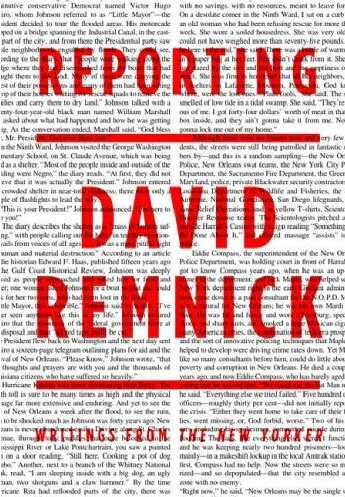
Reporting, a new collection of Remnick's writing from the New Yorker, has just been published. It reveals not only the scope of his interests - he is as lucid about the PLO as he is touching about Solzhenitsyn, as excruciatingly accurate about Tony Blair as he is compelling on the subject of Mike Tyson's trainer - but also the deceptive straightforwardness of his style.

Remnick won a Pulitzer Prize for his first book, Lenin's Tomb, in 1994, and the great pleasure of that book, which gives a kaleidoscopic account of the fall of the Soviet Union, was that you felt party to the open mind of a reporter (originally at the Washington Post) who followed his instincts at every turn. He didn't mind telling you, for instance, that his wife's family had been interned in camps in the country to which they were now returning; if he saw someone handing out flyers in the street, he would delve deeply into their purposes; he was not shy of doorstepping ancient members of the KGB. In that first book, as in his others - a follow-up about Russia called Resurrection; a collection of pieces entitled The Devil Problem; a story about Muhammad Ali called King of the World; and Reporting - simply turned sentences open up vistas of complication. Yet the quality that Remnick shows most in conversation is his capacity for self-deprecation. He opens a profile of Katharine Graham, the imperious proprietor of the Washington Post and his sometime boss, with a story about his own involvement in the Post's historic interview with Mikhail Gorbachev, the General Secretary of the Communist Party of the Soviet Union, in 1988:

'As the junior man in the bureau, I was given the task of finding the hairdresser. I would not insist that Moscow was short on luxury in those days, except to note that I did not so much find a hairdresser as create one. At one of the embassies, I found a young woman who was said to own a blow-dryer and a brush. I rang her up and explained the situation. Gravely, as if we were negotiating the Treaty of Ghent, I gave her an annotated copy of Vogue, a mug shot of Mrs Graham, and a hundred dollars.

"You're on," she said.

'Apparently, the interview went well. It was featured, with a photograph, in the next day's edition of Pravda. Mrs Graham looked quite handsome, I thought. A nice full head of hair, and well combed. I felt close to history.'

In a piece about Tony Blair written just before the last election, Remnick witnesses, behind the scenes, the Prime Minister's utter humiliation at the hands of Little Ant and Little Dec. In a profile of Al Gore he reveals that Gore employs a private chef who still addresses him, years after his presidential defeat, as 'Mr Vice-President'. He gets to hang out with the famously publicity-shy Philip Roth in his most feverishly creative period; he visits Solzhenitsyn and his wife as they prepare to return to Russia. Yet in a preface to the book, Remnick alerts the reader to the fact that most of his subjects are public figures who do their best not to let their guard down. Why offer the warning? To suggest we'll never find out about them?

'No,' he replies, 'so that you'll find out about them in a different way.' With politicians, 'you've got press secretaries, and you've got a very, very self-conscious actor, who's performing in public and the course of whose career is dependent on how he's going to appear to some degree. And he's very experienced at it. And any question you ask him, he's heard, and he has a little tape loop in his head. So when something like Ant and Dec comes along,' - Remnick grins broadly and looks up to the skies in gratitude - 'Happy birthday. The gods of non-fiction have provided an unscripted scripted moment!'

Remnick pauses for a moment to tell a story about the glorious predictability of journalism. 'There was a wonderful thing Slate did years ago, when it was just getting started, called the Hackathlon. It was Michael Specter, Malcolm Gladwell and I forget who else.' (Specter and Gladwell are both old friends of Remnick's from the Washington Post, and both now colleagues at the New Yorker.) 'Each day there would be an event. You had to write a 500-word lede [an American term for an article's opening paragraph] in the Vanity Fair style to a Richard Gere profile: Ready, begin. Then you had to do an Economist situationer on Tanzania - first 400 words. Then maybe a Rolling Stone lede to a ... you know: Mick Jagger is angry. Period. Paragraph. Very Angry. Period. The limo is late. You know, one of those. And then maybe a New Yorker thing on the history of sand. I don't remember the specifics.'

Remnick leans in with a smile of utter glee, and goes on: 'Specter beat Gladwell. He came from behind, but his lede on the Richard Gere, comparing the colour of his hair to his grey cashmere sweater, was just so brilliant that he overwhelmed him in the Hackathlon. I mean, he could do nothing else in his career and his New York Times obituary would read: "Michael Specter, winner of the 1997 Slate Hackathlon, died today of complications of a hernia operation. He was 98."'

David Remnick was born in 1958 and grew up in Hillsdale, New Jersey, where his father was a dentist and his mother an art teacher. The extent of his early gifts, to hear others tell it, borders on the embarrassing. Richard Brody, a close friend Remnick met at Princeton, remembers a story Remnick told him at the time about his activities in high school.

'He was interested in journalism already, and in literature and poetry,' Brody tells me. 'So he interviewed poets, and put together a collection of those interviews for a small literary magazine, and I think some of them were collected in a book. So even in high school he had not only the idea, but let's say the lack of false modesty to go ahead and do something which many people much older would not have dared to do. '

Brody and Remnick found that they shared a love of Bob Dylan, a Jewish upbringing in the suburbs, and 'a literary school of sorts'. As Brody puts it: 'There was a whole generation of Jewish American writers - when Saul Bellow won his Nobel Prize, I guess when we were all freshmen or about to enter school. There were people like Philip Roth and Norman Mailer and Bernard Malamud and Joseph Heller. We sort of had a canon of fathers. I think we weren't postmodernists, temperamentally. We had read our Thomas Pynchon and our John Barth, but that wasn't what excited us. We were excited by the late flowering, among the children of Jewish immigrants, of the late 19th-century novel.'

(Remnick, still an enduring fan of Roth, tells me that he would have published Roth's latest novel, Everyman, in its entirety in the magazine, but Roth's agent wouldn't allow it.)

When he left Princeton with a degree in Comparative Literature, Remnick got a job at the Washington Post, where his early days were occupied by covering the night-cop beat, or doing celebrity interviews for the Style section, or writing about sport. In 1987, the Post decided it needed a second person in Moscow, and, as Remnick now recalls, 'Nobody else wanted to go. It's cold, in those days if you wanted a box of coffee, you had to order it from Denmark. Nowadays there are rich people and stores and all kinds of stuff. (It's still cold - pace global warming.) So I got to go - I was 28, 29 - and it was the best kind of foreign story: really exciting, constantly changing, intellectually fascinating, ethnically various. It was heaven for a reporter.' Before he left he married Esther B Fein, a reporter for the New York Times, who also filed stories from Russia.

'When we were at the Post he was a kind of legendary figure and I was a little underling,' remembers Malcolm Gladwell. 'People have forgotten that - and this is not by any means an exaggeration - David was the great newspaper reporter of his generation. And had he never been anything but a newspaper reporter he would be, right now, the best. At the Washington Post there was one day when he had three stories on the front page, which I don't think has ever been repeated. He was in a league by himself. So the idea that he would have a second act where he would outperform his first act is kind of unbelievable.'

When Remnick was offered the editorship of the New Yorker, he had never edited anything before - with the exception, as he likes to remind people, of his school magazine. The decision to abandon writing - which, for the most part, he has (he now only writes two long pieces a year, plus commentary in the magazine) - was made on the basis of 'a very simple calculation': 'I had about two days - a day - I had seconds to decide, actually. Where could I make the bigger contribution? The ability to affect this magazine and its place in the culture - now, I may cock it up as an editor, I don't know, but the capacity for potential was greater doing this.'

Tina Brown left on a Wednesday in 1998. Remnick, who had written over 100 pieces for the magazine in the six years he'd been there, and who was, as Brown put it, 'a key member of my dream team', consulted on all kinds of editorial matters, was offered the job the following Monday, and took over straightaway, rallied by a five-minute ovation from his colleagues. 'And then Tina was gone and the magazine had to come out the next week - and the week after that, and on and on,' says Remnick now, looking amusingly baffled. 'And I was an absolute novice. And the only saving grace is that there were these people around who were so good.'

It wasn't easy. There have been times, even recently, when his instinct has failed him. He came out in favour of the war in Iraq, for instance, on the grounds of concern about weapons of mass destruction, and says now that 'I was wrong about that, totally wrong, as events proved very quickly.' The job, as Robert Gottlieb once memorably described it, is 'like sticking your head into a pencil sharpener'. To make matters worse, in some quarters Schadenfreude kicked in early; a profile of Remnick in the New York Times took offence at his choice of interview venue - a formica-topped table in a coffee shop, which was seen to suggest that the 'buzz' of the Tina years had fizzled out on the spot.

Michael Specter, Remnick's close friend of 20 years, tells me that a couple of months after Remnick took over, they went to Paris. 'We took a walk and he said, "The worst thing is, everybody comes up to me and says: 'Oh my God! You must be enjoying it so much!' And I just want to say: 'Yeah, it's like enjoying cancer!'" Because it was really scary, and I think it was a lot to take on that job, never having been an editor, when the magazine was financially in trouble. '

In a profile he wrote many years ago of the legendary Post editor Ben Bradlee, Remnick remarked: 'Generalship is not about fighting the battle; it's about inspiring the enlisted.' It's a notion Remnick has clearly kept in mind in his own work as General. Asked to illustrate his editorial methods, Remnick reaches for a baseball analogy: Joe Torre, the manager of the Yankees, 'gives players the confidence they need to play their best, then he gets the hell out'. He adds: 'I don't believe in swagger. I think it's infantile.'

The magazine's editorial director, Henry Finder, says drily that Remnick 'has something very scarce in this city: an aura of sanity. He exudes a sort of calm that most New Yorkers get to experience only with prescription medication. As an editor, I think that aura of equipoise turns out to be very helpful, because you have so many people here who are professional neurotics, always acting out, drama queens, who have one form of craziness or another. And I think he sees it as his job to be... sane.

When I ask Malcolm Gladwell what he thinks the legend of Remnick's tenure will be, he says: 'How exactly things got so effortless.'

Specter says he'd like some sort of atomic clock so he could 'divide 24 by Remnick time' and work out how he fits everything in. (Remnick himself has minted the immortal dictum: 'There are only 30 hours in the day - and that's if you're lucky enough to change time zones.') It's not just the work: he has a family too. Remnick and Esther Fein have two teenage sons and a seven-year-old daughter. He does his fair share of ferrying to music lessons and little league games. Asked to explain how he manages to balance these things, Remnick shrugs and says he doesn't do anything other than spend time with his family and work. 'It's not like I build toy ships, or travel to Tahiti. I don't go surfing. I don't know: what do people do?'

He admits that certain pleasures have largely fallen by the wayside. 'My son said to me - we were reading one night, he his book for school and I a stack of manuscripts - and he said: "You don't read anything with covers any more."' Remnick cringes. 'Dombey and Son immediately came down from the shelf!'

Yet there are other things he seems to make time for, somehow. Specter says the only person he knows who watches more television than Remnick is his own ex-wife, Alessandra Stanley, the TV critic for the New York Times. He remembers calling Remnick when one of their old favourites, the BBC version of John le Carre's Smiley's People, came out on DVD. 'I said, "Are you watching it?" He said, "Yes." He was writing a piece. He said: "I'm giving myself three hours of writing, one hour of Smiley." And I just thought, Jesus Christ. I watch three hours of Smiley, then I have lunch, then I write for a couple of minutes. '

I tell Specter how proudly Remnick told me of his triumph in the Hackathlon, and that I wondered afterwards what he meant by extolling such bare-faced bad writing. 'If you do it to change the world, you can get really bummed out,' replies Specter. 'The Hackathlon was a celebration of the fact that it's a day job.' He thinks for a second and laughs. 'I think he's happy when we do well. But he was much more excited about the Hackathlon than he was about any science writing or global health award I've ever received.'

'The things about him that I wish ...' Specter goes on, a little awkwardly. 'He's an incredibly good friend. I mean, he's a better friend than he is an editor. And he's very funny. My daughter thinks he's hilarious. She said: "You know, David's the coolest of your friends, Dad." Then she said: "Actually, he's not cool, but he's the best of them."'

· Reporting by David Remnick is published by Macmillan at £18.99

Friday, September 15, 2006

The rise & fall of the intellectual (James Piereson, The New Criterion)


The rise & fall of the intellectual


September 2006

By James Piereson


In his landmark study The Rise and Fall of the Man of Letters (1969), John Gross sketched out the lives and careers of the various writers who shaped literary opinion in England from the late eighteenth century through the Victorian era and into modern times. Gross was mainly concerned with the critics, reviewers, and editors who came into their own during the nineteenth century by bringing art and literature under the purview of critical judgment. In many ways, the vocation of critic and reviewer emerged in tandem with the rise of literature itself as a subject of public consumption, entertainment, and instruction.


The “man of letters,” as Gross understands him, is one who lives by writing and makes a living by doing so—that is, a professional writer, albeit one with literary interests. Though he is mainly concerned with the journalists and critics of the era, he does not slight major writers like Carlyle, Mill, and Matthew Arnold. These—the major and minor figures alike—were literary men (and, occasionally, women) who were associated with the leading literary journals and magazines that thrived during the Victorian period: The Edinburgh Review, The London Magazine, Blackwood’s, and The Spectator, among others. Their main preoccupations, mirroring their readerships, were with literature and poetry, along with related pursuits like history and philosophy. Politics was not yet the obsessive concern that it later became. The men of letters of the Victorian age were the opposite of specialists or pedants: the figures Gross portrays might as readily assess a novel or poem as a work of history.


Carlyle held to the view, one held also by many at the time though rejected by Gross, that literature represents a modern expression of the religious impulse. Thus he went so far as to say, in his lectures On Heroes and Hero Worship, that the man of letters is “our most important modern person,” placing him alongside the priest, prophet, and poet of previous ages. Here, of course, he was referring to the creative writer rather than to the editors and critics that are the subject of Gross’s study. Gross deftly traces the implications of this idea as they worked themselves out over the latter part of the nineteenth century, wryly showing how it eventually led to the incorporation of English studies into the university curriculum with all of the attendant controversies over the definition of the subject and who was qualified to teach it. By the time the academics took control, there were few who any longer held such an exalted view of literature.


The disintegration of the literary culture of the nineteenth century was accompanied by the gradual disappearance after 1900 of the man of letters himself. Within a short time, the man of letters began to appear as a dilettante, a dabbler, a dying species, even as a crank. The term itself came to be used as an instrument of abuse to signify an aged and somewhat eccentric bookman. In short order, modern life began to evolve its own substitutes for the dying breed. “Instead of men of letters,” Gross writes, “there are academic experts, mass media pundits, cultural functionaries.” He is right to wonder if we have gained or lost from the exchange, and the passage of nearly four decades since the publication of his important book has only reinforced our skepticism.


It seems plain, however, in looking back across the century that the man of letters, no matter how he is defined, was pushed aside not so much by academics and experts, but by that distinctive twentieth century phenomenon—the intellectual. The term itself is more or less coeval with the century, having been coined in 1898 to describe the collection of writers and teachers that came to the defense of Captain Dreyfus. The pedigree of the term was thus more political than literary, was associated with protest and opposition, and associated also with the political left. These have been enduring characteristics of the intellectual, and perhaps they serve as well to distinguish the species from the man of letters it supplanted. It might even be said, pace Carlyle, that the intellectual has been our most important modern person, interpreting events for expanding democratic publics and even shaping those events themselves. The immense volume of books and articles that have appeared in recent years seeking to define, understand, or interrogate the intellectual might be taken as evidence for such a conclusion. Yet there is some sense that, in a new century with many of the old shibboleths (Marxism) in decay, the influence of the intellectual in contemporary societies is on the wane. Is it possible or likely that the intellectual will go the way of the man of letters?


This is precisely the kind of question that Stefan Collini is at pains to put to rest in his fascinating new volume, Absent Minds: Intellectuals in Britain.[1] Collini, professor of intellectual history at Cambridge University, has written an unusual book that focuses less on what intellectuals have had to say about the major issues of their day than on what they have had to say about intellectuals themselves and the intellectual vocation. The title is taken from a question posed by Anthony Hartley in 1963: Is there such a thing as an English intellectual? The question will appear strange to Americans who have long had the deferential habit of looking to the British for guidance on matters of intellectual taste and judgment. Yet, as Collini shows, there has always been a strong sense among British intellectuals that the culture of their nation is too practical or self-satisfied to nurture genuine intellectuals of the kind found in, say, France. Collini’s excellent volume seeks to demonstrate not merely that the “absence thesis” is wrong but also that the intellectual has been a vibrant force in British life for more than a century. More generally, he asserts the continuing importance intellectuals in contemporary society against claims that they are too specialized and out of touch with the main currents of modern life or, alternatively, that they have betrayed their vocation by chasing power, influence, and celebrity.


Many of the misconceptions and contradictory expectations about intellectuals go back to the very origins of the term in the Dreyfus Affair. The concept itself, however, did not arise full-blown in the midst of this controversy. Coleridge had earlier in the century used the term “clerisy” to refer to the “learned men” of the nation, but Collini shows he used the term more as a way of calling for spiritual leadership among writers and poets than as a means to political influence. In addition, the term “intellectual” (intellectuel) began to make occasional appearances in French in the late 1800s, usually as a pejorative reference to educated men who had no practical sense. There is little doubt, however, that the Dreyfus Affair established the enduring significance of the term.


The day after Emile Zola published his open letter J’Accuse, indicting military authorities of fabricating the case against Captain Dreyfus, a radical Paris newspaper carried a short protest along the same lines signed by 1200 writers, teachers, and students grouped by their academic or professional qualifications. Georges Clemenceau, himself a member of the radical party and also owner of the paper in which Zola’s letter was published, quickly referred to this as “the protest of the intellectuals.” The term stuck as a description of academics and writers who are active in political causes. What was new and important about the protest was that the signatories sought to use their academic qualifications or professional achievements to suggest that their views should be given privileged standing in a political context. Their protest generated an immediate counterattack from conservatives who associated the term “intellectual” with disorder, treason, and abstract reasoning. The way in which the Dreyfus affair played out established a template for the understanding of later conflicts and controversies. In so doing, Collini writes, “the Affair also carried forward a paradigm of the operation of intellectual authority in politics.” It is this paradigm, he argues, that has led intellectuals in Britian and elsewhere to conclude falsely that they lack the status, influence or, even, the authenticity of intellectuals in France.


Collini uses the term “intellectual” in three distinct senses. There is, first of all, the sociological sense in which the intellectual is a member of an occupational grouping of professors, teachers, writers, journalists, government workers, and the like. This meaning corresponds to the concept of an intelligentsia or a “new class” of intellectuals that has come into being in modern societies and works to advance common interests. There is, secondly, a more subjective sense in which the term is used to identify persons with interests in books, ideas, and intellectual debate. There is, finally, a third sense in which those who have developed intellectual authority on the basis of achievements or appointments try to use that authority to appeal to the broader public on subjects that go beyond their specialty. This third sense is the one generally employed by the author—and it is the sense that best fits the intellectual protesters in the Dreyfus Affair. Yet this understanding has created endless controversies among intellectuals over how and for what ends such authority should be used.


This was evident in the first great attack on intellectuals from another intellectual—Julien Benda’s 1927 classic La Trahison des Clercs, later translated into English as The Betrayal of the Intellectuals. Among all the works dealing with the duties of intellectuals, Benda’s probably remains the one with the most enduring influence, though his concept of clerc was imperfectly translated into English as “intellectual.” Benda asserted that through the history of mankind there existed a class of men whom he designated the clercs whose duty consisted of abstract speculation about justice, good and evil, and the common good. Their kingdom was not of this world; practical affairs, including politics and government, were the province of laymen. The vocation of the spiritual men and the men of learning was to hold up in front of kings and laymen an ideal of justice that ought not to be betrayed. But in the previous fifty years, Benda argued, the clercs had betrayed their calling by becoming spokesmen for class and national passions, thus helping to bring about the disasters of world war and communist revolution. As a consequence, he wrote, the modern age is characterized by “the intellectual organization of passions.”


Yet, as Collini observes, Benda’s otherworldly conception of the clerc had already been repealed by the rise of the intellectual whose identity was wrapped up in bringing ideas into the service of political causes. This, however, was merely another way—a conceptual way—of making Benda’s point. T. S. Eliot, who published two reviews of the book, had grave misgivings about its thesis, writing that it is “a counsel of despair, for it advises leaving the regiment of the world to those persons who have no interest in ideas whatever.” Benda had thus crystallized one of the continuing debates about the duties of intellectuals—whether they should remove themselves from the world or intervene to influence or shape it.


Absent Minds contains insightful chapters on many of the leading intellectual figures of the century, including especially Eliot and Orwell, along with fine chapters on intellectuals in America and France, the latter containing a reprise of the disputes between Sartre and Aron over the role of the intellectual. Collini is surprisingly harsh to Orwell, concluding that he was guilty of that “most unlovely and least defensible of contradictions, the anti-intellectualism of the intellectual.” There is certainly something to this, as it is true that Orwell could be unsparing in his attacks on what he called “the left intelligentsia” or, alternatively, “the pansy left.” Yet here one feels that the author has lost his moral balance by giving more weight to Orwell’s commentary on intellectuals than to his far more important writings on tyranny and totalitarianism. In reading this chapter, it is difficult not to feel sympathy for Orwell as he adjusts his early left-wing views in light of harsh experience to become by the time he died a peerless defender of liberty and democracy.


If there is a general weakness in Absent Minds, it is that Collini approaches his subject from a liberal or left-wing standpoint, assuming affairs. The only immoderate or extreme statements that the reader encounters in the book occur when the author is forced to say something about the Thatcher government. Except for an insightful chapter on Eliot, Collini rarely engages conservative or free market ideas at all. Hayek, who wrote extensively on intellectuals and whose Road to Serfdom was one of the most influential books of the century, is mentioned only once in passing. Perhaps here Collini implicitly acknowledges that there is a tension between conservative ideas and the activist and interventionist role that intellectuals have assumed. Indeed, Eliot disdained to be called an intellectual at all, preferring instead that more dignified title of man of letters. It is true also that the religious sensibilities of conservatives run against the grain of the secular and activist assumptions of most intellectuals. Conservatives are thus far more likely to criticize intellectuals than to dilate on their proper role.


Collini has little patience with those who are convinced that the intellectual is likely to die out because of the disappearance of the “grand narratives” of socialism and communism, the steadily encroaching reach of the mass media into the world of ideas and intellectual life, or the temptation for intellectuals to retreat into the specialized world of academe. The impending demise of the intellectual, he says, has been a recurring theme in intellectual discourse for some time. In addition, many of these modern temptations have in fact been with us for some time and have thus far been resisted with some success. A scholar or intellectual, moreover, still has the right to say “no” to such inducements that distract him from his true calling. There is also the possibility that intellectuals might even begin to use media outlets to reach the wider public, much as the BBC’s Third Programme served in the 1950s as an avenue for intellectual discourse.


Still it is true, he writes, that intellectuals themselves as well as the broader public have contradictory expectations as to what the intellectual vocation really entails:


We want our intellectuals to engage with the world, not to live in monkish withdrawal, but we also want them not to be tarnished by the vulgarity of the world. We want them to have achieved intellectual distinction, but we also want them not to be narrow specialists. We want them to speak out, but we also want them not to be all mouth.


These contradictory assumptions suggest to Collini that some powerful wish is concealed within them—the wish, namely, that “intellectual inquiry or aesthetic creativity might yet yield some guidance about how to live.” In his mind, this wish or longing points to a continuing role for intellectuals in Britain and elsewhere and suggests that predictions about the death of the intellectual are greatly exaggerated.


Collini makes a strong case in this important book for the durability and adaptability of intellectuals in the modern world. Yet, thorough as he is, he does not address some of the vexing questions raised in the course of this essay. Why did the intellectual displace the man of letters as the chief figure in the world of ideas? Why did Eliot, and other conservatives who followed him, reject the term? Why, after a full century, is the intellectual still associated with the political left?


Both Gross, in The Rise and Fall of the Man of Letters, and Collini, in Absent Minds, treat their paradigmatic subjects—the man of letters and the intellectual—more as vocational or functional types who perform influential roles in society than as carriers of specific ideas. It is certainly the case that an almost infinite variety of views might be associated in the past with either men of letters or intellectuals. With respect to the man of letters, it would be fair to say that he was associated over the centuries with classical learning.


Thus, the man of letters did not originate in the nineteenth century with the rise of the critic and reviewer but probably centuries earlier with the re-discovery of the ancient Greek and Roman texts. The ancient authors, as their works were reproduced by the printing press and then widely circulated among the universities and monasteries of Europe, provided laymen with a wide field of moral and philosophical study that was independent of theology and sacred texts. Such texts, in turn, provided a basis for a secular education and the development of a secular outlook, though many thinkers from the Renaissance to the Enlightenment had little difficulty in squaring ancient philosophy with Christian doctrine. Others, however, especially Enlightenment figures like Hume, Gibbon, and the French philosophes, saw in the ancients a powerful alternative to Christianity and, indeed, an instrument for attacking it. Throughout this period, the sign of an educated man—the man of letters—was through his knowledge of the ancient languages and texts. The man of letters as a classicist probably reached something of a high point in the late eighteenth century when many of the leading writers and statesmen in Europe and America, including the leading figures of the Enlightenment, could converse readily on Greek and Roman history and the major ancient writers. This tradition, however, began to exhaust itself in the nineteenth century as it lost its sense of freshness and its connection to the wider world and as competing modes of thought pushed themselves forward. These latter developments were probably connected in some way with the decline and eventual fall of the man of letters.


Julien Benda, in La Trahison des Clercs, traced the disasters of his time to the rise of German historical and nationalist thought in the nineteenth century. The triumph of German ideas, he wrote, led to the “bankruptcy of Hellenism”—that is, to the tradition of classical learning that had earlier been so influential. Hayek, in The Road to Serfdom, wrote something similar when he pointed out that the ideals of liberty that prevailed among thinking men in 1800 were gradually overtaken during the nineteenth century by German historical thought that originated with Hegel and Marx. By the time of World War I, he wrote, most intellectuals had been converted to one or another version of socialism. By this Benda and Hayek meant not that most intellectuals were Marxists or Hegelians, but that they accepted the main presumption of historicism that history is moving in some identifiable direction toward a grand destination. In the case of left-wing or progressive thinkers, this meant that history is moving inevitably in a secular and egalitarian direction which will culminate either in socialism or a version of a democratic welfare state. The proper role of the intellectual, then, given the assumptions of historicism, is to assist the movement of history along this general path. If we are to believe Benda and Hayek, the intellectual advanced through the twentieth century in tandem with the historical premise.


Collini is confident that intellectuals will survive and prosper because they fulfill a deep human need for “guidance about how to live.” Yet this is precisely the kind of guidance that intellectuals cannot provide to the degree to which they are concerned with the march of history, the social and economic organization of society, and the promotion of “progressive values.” The question “How should we live?” in fact originated with the ancient Greek philosophers and was incorporated into the tradition of classical learning. Thus, the men of letters of old were far more capable of addressing this question than the progressive intellectuals of modern times or our highly specialized and overly theoretical academics.


In a postscript to the 1991 edition of his book, Gross acknowledged that his diagnosis of the “fall of the man of letters” may have been slightly exaggerated. The man of letters, he writes, is with us still and may be more urgently needed than ever. Gross, like many others, lamented the academic takeover of literary criticism, but neither he nor anyone else a generation ago could have predicted the malevolent directions that academic criticism would eventually follow. The pervasive influence of critical theory in the universities has established the priority of theory over literature in those hallowed precincts. That is bad enough, but, as Gross writes, the situation is even worse for “a great deal of critical theory is devoted not so much to illuminating literature as to undermining it and robbing it of its autonomy.” The answer to the academic theorists, Gross says, and the antidote to their claims for theory over literature, can only come from the man of letters whose commitment to the ideal of literature as common property is as valuable today as it was a century ago. Indeed, it may be true that, because of the vacuum created by the academics, those who are willing and able to defend the traditional ideals of the humanities to a broad audience of educated laymen can have greater influence today than they have had in more than a century.


Some years ago Francis Fukuyama published an influential article titled “The End of History?,” in which he argued that the fall of socialism and communism had left liberal democracy as the only form of government and social organization that can be defended by universal reason. He concluded from this that the long history of conflict over forms of government had been brought to an end, that liberal democracy represented the “end point of mankind’s ideological evolution.” This meant, in turn, that history, defined as the long struggle over forms of government, had itself been brought to an end. Fukuyama cleverly flipped the analysis advanced by Marx, who claimed that the end of history would occur when communism overthrew bourgeois liberalism and inaugurated a classless society. Fukuyama turned Marx on his head, arguing that the triumph of capitalism had brought about the end of history.


It is now apparent with the rise of Islamism that Fukuyama overstated the case and that clashes among civilizations and nations over religions and forms of government are bound to continue into the infinite future. Yet the fall of communism and socialism, along with the loss of confidence in the welfare state, has in fact discredited the powerful idea that history is headed in a progressive direction. Fukuyama’s thesis might thus have been more aptly titled “The End of Historicism,” for what he was suggesting was that the grand historical narratives of socialism and liberalism had been discredited by events that no intellectual was able to foretell. If this fundamental idea has in fact been marched off the stage of history, one wonders if the intellectual might not be far behind.


Endnote
1. Absent Minds: Intellectuals in Britain, by Stefan Collini; Oxford University Press, 526 pages, $45.


The New Criterion Website: http://www.newcriterion.com/

Wednesday, September 13, 2006

Fear Factor (Christopher Hitchens, Slate.com)


Note to the Caption: Chrisopher Hitchens

fighting words
Fear Factor
How did we survive Ari Fleischer's reign of terror?
By Christopher Hitchens
Posted Monday, Sept. 11, 2006, at 5:04 PM ET

And there it was again, in Frank Rich's column (TimesSelect subscription required) in the New York Times of Sunday, Sept. 10, recalling the alleged pall of fear that fell over Americans five years ago this month:

The presidential press secretary, Ari Fleischer, condemned Bill Maher's irreverent comic response to 9/11 by reminding "all Americans that they need to watch what they say, watch what they do." Fear itself—the fear that "paralyzes needed efforts to convert retreat into advance," as FDR had it—was already being wielded as a weapon against Americans by their own government.

I have been meaning to put this pathetic canard out of its misery for some time now, and this week seems as good a time as any.

The first hundred or so times I was told about Ari Fleischer's supposedly chilling words, or had them brought up against me in debates, I did not know how to dispute them and believed that they had actually been uttered as quoted above. My response was to say that the job of White House press secretary is one of the most unimportant in the government, and Ari Fleischer one of the most gentle and herbivorous people ever to hold the position, and that anyone who took fear at anything said by such a source was obviously pretty easily scared.

However, in March 2004 I saw a letter from Fleischer in the New York Times, this time responding to a column by Paul Krugman. Krugman's reading of the original press conference on Sept. 26, 2001, was that the president's press spokesman had "ominously warned" Americans to "watch what they say," and that this amounted to telling citizens "to accept the administration's version of events, not ask awkward questions." Fleischer disputed this interpretation, and I decided to check if what he said was true, which it was and is. Here is the entire transcript if you care to check it, and here is the backstory to it:

Shortly after the assault of Sept. 11, a buffoonish Republican congressman from Louisiana named John Cooksey—incredibly enough, a member of the Committee on International Relations—had made the following contribution to the debate on ethnic profiling:

If I see someone come in and he's got a diaper on his head and a fan belt around that diaper on his head, that guy needs to be pulled over and checked.

This had provoked anguish in the Sikh community (though I remember my friend Hussein Ibish, then of the American-Arab Anti-Discrimination Committee, saying that he refused to protest on the grounds that the remark was at least funny). Ari Fleischer was duly asked about the congressman at the briefing on Sept. 26 and responded as follows:

Q: Has the President had any communication with Representative Cooksey regarding his comments on Sikh Americans? And does he have a message for the lawmakers and members of his party in particular about this issue?

A: The President's message is to all Americans. It's important for all Americans to remember the traditions of our country that make us so strong and so free, our tolerance and openness and acceptance. All Americans—and we come from a very rich cultural heritage, no matter what anybody's background in this country. And that's the strength of this country, and that's the President's message that he expressed in his speech to Congress and as he has done when he visited the mosque a week ago Monday, and in the meetings that he's hosting here at the White House today with Muslim Americans and Sikh Americans.

Q: Did he speak to Representative Cooksey, and what were his reactions upon hearing those?

A: The President was very disturbed by those remarks.

Several questions later on, up came the matter of Bill Maher and his use of what Frank Rich oddly calls "comic irreverence:"

Q: As Commander-in-Chief, what was the President's reaction to television's Bill Maher, in his announcement that members of our armed forces who deal with missiles are cowards, while the armed terrorists who killed 6,000 unarmed (sic) are not cowards, for which Maher was briefly moved off a Washington television station?

A: I have not discussed it with the President, one. I have …

Q: Surely, as a—

A: I'm getting there.

Q: Surely as Commander, he was enraged at that, wasn't he?

A: I'm getting there, Les.

Q: Okay.

A: I'm aware of the press reports about what he's said. I have not seen the actual transcript of the show itself. But assuming the press reports are right, it's a terrible thing to say, and it's unfortunate. And that's why—there was an earlier question about has the President said anything to people in his own party—they're reminders to all Americans that they need to watch what they say, watch what they do. This is not a time for remarks like that; there never is.

Is it not absolutely and glaringly obvious, from these exchanges, that the second reply from Fleischer is a direct reference back to his first one, which itself consists of a mild rebuke to a crass remark made by a Republican Congressman? No more is being urged, in either case, than a politically correct respect for civility in a rather testing time. The choice of the term watch might be slightly unfortunate ("be more careful in their choice of words" might have been better) but then, the questions are clumsily phrased as well. And in fact, Fleischer is clearly refusing, in the second instance, to be drawn or goaded into going further than the topic will warrant. It is quite impossible to read anything minatory or bullying into his answers. The word terrible is not that strong, and the word unfortunate is positively feeble, and both are delivered conditionally because Fleischer won't even go as far as to say that he knows for sure what Maher had come up with! The only fear-mongering here comes from columnists who are too lazy to check (and too idle to read the letters to their own paper).

I do not know how many times I have either read or heard Fleischer being misquoted on this, either accidentally or deliberately, since his own modest letter was published in the New York Times two and a half years ago. But I think this slander should now be put to rest. I think so, first, because it is a minor injustice and a minor distortion of the historical record. I think so, second, because I recently spent a full hour being interviewed on Al-Jazeera, which was mounting a show on the "fear industry" in the United States. I felt obliged then, and feel obliged now, to say that such fear as there is has been principally the result of loud and gloating statements and actions, made and taken by people who thirst to kill us. To enjoy the privilege of a newspaper column, and to choose to stress instead the Fleischer reign of terror, strikes me as grotesque, and also as very slightly worrying.


Christopher Hitchens is a columnist for Vanity Fair. His most recent book is Thomas Jefferson: Author of America.

Tuesday, September 05, 2006

Angleterre, je t'aime (by Giles Hattersley, the Sunday Times )


The Sunday Times
September 03, 2006


Giles Hattersley meets Marc Levy

The French ego has taken a beating this summer. In July Nicolas Sarkozy, the interior minister, published Témoignage (Testimony) in which he told his countrymen to buck up, work harder and be more like the Brits. The response to Sarkozy’s call to arms was a resounding “Bof”. But thanks to some juicy revelations about the minister’s private life, the book has been at the top of the non-fiction bestseller list for weeks, permeating the culture with its doubting voice and making for plenty of uncomfortable debate about the national character.

This was only the beginning for France’s confidence crisis. Also that month Marc Levy, the country’s bestselling novelist, published Mes Amis Mes Amours, the story of two divorced Parisian men who move to the UK to raise their children. The plot was really just a framing device for Levy’s real purpose: a love letter to his adopted home of London.

In the book (which will be published in English next year) the author waxes poetic on the joys of living in Britain. He writes of superior baguettes (made by English hands with English flour), our lovely climate (“You never get a completely grey day like in Paris”), the charming locals (“Shop assistants that actually smile at you!”), a more varied intellectual life and a capital city more conducive to love than a moonlit stroll by the Seine. London, concludes Levy, is everything Paris was 40 years ago.

Like Témoignage, this slice of Franco-bashing shot straight to the top of the French bestseller list. At 400,000 copies it is already the highest selling novel of the year. But it has sparked far more vicious invective than Sarkozy’s book. Apparently it is one thing to brand the French as workshy, petty snobs who need to get the Anglo-Saxon work ethic, but questioning their ability to produce the world’s best pastries or doubting their supreme prowess as lovers is out of order.

On a recent debate on state radio, callers rang in to savage Levy’s pro-Anglo stance. It might be acceptable, they conceded, to live in London for some high-paying job, but the idea of crossing the Channel to improve on l’art de vivre was anathema.

“But look around us,” cries the rakish Levy, 44, in an accent courtesy of Jean-Paul Belmondo. “England is so marvellous.”

And he’s right. It does look marvellous sat in South Kensington, sipping Perrier outside Levy’s favourite cafe, the Raison d’Etre. This is home to those baguettes that he’s so fond of and is on Bute Street, known affectionately among London’s large French population as Frog Alley. This evening, in the shadow of the Lycée Français, the bookshops and boulangeries are full of yummy mamans buying their children ice-creams and talking French.

As Peter Mayle wrote of the British invasion of Provence, this is the French response. “There are 300,000 of us in the UK now and it isn’t like we all come here just to get a job. It is more than economic. It’s about open minds. You may look uptight with your trench coats and umbrellas, but you are really very relaxed — more relaxed than we can ever be,” says Levy.

“Because of that, when you land here you feel as if you can do anything. The French try to restrain the attractiveness of England by saying it is only for jobs that we should come, but they should forget that. England is the land of opportunity. It is just like America 100 years ago.”

As his motherland is currently in economic purgatory, the opportunity bit seems a given. But can we really be culturally and socially superior? “Absolutely. Back in the 1960s Paris was the heart of creativity, although it wasn’t the richest city in the world and had great social problems. But it had this amazing energy and joy of life. It seems to me that, in the mid-1990s, this energy landed in London. London, and some other parts of England too, have this perfume of culture and happiness.”

But British culture is all Daily Star and Big Brother’s Chantelle. How can we compare with a country where philosophers are feted like rock gods? “It is a myth this thing about France being all high culture,” he laughs. “If Robbie Williams walked down the street in Paris with Bernard-Henri Lévy, I can assure you that no one will be shouting ‘Bernard! Bernard!’ There are many more French women who would prefer to have lunch with Johnny Hallyday than Jean-Paul Sartre.” Levy should know. His long-term girlfriend is a reporter for Paris Match magazine.

“Your culture here is really much more high. Your planning laws, for example, allow fantastic new buildings to be made. They are a sign that the whole country is progressing — 99% of Paris doesn’t even belong to the 21st century. Paris is like a dead city with no progress while everything here has the buzz,” Levy says.

“Even your television is wonderful and has a very sophisticated tone. Coupling, The Office — so clever, so funny. And I am absolutely the biggest fan of Nigella (Lawson). She is as beautiful and smart as any French woman and much more natural.”

But surely French women — who never get fat — are the best in the world? “I admit there is a kind of elegance to French women but it comes with a price. Historically, elegance is enforced in French culture and girls are judged very toughly from a young age. Sometimes this makes them not at all elegant on the inside.”

It also, believes Levy, results in a lot of French women (as well as plenty of men) adopting the “Ce n’est pas possible” attitude as a life philosophy: “It is defensiveness that makes them think that power can only come with saying ‘non’. They say it without thinking, all the time, every day, to everyone they meet. It’s like they think, “Lets start with ‘non’, have a think, then if we change our minds we can say ‘non’ to ‘non’. Anything so long as it’s never ‘oui’!” He laughs and lights a cigarette. “These sound like the small details of life to you, but I assure you when there is social or economic trouble in a society, like we are seeing in France now, the attitude of that society can be the difference between survival and disaster.”

Levy and Blighty enjoyed their coup de foudre shortly after he moved to London with his son Louis, then nine, in 2000. By that point he had lived all over. Born in France, as a young man he had worked for the Red Cross and lived in America before repairing to Paris to set up and run an architecture firm specialising in corporate headquarters (he did Coca-Cola and Evian).

In 1999 his sister, a screenwriter, came across a book that he had been tinkering over in his spare time: If Only It Were True, the story of a student’s love affair with a dying girl’s ghost. She encouraged her brother to send it to a publisher, who took it on. Within months the international rights were selling for seven-figure sums and Steven Spielberg had shelled out $2m to make the movie version — which came to light last year as the Reese Witherspoon vehicle Just Like Heaven.

An overnight sensation, Levy quit his job and upped sticks to London because he didn’t like people pointing at him in restaurants. Just as well. His five subsequent novels — which have now sold more than 10m copies — went on to be the bestselling French book in each year since 2000.

Back to the coup de foudre: “My son and I had just moved to London, off Oxford Street, and were late for school so we get a taxi. The driver takes us through Hyde Park where a man riding a horse comes along next to us. The driver and the horse rider they give each other the nod and start to gently race through the park. I turn to my son and I say, how many children can say they race a horse to school? This couldn’t happen in Paris because it is your crazy poetic humour.”

Humour, believes Levy, is our trump card. “Humour and ego fight to occupy the same place in the brain. In England the humour is always more likely to win and in France it will always be ego. The best thing about this for England is that it makes this country more civilised than France. If I was as polite to people in Paris as I have to be here they would spit at me in the street,” he shrugs Gallicly.

“But more than that, humour and civility have made your communities less divided. Last week again you all worried that multiculturalism has failed, but I think the opposite. All over London, all over England, people are getting on with it better than in most countries. The UK should be proud of its multicultural communities.

“I watched the race riots in France last year. It looked like the place was falling apart, which was not true. But integration has not worked as well there as it has in England. Part of that is because of economic problems but part is because of attitude.” Are you saying the French are more racist than the Brits? “It is not racism. It is arrogance and it is very widely spread. In the bad neighbourhoods and in the political classes people agree that things have to change but no one wants to do it.”

A passing beggar ambles up to the table and asks Levy, very politely, for money. “You see, in England even your homeless people are marvellous,” he says, beaming and handing over change.

There must be things you hate, though. He goes quiet for ages before saying that our public transport is dreadful. And British Telecom is a mess. And thank God his son is at the Lycée and not a state school. And that, at the first sniff of a cold, he will bypass the dreaded National Health Service for the French medical centre.

“Now I’m worried that my English neighbours are going to shout at me for being a traitor,” he says, reaching for another cigarette.

He should probably be much more scared of the French.

Sunday, September 03, 2006

Why Hemingway Is Chick-Lit (by Lakshmi Chaudhry, In These Times)


Culture > August 16, 2006
Why Hemingway Is Chick-Lit
By Lakshmi Chaudhry

“When women stop reading, the novel will be dead,” declared Ian McEwan in the Guardian last year. The British novelist reached this rather dire conclusion after venturing into a nearby park in an attempt to give away free novels. The result?

Only one “sensitive male soul” took up his offer, while every woman he approached was “eager and grateful” to do the same.

Unscientific as McEwan’s experiment may be, its thesis is borne out by a number of surveys conducted in Britain, the United States and Canada, where men account for a paltry 20 percent of the market for fiction. Unlike the gods of the literary establishment who remain predominantly male—both as writers and critics—their humble readers are overwhelmingly female.

In recent years, various pundits have used this so-called “fiction gap” as an opportunity to trot out their pet theories on what makes men and women tick. The most recent is New York Times columnist David Brooks, who jumped at the chance to peddle his special brand of gender essentialism. His June 11 column arbitrarily divided all books into neat boy/girl categories—”In the men’s sections of the bookstore, there are books describing masterly men conquering evil. In the women’s sections there are novels about … well, I guess feelings and stuff.” His sweeping assertion flies in the face of publishing industry research, which shows that if “chick-lit” were defined as what women read, the term would have to include most novels, including those considered macho territory. A 2000 survey found that women comprised a greater percentage of readers than men across all genres: Espionage/thriller (69 percent); General (88 percent); Mystery/Detective (86 percent); and even Science Fiction (52 percent).

Brooks’ real agenda, however, is not to deride women’s fiction, but to promote the latest conservative talking point: blaming politically correct liberals for a “feminized” school curriculum that turns young boys “into high school and college dropouts who hate reading.” According to Brooks, we have burdened little boys with “new-wave” novels about “introspectively morose young women,” when they would be better served by suitably masculine writers like Ernest Hemingway. “It could be, in short, that biological factors influence reading tastes, even after accounting for culture,” Brooks claims. “The problem is that even after the recent flurry of attention about why boys are falling behind, there is still intense social pressure not to talk about biological differences between boys and girls (ask Larry Summers).”

It takes a bizarre leap of logic to connect current school curricula to the reading habits of adult men. Moreover, there is no indication that men “hate reading”—women just read more fiction. Men out-read women by at least ten percentage points when it comes to nonfiction books—surely good news for the bestselling author of Bobos in Paradise.

To be fair, conservatives like Brooks are not the only talking-heads to resort to biological determinism in explaining the “fiction gap.” Psychologist Dorothy Rowe told the Observer that women like fiction because they have richer and more complex imaginations. “Women have always had to try to understand what other people are doing because women have always had to negotiate their way through the family,” she said. “They have always had to get their power by having a pretty good idea of what’s going on inside other people and using that knowledge to get them to do things.” Quite apart from the unintended implication that feminism is likely to fulfill McEwan’s worst fears—i.e., kill the novel—such arguments reproduce the worst kind of gender stereotypes: Women as sensitive, emotionally intelligent creatures; men as unreflective dolts.

Cognitive literary critic Lisa Zunshine, whose multidisciplinary field integrates the insights offered by cognitive science to better understand fiction, offers a more modest and nuanced hypothesis. Her book, Why We Read Fiction, argues that fiction as a literary form offers us pleasure because it engages our ability to mind-read, “a term used by cognitive psychologists, interchangeably with ‘Theory of Mind,’ to describe our ability to explain people’s behavior in terms of their thoughts, feelings, beliefs, and desires.” Fiction, therefore, “lets us try on different mental states.”

Women are more likely than men to enjoy reading fiction, period (as opposed to just reading about “feelings and stuff”), because “they generally want more input for their Theory-of-Mind adaptations,” says Zunshine. “They want to experience other ‘minds in action’—which is another way of defining ‘empathy’—much more than men do.”

Zunshine underscores the fact that such cognitive research is based on “average statistical scores,” and offers no guidance as to what individual men or women may read. Moreover, the biological difference between male and female Theory-of-Mind is small, and likely only accounts for a “somewhat greater” predilection for fiction among women.

But in a culture infused with polarizing messages about gender, such small differences can be magnified into vast disparities. If the act of reading novels today seems more “girly”—because of female-dominated book clubs or a publishing industry increasingly geared toward its most loyal customers, i.e., women—then men are less likely to do so. That’s partly why Jonathan Franzen worried about being endorsed by Oprah. Franzen told NPR, “I had some hope of actually reaching a male audience [for The Corrections] and I’ve heard more than one [male] reader in signing lines now at bookstores say ‘If I hadn’t heard you, I would have been put off by the fact that it is an Oprah pick. I figure those books are for women. I would never touch it.’ “

Desperate efforts to “macho” up the novel include Penguin’s “Good Booking” campaign, which sent out—who else?—beautiful models to award prizes of £1,000 each month to any British man under 25 caught in flagrante with one of its testosterone-friendly titles. The advertising tag line? “What women really want is a man with a Penguin.”

Apart from sex with beautiful models, men are also socialized to seek out activities that confer status—which, these days, sadly doesn’t include reading novels. According to novelist Walter Kirn, “If novelists have become culturally invisible—at least to today’s men—it’s partly because the life of a novelist offers few rewards to the traditional male ego. It’s not about power, glory and money,” unlike the adulation our culture reserves for rap stars, athletes and movie actors.

Don’t look now, but we may be headed back to the 19th century, when the novel was considered a low-status, frivolous, pastime of ladies of leisure, unfit for real men. As Margaret Atwood pointed out in a 1998 speech, “To trace the trajectory of the novel is to follow the struggle of the novelist—even, perhaps especially, the male novelist—to be taken seriously—that is, to raise the perception of his chosen form from that of a piece of silly frou-frou to the higher, more male realm of capital-A Art.” This project kicked into high gear in the 20th century—so much so that by 1935 Ernest Hemingway could blithely declare, “All modern American literature comes from one book by Mark Twain called Huckleberry Finn.”—and reached its peak during the chest-thumping Beat movement.

But were men more likely to read novels when Jack Kerouac ruled the literary world? The answer is unclear, primarily because industry research in this area has been erratic until recent decades. So, it’s hard to establish a definitive link between the size of male readership and the status accorded fiction in society—at least over the past 100 years. Nor do we know if these trends hold true in other, non-English speaking cultures.

What is clear is that the novel seems to be reverting to its origins as a feminine hobby, and hence is in danger of being toppled off its high artistic perch. Explaining his newspaper’s decision to radically cut down on fiction reviews, New York Times editor Bill Keller told a Poynter columnist, “The most compelling ideas tend to be in the non-fiction world.” Others, like Toronto Star book columnist Phillip Marchand, are happy to quote their 19th century forbears like poet Samuel Taylor Coleridge—”Where the reading of novels prevails as a habit, it occasions in time the entire destruction of the powers of the mind.”—to conclude, “And if non-fiction can provide examples of fresh and precise use of language, and enlargement of our powers of sympathy and imagination, there’s no reason to insist, in the case of male readers, that it make way for fiction.”

It’s a good thing, then, that the great male novelists can still rely on us girls to finance their literary careers.
Lakshmi Chaudhry has been a reporter and an editor for independent publications for more than six years, and is a senior editor at In These Times, where she covers the cross-section of culture and politics.

Panting Prose (by By Jonathan Yardley, the Washington Post)


Panting Prose

By Jonathan Yardley,
whose e-mail address is yardleyj@washpost.com
Tuesday, August 8, 2006; Page C01


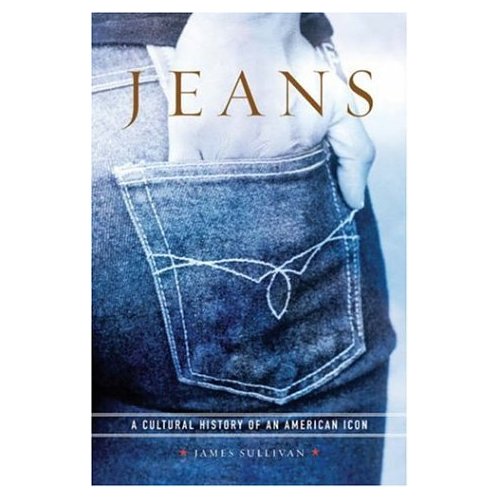
Jeans
A Cultural History of an American Icon

By James Sullivan
Gotham. 303 pp. $26


Book publishers are like wolves: They travel in packs. One gets an idea, and everyone else rushes to imitate it. Thus it is that of the eight books I've reviewed in the past month, three have been about something alleged to be "an American icon." First there was rum, which Wayne Curtis in "And a Bottle of Rum" called "classically American." Then there was the popular music guru John Hammond, who, according to Dunstan Prial in "The Producer," championed "uniquely American music." Now we have bluejeans, which James Sullivan would have us believe embody "two centuries' worth of the myths and ideals of American culture."

Hey, the plane's still at the gate. Anyone else want to get on board? What about Coca-Cola? Jambalaya? Alice Waters? Little Richard? Boston baked beans? Warren Buffett? The Chevy Corvette? Newt Gingrich? Paris Hilton? Buddy Holly? Parson Weems? Lizzie Borden? Aren't they "American icons"? Shouldn't all of us be reading books about them, books that show how they "changed America" and "made us what we are today" and embody "everything it means to be American"?

Well, actually, no, we shouldn't, but that doesn't mean we won't. Heaven knows how many scriveners are holed away even as these words are typed, batting out paeans to America as seen through the prisms of, oh, Lawrence Welk and Baba Wawa. So let's call a halt to it right now. Let's make "Jeans" the last "American icon" book, and bury the genre before it turns into Frankenstein's monster.

It's not that most of these books are bad -- they're more like fair-to-middling -- but that the idea was stale before it was born. This country is much too big and diverse for any one thing -- a person, a product, even an idea -- to embody it. As James Sullivan's book makes plain, the story of bluejeans is interesting enough in and of itself. Why tart it up with thematic baggage it can't sustain?

But just so you know, here's what Sullivan says: "Jeans are the surviving relic of the western frontier. They epitomize our present-day preoccupations -- celebrity and consumer culture. . . . Blue jeans -- not soft drinks, or cars, or computers -- are the crowning product of American ingenuity. . . . They can imply either democratic parity or the aristocratic hierarchies of status. . . . First they built the country's infrastructure, then they populated it with a collective identity." Et cetera. In a word, bluejeans have Meaning. Maybe even Deep Meaning. And in the chattering classes, Meaning is treasured above all else . . . even bluejeans.

So if the history of denim trousers interests you -- and there are plenty of reasons why it should, not least of them being the pair of jeans you're probably wearing right now -- skip the heavy-breathing parts of "Jeans" and stick to the straight stuff. That, for example, "the name denim is presumed to derive from the phrase serge de Nîmes , the trade term for a cotton-wool blend first introduced in Nîmes, in southeastern France, around the sixteenth century"; that the most famous of all denim manufacturers, Levi Strauss, didn't start to make his name and his fortune until he hooked up with a tailor named Jacob David who used copper rivets to toughen the pockets of the pants he made; that it was the company founded by one of his competitors, H.D. Lee, that introduced a novelty called the Whizit, now universally known as the zipper; that women didn't start wearing denim in significant numbers until World War II and the coming of Rosie the Riveter.

There's more. It wasn't until around 1960 that "bluejeans" became the universal term for denim trousers; as a boy in the 1950s I assumed -- as did all my friends -- that "bluejeans" were for girls and sissies, while real guys wore "dungarees." In part that may have been because, though we actually were good little boys, we treasured the image of juvenile delinquency that clung to denim during the '50s, in no small measure thanks to James Dean ("Rebel Without a Cause") and Marlon Brando ("The Wild One"). As Sullivan points out, in that decade "Jeans manufacturers were experiencing a strange paradox of the American marketplace. They had a daunting image problem, yet it was precisely that image problem that gave the product its desirability among the target audience." Sonny Boy may have thought that denim pants were the cat's pajamas, but Mom and Dad thought they were "the clothing of a much less wholesome kind of boy," which is putting it mildly.

In that narrow sense, the story of bluejeans is indeed an American story. A recurrent theme throughout our history -- especially 20th-century history -- is the tension between our puritanical heritage and our sybaritic, hedonistic instincts. The prude in us resists temptation but the pleasure lover in us leaps at it, and in the long run the pleasure lover almost always wins. When Sullivan says that "we'll likely be wearing [jeans] long after the business suit, say, has been relegated to the dustbin of fashion," he's probably right, or so at least history suggests.

Now that everybody is wearing jeans, the inevitable has happened: the trendies have taken them over. The solid working pants of yore now spill onto the marketplace in every imaginable variation: designer jeans, stonewashed jeans, ancient jeans that have been rescued from the scrap heap and resold at outrageous prices to rich folks who go slumming in them. Ancient bluejeans are "collectible," just like every other piece of American junk.

But to tell the truth, jeans aren't really "American" anymore. The jeans you're wearing may well have been sewn in the United States, but the denim probably came from someplace else. Here's what globalization means:

"Over the past few decades competitive foreign manufacturers have brought giant North American textile mills such as Cone, Swift, and Canada's Dominion Textiles to their knees. India's Arvind Mills, rooted in a multigeneration family cotton business, has become one of the world's biggest denim manufacturers and the number-one exporter, producing more than 120 million meters annually. Brazil -- now the second biggest consumer of 'pantalones vaqueros' in the world -- is home to several huge mills. . . . By 1997 East Asian suppliers had surpassed the aggregate output of United States mills, producing 1.7 billion square yards. In recent years Turkey has emerged as another aggressor, building at least three massive mill groups."

All of which is to say that the story of bluejeans is a big one that ultimately encompasses far more than the country in which they began. It entails matters that have to do with more than just the seat of your pants, from fashion to globalization to intergenerational conflict. But these are matters of fact, not of Meaning, and Sullivan's efforts to twist them into Meaning ultimately mean . . . nothing.

This is Jonathan Yardley's last regular weekly book review for Style. After a quarter-century with The Post, he is moving into semi-retirement. His occasional Second Reading columns will continue in Style, as will his Sunday book reviews in Book World.

Wednesday, August 30, 2006

Who killed the newspaper? (From The Economist print edition)


The future of newspapers
Who killed the newspaper?

Aug 24th 2006
From The Economist print edition
The most useful bit of the media is disappearing. A cause for concern, but not for panic


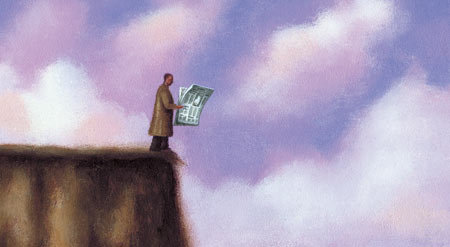
“A GOOD newspaper, I suppose, is a nation talking to itself,” mused Arthur Miller in 1961. A decade later, two reporters from the Washington Post wrote a series of articles that brought down President Nixon and the status of print journalism soared. At their best, newspapers hold governments and companies to account. They usually set the news agenda for the rest of the media. But in the rich world newspapers are now an endangered species. The business of selling words to readers and selling readers to advertisers, which has sustained their role in society, is falling apart (see article).


Of all the “old” media, newspapers have the most to lose from the internet. Circulation has been falling in America, western Europe, Latin America, Australia and New Zealand for decades (elsewhere, sales are rising). But in the past few years the web has hastened the decline. In his book “The Vanishing Newspaper”, Philip Meyer calculates that the first quarter of 2043 will be the moment when newsprint dies in America as the last exhausted reader tosses aside the last crumpled edition. That sort of extrapolation would have produced a harrumph from a Beaverbrook or a Hearst, but even the most cynical news baron could not dismiss the way that ever more young people are getting their news online. Britons aged between 15 and 24 say they spend almost 30% less time reading national newspapers once they start using the web.


Up to a podcast, Lord Copper?


Advertising is following readers out of the door. The rush is almost unseemly, largely because the internet is a seductive medium that supposedly matches buyers with sellers and proves to advertisers that their money is well spent. Classified ads, in particular, are quickly shifting online. Rupert Murdoch, the Beaverbrook of our age, once described them as the industry's rivers of gold—but, as he said last year, “Sometimes rivers dry up.” In Switzerland and the Netherlands newspapers have lost half their classified advertising to the internet.


Newspapers have not yet started to shut down in large numbers, but it is only a matter of time. Over the next few decades half the rich world's general papers may fold. Jobs are already disappearing. According to the Newspaper Association of America, the number of people employed in the industry fell by 18% between 1990 and 2004. Tumbling shares of listed newspaper firms have prompted fury from investors. In 2005 a group of shareholders in Knight Ridder, the owner of several big American dailies, got the firm to sell its papers and thus end a 114-year history. This year Morgan Stanley, an investment bank, attacked the New York Times Company, the most august journalistic institution of all, because its share price had fallen by nearly half in four years.


Having ignored reality for years, newspapers are at last doing something. In order to cut costs, they are already spending less on journalism. Many are also trying to attract younger readers by shifting the mix of their stories towards entertainment, lifestyle and subjects that may seem more relevant to people's daily lives than international affairs and politics are. They are trying to create new businesses on- and offline. And they are investing in free daily papers, which do not use up any of their meagre editorial resources on uncovering political corruption or corporate fraud. So far, this fit of activity looks unlikely to save many of them. Even if it does, it bodes ill for the public role of the Fourth Estate.


Getting away with murder


In future, as newspapers fade and change, will politicians therefore burgle their opponents' offices with impunity, and corporate villains whoop as they trample over their victims? Journalism schools and think-tanks, especially in America, are worried about the effect of a crumbling Fourth Estate. Are today's news organisations “up to the task of sustaining the informed citizenry on which democracy depends?” asked a recent report about newspapers from the Carnegie Corporation of New York, a charitable research foundation.


Nobody should relish the demise of once-great titles. But the decline of newspapers will not be as harmful to society as some fear. Democracy, remember, has already survived the huge television-led decline in circulation since the 1950s. It has survived as readers have shunned papers and papers have shunned what was in stuffier times thought of as serious news. And it will surely survive the decline to come.


That is partly because a few titles that invest in the kind of investigative stories which often benefit society the most are in a good position to survive, as long as their owners do a competent job of adjusting to changing circumstances. Publications like the New York Times and the Wall Street Journal should be able to put up the price of their journalism to compensate for advertising revenues lost to the internet—especially as they cater to a more global readership. As with many industries, it is those in the middle—neither highbrow, nor entertainingly populist—that are likeliest to fall by the wayside.


The usefulness of the press goes much wider than investigating abuses or even spreading general news; it lies in holding governments to account—trying them in the court of public opinion. The internet has expanded this court. Anyone looking for information has never been better equipped. People no longer have to trust a handful of national papers or, worse, their local city paper. News-aggregation sites such as Google News draw together sources from around the world. The website of Britain's Guardian now has nearly half as many readers in America as it does at home.


In addition, a new force of “citizen” journalists and bloggers is itching to hold politicians to account. The web has opened the closed world of professional editors and reporters to anyone with a keyboard and an internet connection. Several companies have been chastened by amateur postings—of flames erupting from Dell's laptops or of cable-TV repairmen asleep on the sofa. Each blogger is capable of bias and slander, but, taken as a group, bloggers offer the searcher after truth boundless material to chew over. Of course, the internet panders to closed minds; but so has much of the press.


For hard-news reporting—as opposed to comment—the results of net journalism have admittedly been limited. Most bloggers operate from their armchairs, not the frontline, and citizen journalists tend to stick to local matters. But it is still early days. New online models will spring up as papers retreat. One non-profit group, NewAssignment.Net, plans to combine the work of amateurs and professionals to produce investigative stories on the internet. Aptly, $10,000 of cash for the project has come from Craig Newmark, of Craigslist, a group of free classified-advertisement websites that has probably done more than anything to destroy newspapers' income.


In future, argues Carnegie, some high-quality journalism will also be backed by non-profit organisations. Already, a few respected news organisations sustain themselves that way—including the Guardian, the Christian Science Monitor and National Public Radio. An elite group of serious newspapers available everywhere online, independent journalism backed by charities, thousands of fired-up bloggers and well-informed citizen journalists: there is every sign that Arthur Miller's national conversation will be louder than ever.

Monday, August 28, 2006

The next phase of instant messaging (by David Kirkpatrick, Fortune)


image source

meebo could be a hit with the MySpace generation - and a boon for big businesses, too.


FORTUNE Magazine
By David Kirkpatrick, Fortune senior editor
August 2 2006: 9:21 AM EDT

NEW YORK (Fortune) -- A tiny software company called meebo Wednesday opened a new channel of communication on the Web. Now, if you have a Web page your visitors can talk to you using instant messaging, even if you're away from your home computer. (That includes all you MySpace users.)

If this doesn't sound interesting, you are probably over the age of 25. The founders of meebo are, but just barely.

"Like Hotmail put e-mail into the Web, we put IM into the Web," says meebo CEO Seth Sternberg, who is 28.

meebo got its start when its three founders, Sternberg and Elaine Wherry, 27, and Sandy Jen, 25, were all meeting repeatedly at one another's houses in Silicon Valley trying to come up with ideas for a consumer Web company.

As a company history on meebo.com explains: "Sandy kept having this problem where she couldn't easily IM her friends from Seth's and Elaine's houses. Hence, meebo!"

That was meebo's first innovation - a very efficient and rapid Web-based IM service, which enables you to combine your AIM, ICQ, Yahoo or MSN instant message accounts in one place.

Meebo wasn't first to offer Web-based instant messaging - but it is, by most accounts, the most efficient and easiest.

It isn't the ability to consolidate accounts that gets users excited, according to Sternberg and Wherry, who I met with recently, but simply the fact that meebo works as well on the Web as an IM software client works on your PC. Now you can be in touch with your IM buddies from any computer.

Wednesday's innovation is to take that capability and insert it into any page on the Internet, private or commercial. Once your Web site has a meebo window, when you log into meebo you not only see your usual buddies. You also can see a special group on your buddy list that represents visitors to your Web page.
Not just for the MySpace generation

"This is going to be really big with the MySpace kids," says Sternberg. I think he's right. After you've displayed yourself to the world in all your tasteless glory, won't you want to find out who's looking at it all? (I'm assuming you're 18.) Won't you want to have the capability to talk to them?

But meebo could be used as readily on eBay or Fortune.com, or IBM.com for that matter. The company will let any site use its service, with the only caveat that past a certain level of usage they might ask you to pay something. Otherwise it's free.

To use this meebo capability, just go to its homepage and get an account. Then download the code for the meebo "widget" and insert it into your Web page.

The earnestness and enthusiasm of meebo's founders is as endearing as the simplicity and apparent usefulness of its service. In a reversal of the usual pattern, the top technologists are the two women. Sternberg is the front man and marketing guy.

The company's ethos is resolutely informal and silly. The founders' actual names don't even appear on the site. Identified only by their first names, the founders are listed as "Biz Guy," (Sternberg) "Server Chick" (Jen), and "AJAX Girl" (Wherry). (Ajax is a software technology for creating interactive web pages, which Wherry uses for creating the meebo user interface.)

But meebo's software code, by all appearances, is rock solid and serious. It's backers are serious, too. Sequoia Capital, the venture capital firm that backed YouTube, invested in January. Netscape co-founder Marc Andreessen is an investor and advisor.

meebo, founded in September 2005, already has 700,000 user logins per day, up 60,000 in the three weeks since I met with the founders. Each user stays on the service an average of 69 minutes. That's a lot of time to show advertisements, which meebo will almost certainly eventually do.

Sternberg and Wherry say there will be plenty of ways to make money from meebo, but in classic old-school Web fashion that hasn't been their focus just yet. They expect, aside from traffic-based charges for heavy users, to make money with subtle targeted ads as well as by charging for personalization features.

We may be more than a decade into the Web, but it's still a pleasure to find a tiny 12-person company with a great product, enthusiastic founders and the potential to change the world.

Sunday, August 27, 2006

Panic on 43rd Street (by Michael Wolff, Vanity Fair)

The New New York Times Building Project:
In development
Renzo Piano Building Workshop
Fox & Fowle Architects
New York Times Company New Headquarters
New York, NY

"Each architecture tells a story, and the story this new building proposes to tell is one of lightness and transparency."
-Renzo Piano


The Current New York Times Building and the pictures:


Panic on 43rd Street
By MICHAEL WOLFF

By attacking The New York Times for reporting secret anti-terrorism measures, the White House has evoked the government-defying glory days of the “paper of record.” But even as the Times builds a soaring $850 million headquarters, its newsroom, its leadership, and its business are in a crisis of confidence


It's a different, much less awesome New York Times under attack for its decision to publish secret details of how banks are cooperating with the Bush administration to track terrorist finances. In the past, if you took on the Times, you took on its powerful eastern-establishment base; you took on the media itself. But the base this administration is most concerned with is always its own, and going after the Times—more a label for large parts of the country than a brand, a liberal caricature—seems to thrill it.


During the Bush years, the entire media has been so much easier to threaten because every company is under such relentless shareholder, financial, advertiser, and interest-group pressures—media organizations will do anything not to have politicians and prosecutors sniping at them, too. While the Times—historically, more like a branch of government than a mere commercial enterprise—has often operated as an exception to the rest of the media, it's hard to be a Cadillac in a fading American auto industry, and hard to be even the Times in the imploding newspaper business. The Times's current predicament—its share price has fallen by 50 percent since 2002; almost 30 percent of its shareholders protested the company's slate of directors at the annual meeting this spring—gets closer and closer to that of the Knight-Ridder papers, forced into a sale; the Tribune company, publisher of the Los Angeles Times and the Chicago Tribune, locked in a more or less mortal boardroom war; and Dow Jones, with its worried family members fretting about a sale of The Wall Street Journal. The Bush people cannot be unaware of this. In such a state of play, the Times is also doing that one thing that so often calls attention to a corporation's weaknesses and vulnerabilities and inflated sense of grandeur—a classic precursor to calamity. It's building a fabulous new corporate headquarters on Manhattan's West Side—a Renzo Piano–designed $850 million tribute to itself.


The calculation in the White House may well be that the Times is one of the few organizations that the weakened Bush people are strong enough to go after.


While the administration's anti-Times rants juice its base—made up of people who don't read the Times—the White House appears to be trying, with its drumbeat about treason and banking secrets, to stir up trouble with Times readers too (banking, unlike other hot-button conservative issues, is something that Times readers might get huffy about). The rub is that no one at the Times can be confident this cannot succeed.


The familiar Times reader, the eastern-establishment reader—as dedicated and loyal and homogeneous an audience as few newspapers have ever had—has largely been abandoned by the Times. Or—a supposition the Times may share with the Bush administration—that audience simply may not exist anymore. Or it's just aged out of the economic mainstream. The new Times reader is … well, it's not exactly clear who the new reader is.


Unlike The Washington Post, which has put much of its editorial and business energies into dominating its local market, the Times's strategy—a doomsday scenario, foreseeing a one-newspaper nation, a last-man-standing paper—has been to make the paper national. Hence, The New York Times is no longer principally a metropolitan paper. With a daily circulation of 260,000 in the five boroughs, it's no longer even creditably a New York paper. (Its two tabloid competitors, the Daily News and the New York Post, have far more readers in New York City.) It's an Everyman suburban daily.


Here's the identity crisis: when the president is attacking it with all the media available to him, can the Times count on this new reader, and the advertisers who are courting him, not to doubt it? What beats in the heart of a reader of the St. Paul Pioneer Press whom the Times circulation-promotion campaign has persuaded to read the Times too? (In media-marketing terms, this new reader, the national urban-suburban yuppie type, overloaded on media choices—broadband, digital cable, satellite radio—is among the most fickle.)


Not only are the people at the Times aware of their new readers' likely lack of constancy, they're paranoid about it. In some sense, it's the central obsession at the Times, the driver of the place, this very un-Timesian concern with what people are thinking about it, as the paper increasingly becomes a hot topic in the national court of public opinion. And it's a crazy court. Every politically and emotionally addled information consumer wants to convict the Times of something.


Its two big scandals—the first about Jayson Blair, the reporter who made up an impressive catalogue of vivid stories, and the second involving Judy Miller, who, with the Times urging her on, went to jail for protecting her sources, whom the Times subsequently decided she should not have protected so much—were notable not just for the holes they revealed in the Times's journalistic operation but also for what they revealed about the Times's uncertainty about itself and its tendency to panic under pressure. Howell Raines, the Times executive editor whom the publisher, Arthur Sulzberger, appointed to turn the Times into a national paper—it was under Raines's watch that Blair wrote his fabricated stories—had the publisher's absolute support until the day he didn't and was fired. Judy Miller likewise had the publisher's absolute support until it was clear that P.R. considerations and the court of public opinion called for the opposite position.


The imperturbable Times has become ever so thin-skinned. Instead of a simple, traditional "We stand by our story" response to its critics over the banking revelations, the Times has offered a menu of defenses and rationalizations—on its editorial pages, in public letters, in interviews by editor and publisher. Its essential and contradictory defense—that it agrees some things should not be revealed because of national-security considerations, except when, in its own wisdom, it decides they should be—has not exactly helped. Its rather frantic need to explain itself to the Twin Cities reader—to stay in the good graces of both Middle America and an Internet of doubters—is too painfully obvious.


Karl Rove undoubtedly understood he could play on this desperation.


The Court of Arthur

And then there is the Arthur issue.


The Times, famously impersonal, suddenly has a flamboyant, hard-to-control, easy-to-dislike face. The right-wing editorialists at The Wall Street Journal, which also printed the story about the banking secrets, hurried to distance the Journal not so much from the story but from the Times, and particularly from the 54-year-old Sulzberger, by quoting gleefully from a self-aggrandizing commencement speech, delivered this spring at SUNY New Paltz, offering a vapid political message about the glories and disappointments of the 1960s and how they related to the Iraq war: "Sorry. It wasn't supposed to be this way."


The vulnerability that the Times critics see here—one that causes people inside the Times to gulp—is that difficult, less-than-humble, not-ready-for-prime-time descendants of 19th-century newspaper owners have been the cause of the decline and fall of a great many newspapers.


At the height of the Judy Miller business, just after he had fired her, after operatically standing behind her, Arthur appeared on The Charlie Rose Show. The most riveting thing about this appearance, more than his relative inarticulateness, was that there was no scenario under which it would be possible to imagine Arthur's father, Punch Sulzberger, the company's chief executive for more than 30 years and the steward of the modern paper, having done this—that is, publicly claiming to be the voice and the exemplar of the Times and its journalism.


The Times has prospered, and maintained its not-a-little loopy tradition of primogeniture, because the family, which holds voting power, has exercised it so lightly. If at all. The Sulzbergers—according to a former Times Company executive who was one of the designers of the Times management and shareholder structure—are supposed to be the British monarchy to the parliamentarians who actually run the show.


But there was Arthur on Charlie Rose—defending his company, his newsroom, his editorial decisions, his team. I remarked to this executive, an eminent and longtime Sulzberger adviser, on the oddity of a member of the Sulzberger family's actively managing the policies and editorial decision-making in the newsroom—in fact, representing the newsroom. My interlocutor drew back and said, "Editorial?… He's running the business side too! This wasn't supposed to happen!"


Arthur, on his own say-so, has accomplished a radical management restructuring of the company. He's consolidated, under his control, executive, shareholder, and editorial power—subverting the traditional autonomy of the Times newsroom. Indeed, executive editor Bill Keller is probably the weakest editor in the history of the paper. A company with a historically diffident management structure, where lines of power were always purposefully obtuse, now has a by-the-book, top-down org chart.


With such a figure—attention-seeking, immature, verbally feckless—at the center of the stage, it's hard to maintain a suspension of disbelief, let alone a straight face, about the rights of the firstborn. (This situation must have some resonance in the Bush White House.) The Times, with the scion insisting on his protean leadership, becomes, like any other corporation, judged by its top executive—it's not stronger than he is. Except, profoundly complicating matters, if he turns out to be weak, you can't easily replace this one.


It's Arthur himself who has most consistently articulated the fragility of the Times—its being-and-nothingness struggle in the changing media world. He seems so willing to embrace the sudden-death possibilities of the Information Age, so willing to disregard the conservative, wait-and-see approach favored by executives in Rust Belt–like businesses, that you wonder if there isn't, just a bit, a Munchausen-syndrome-by-proxy aspect to all of this. He gets to make the crisis; he gets to rescue the paper.


His strategy is to have the company face its core mortality—the inevitable end of a paper world—and then figure out what of its DNA can survive: Arthur is the baby Superman being jettisoned from planet Krypton. In modern management terms, the brand might theoretically be able to grow even if the physical product falls away. The newspaper might shrivel, but the Times can be a free-floating idea, somehow continuing in whatever guise offers itself and by whatever forms of delivery might be available—now or yet to be imagined (as they say in publishing contracts).


His vision of an ideal Times company sounds a lot like—without any sense of irony—Time Warner. (Once, during the boom years, I questioned Arthur about this enthusiasm for everything new-media. If this were the 50s, I asked, would he want the Times to buy a television network? "You bet I would," said Arthur.)


Seeing the Times as an acquisitive, multi-platform media company puts it, of course, in the same, ever compromised world of marketing and politicking as all other media companies. On the eve of the Iraq war—which it covered with a guilelessness that it has since apologized for—the Times, along with every other media giant, was petitioning the Bush F.C.C. to relax media-ownership rules to allow it to greatly add to its portfolio of television stations. (The Times's last annual report points to the television duopoly it owns in Oklahoma as one of its core achievements.)


Before scandal and a falling share price crimped their style, Sulzberger and Raines would talk openly about what they'd like to take over. They wanted the Financial Times or The Wall Street Journal and were looking for cable opportunities. (In 1993, the Times, in some misbegotten futurist idea that the Northeast was going to unite in a gigantic megalopolis, anchored by New York and Boston, bought The Boston Globe, which has performed poorly ever since.) When the chance arose, they snatched—for almost no logical reason, other than that they could—control of the International Herald Tribune (an enterprise with virtually no prospects of being anything more than a sentimental artifact) from The Washington Post, the Times's longtime partner in the paper. They did a convoluted deal with the Discovery network. They bought a piece of the Boston Red Sox.


But at the end of this deal-making spree, the most substantive and possibly transformative deal was the acquisition, for $410 million, of About.com. About.com? It's as unlikely an acquisition for the Times as any could be. About.com may actually establish the baseline for the lowest level of information available on the Web (which is saying a lot): a multi-million-page mishmash of superficial, often out-of-date, dumb, frequently wrong info bits, a place you never go by choice, but only because a search engine has been "optimized" (that is, tricked) to send you there.


Cyberia

The Internet is the great leap forward at the Times—with vastly more disruptive implications for the paper's future than the caviling of politicians.


For two generations, the Times business model has been to adeptly counter-program against more entertaining and technologically efficient ways to get news. It spent a lot (its news budget is among the largest of any news organization's) on deep and broad coverage, serving an elite, need-to-know audience, which, in turn, advertisers were keen on reaching.


Then, gamely, it gave in to the Internet. The premise is that, via the Internet, the Times can more easily deliver the Times. And, indeed, it's created the richest site of any newspaper in the world, a site whose depth and efficiency inevitably undermine the paper itself. At a conference earlier this year, hosted by Google, Arthur gave a talk about "real journalism," saying that the Times would succeed online because its brand had a proven record of probity—that people would always want the real thing. (His talk was accompanied by video clips of lots of older, exhausted-looking white men working in the newsroom.)


But more and more there is the sinking sensation at the Times that the Internet isn't Kansas. It's not just the relentless reductiveness of the new medium—the Times's long version becomes fodder for everybody else's short version. Or that the Internet requires, according to one hollow-eyed reporter, "everyone to do more and more for no more money." Much more unsettling than that: the Internet, once thought of as the ideal vehicle for reaching a targeted audience, is turning into a high-volume business, super-mass-media, dependent on cheap advertising. Success demands vast numbers: tens of millions or hundreds of millions of habituated users.


The Times, in newsprint form, with its daily 1.1 million circulation, and Sunday 1.7 million, makes between $1.5 and $1.7 billion a year (the company does not break out the exact figure). Times.com, with its 40 million unique online users a month, likely makes less than $200 million a year. Cruelly, an online user is worth much less—because his or her value can be so easily measured—than a traditional reader.


To replace its $1.5 to $1.7 billion traditional business with its online business—as it keeps suggesting it will one day do, and as critics have urged it to do on an even faster timetable—the Times might, impossibly, have to increase its online business to 400 or 500 million users a month. Or it will have to remake its content to more accurately reflect its advertisers' interests: oversize-shoe advertisers pay more to be next to a story about oversize shoes than they do to be next to a story about the Iraq war. Or, in another approach, it could look to MySpace: while the Times's 40 million monthly users generated, in May, according to ComScore, 489 million page views—this is the number that interests advertisers—MySpace's 50 million monthly users, deeply entertained by its user-created content, generated 29 billion page views.


The Times as we know it, as a pastiche of its paper self, can't succeed online (the whole idea that an old-time business can morph seamlessly into a huge, speculative entrepreneurial enterprise is a kind of quackery). At best, it might become a specialized Internet player, having to drastically cut its current, $300 million news budget. What it might providentially become, however, is About.com, a low-end, high-volume information producer, warehousing vast amounts of advertiser-targeted data, harnessing the amateurs and hobbyists and fetishists willing to produce for a pittance any amount of schlock to feed the page-view numbers—and already supplying 30 million of the Times's 40 million unique users.


They'd get red in the face disputing this at the Times. They'd say new business models may develop online, possibly paid models, or the price of advertising may increase, or something—because people will always want the Times, won't they? On the other hand, these same managers bought About.com. They know the future is equivocal.


Taking Stock

And then there are the shareholders—much scarier than the Bush people. The owners of the Class B stock—the Sulzberger-Ochs family, who hold voting control—are, in a very real sense, supported by the A shareholders, who own most of the company. It's the A shareholders who maintain the price of the stock. It's the B shareholders—50 or so descendants and spouses—whose daily lives are supported by the dividends produced by the stock.


The traditional assumption is that, for media companies, the market understands and accepts two tiers of stock (Murdoch's News Corp. has two tiers; The Washington Post has two tiers; Viacom has two tiers). If you don't like it, you don't buy it in the first place. But in this new age of shareholder activism, two tiers suddenly become a juicy wedge issue.


The activist shareholders are—not dissimilar to the Bush White House—waging a press campaign against the Times. The dissidents—only Morgan Stanley Asset Management, with 5 percent, has taken a public stand, but Bruce Sherman's Private Capital Management, which forced Knight-Ridder into a sale, is one of the Times's largest shareholders—are claiming that the B shareholders, presiding over scandal, are being reckless with the Times's brand and with their stewardship of a national treasure. (To cut costs and raise revenues, management is trimming the width of the paper by 1.5 inches, reducing news coverage by 5 percent, and selling ads on the front page of the Business section.)


They're characterizing the B shareholders as, in effect, being in it for themselves, pointing to Arthur's ever increasing multi-million-dollar compensation package—$3.2 million in 2005.


They are also using the "governance" word. By challenging the "governance" of a company—the independence and responsibility of its board—you question its integrity and uprightness (i.e., its fundamental Timesness). And, truly, the Times board—controlled by its B shareholders—is a passive and lackluster bunch. Whereas Warren Buffett is on the Washington Post board, the Times board's one corporate star, IBM's former C.E.O. Lou Gerstner, resigned in frustration several years ago.


In any conventional sense, control of the company, as long as the family stays united, is invulnerable. And most people take the fact of that unity as a historic given. But now it's being tested in the face of shareholders whose activism effectively talks down the price of the stock, the point on which management, the board, and the family are most accountable, and does it with the one other thing the Sulzbergers are perhaps most touchy about—bad press.


What will the B shareholders give to make it stop?


The fear in the newsroom is that the first thing to be given up will be bodies—fire enough people and earnings improve and stock creeps up and that takes immediate pressure off management. (It's already begun: "There's no money here," hissed a reporter to me recently in what had been a little gossip about expense accounts.)


But if that's not enough—and it never is enough—then what's next is more independent board members, followed by little changes in the nature of control, and then asset sales, and lots of secret meetings among family members on the subject of what to do about Arthur, and then a plan afoot to take the title of publisher from him, and on and on … until … the powers that be face the dreadful discrepancy between the declining fortunes of business as usual and a more probable upside of dismantling, selling, and letting the market have its certain way.


The form for projecting and maintaining great authority is, most classically, to talk softly. But that's not a modern media idea. The modern idea is to fight it out in the marketplace. All media is big media, rising and falling. Operatic. Building corporate as well as architectural monuments to itself. The Bush administration, as much a media enterprise as a governing one, has gone into the media marketplace to try to upend the Times, which it sees as one of its brand and message competitors—one that it can efficiently take on. This seems to me another Bush miscalculation. Its invective is actually brand enhancement for the Times, recalling the Times's real journalism, and evoking an era before the Times cast its fate with all the players and all the visions and all the clashes of the titans in the great media soup, or, worse, before—despite all its efforts to be something else and to forestall the inevitable—it got caught out as just another newspaper company coming to its natural end.


For a dwindling number of us—over-50 Manhattanites, over-50 Jews, over-50 liberal-minded people, over-50 journalists—that's a "God is dead" sort of statement. It's too big. Too existential. And, anyway, how do you exactly define "end"? You mean NO New York Times? Nada? Darkness?


Well, yes, in effect.


Michael Wolff, a Vanity Fair contributing editor, is the author of Autumn of the Moguls (HarperBusiness) and Burn Rate: How I Survived the Gold Rush Years on the Internet (Simon & Schuster).